
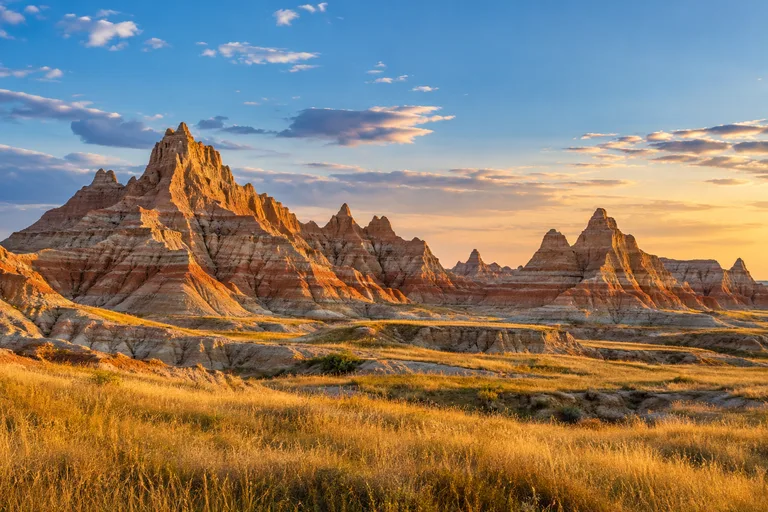
Badlands National Park protects 244,000 acres of sharp, eroded buttes and mixed-grass prairie in western South Dakota, about 75 miles east of Rapid City. Most visitors drive the 30-mile Badlands Loop Road, stop at the overlooks, walk a short boardwalk trail and watch for bison and bighorn sheep. One day covers the highlights. The park also pairs easily with Mount Rushmore on a Black Hills trip.
This guide covers the Loop Road stop by stop, the best Badlands hikes, wildlife, fees and where to stay. It ends with the best time to go and a Badlands and Mount Rushmore itinerary. For the rest of the state, see the South Dakota travel guide.
Badlands National Park at a Glance
| Question | Short answer |
|---|---|
| Where is it? | Western South Dakota, about 75 miles east of Rapid City, just south of I-90 |
| How big is it? | 244,000 acres, including the 64,000-acre Badlands Wilderness Area |
| Main road | Badlands Loop Road (Highway 240), 30 paved miles between I-90 exits 131 and 110 |
| Time needed | 1 to 2 hours for the Loop Road alone; a full day adds hikes, Sage Creek Rim Road and sunset |
| Open | 24 hours a day, every day of the year; roads can close in bad winter weather |
| Entrance | Pass required, fees collected all year, no timed entry; check the official site for prices |
| Wildlife | Bison, bighorn sheep, prairie dogs and black-footed ferrets |
| Main visitor center | Ben Reifel Visitor Center, on the Badlands Loop Road |
Visit: Badlands National Park, 25216 Ben Reifel Road, Interior, SD 57750 | 605-433-5361 | nps.gov/badl
Is Badlands National Park Worth Visiting?
Yes. Its biggest views sit beside a paved road and short boardwalks, so a visit needs no long hike. The National Park Service calls its rock layers one of the world's richest fossil beds, where ancient horses and rhinos once roamed. Today the prairie around the formations is home to bison, bighorn sheep, prairie dogs and black-footed ferrets.
It works well for many kinds of trips:
- Families: short boardwalk trails, a fossil exhibit trail, Junior Ranger booklets and a lab where paleontologists work on real fossils.
- Couples: quiet overlooks, sunset drives and a summer night sky program with telescopes.
- Road trippers: the Loop Road sits right off I-90, so it fits a cross-state drive with only a short detour.
The Lakota people knew this land as mako sica. The name lives on in the park's exhibits and in the South Unit, which the Oglala Lakota and the National Park Service manage together.
How the Park Is Laid Out: North Unit and South Unit
Badlands National Park has two very different halves. The North Unit holds the paved Loop Road and most of the trails. The South Unit is remote, with no road running through it.
| North Unit | South Unit (Stronghold and Palmer Creek) | |
|---|---|---|
| Best for | First visits, short hikes, scenic driving | Experienced visitors, solitude, Lakota history |
| Roads | Badlands Loop Road (paved) and Sage Creek Rim Road (gravel) | No road through the unit; Sheep Mountain Table Road or a perimeter drive |
| Visitor center | Ben Reifel Visitor Center | White River Visitor Center |
| Who manages it | National Park Service | Oglala Lakota and the National Park Service, under a cooperative agreement, inside the Pine Ridge Indian Reservation |
| Camping | Cedar Pass Campground (east) and Sage Creek Campground (west) | No campground named by the park |
The park calls the North Unit the best known and most easily explored area. Nearly every first visit, and every itinerary below, starts there.
Getting to Badlands National Park
The park sits just south of I-90, about 75 miles east of Rapid City. There are three entrances, so the best one depends on which way you are driving.
- Driving west on I-90: take Exit 131 (Interior) and follow the signs south about 3 miles. The Northeast Entrance is at 21020 SD Hwy 240, Interior, SD 57750.
- Driving east on I-90: take Exit 110 at Wall and follow the signs south about 7 miles. The Pinnacles Entrance is at 24240 Hwy 240, Wall, SD 57790.
- From the south: State Highway 44 is a scenic alternate route. It meets Highway 377 in the town of Interior. Follow 377 north 2 miles to the Interior Entrance, 20640 SD Hwy 377, Interior, SD 57750.
Because the Loop Road links Exit 131 and Exit 110, it works as a through route. Enter at one end, drive the loop and rejoin I-90 at the other end with no backtracking.
Know before you go: the park is rural, cell service is not always available and GPS directions are not always reliable. Pick up a paper park map at an entrance booth or the visitor center. The nearest airport is Rapid City Regional Airport, and a car is the only practical way to see the park.
Entrance Fees and Passes
Every visitor needs an entrance pass, and the park collects fees all year. No reservation or timed entry is needed for a general visit. Prices change, so check the official fees page before you go.
- Standard 7-day pass: covers a private vehicle, a motorcycle or one person on foot or bike for 7 days, at Badlands only.
- Badlands annual pass: covers one private vehicle and everyone in it for a year from the month of purchase.
- America the Beautiful pass: the interagency pass covers entrance at Badlands and other national parks. It makes sense if the trip includes several federal sites.
Buy the pass ahead on Recreation.gov or at an entrance station. Details are on the Badlands fees and passes page.
Badlands Loop Road: Stop by Stop
The Badlands Loop Road (Highway 240) is a 30-mile paved road through the eastern half of the North Unit. It runs from I-90 Exit 131 back out to Exit 110. Along the way are 10 overlooks and two picnic areas. The park plans 1 to 2 hours for the drive alone.
It is a two-lane road suitable for all vehicles, with steep passes and slow sections. Most of the overlooks have wheelchair-accessible boardwalks. Here are the stops from east to west, as the park lists them:
- Big Badlands Overlook: one of the spots where bighorn sheep are often seen.
- White River Valley Overlook.
- Bigfoot Pass Overlook: includes a picnic area.
- Panorama Point.
- Prairie Wind Overlook.
- Burns Basin Overlook: a prairie dog town is visible from the road.
- Homestead Overlook.
- Conata Basin Overlook.
- Yellow Mounds Overlook.
- Conata Picnic Area.
- Ancient Hunters Overlook.
- Pinnacles Overlook: bighorn sheep often stand on the rocky ledges here. Sage Creek Rim Road branches off just north of it.
The short trails and the Ben Reifel Visitor Center are also on or near the Loop Road. The Door, Window and Notch trails share the Door and Window parking lot. The Fossil Exhibit Trail, Cliff Shelf and Saddle Pass trails sit nearby.
Loop Road Driving Tips
- Never stop in the road. The park asks drivers to use overlooks and pull-outs, because stopped cars block traffic.
- Watch the weather. Conditions change fast, and rain, snow or ice make the passes slippery.
- Mind the speed limits, especially near parking lots where people walk.
- Call ahead in winter. The park closes the road now and then for weather. Call 605-433-5361 for conditions.
Sage Creek Rim Road and Other Scenic Drives
The Loop Road is not the only drive. The park has three more, and each suits a different traveler.
Sage Creek Rim Road
Sage Creek Rim Road (SD 590) is a dirt and gravel road through the Sage Creek Wilderness Area. It connects SD 44 with the Badlands Loop Road near Pinnacles Overlook. Plan 1 to 2 hours. From east to west, its stops are Hay Butte Overlook, Badlands Wilderness Overlook, Roberts Prairie Dog Town and Sage Creek Basin Overlook. The road also leads to Sage Creek Campground.
This is the park's best road for wildlife. Bison, bighorn sheep, prairie dogs and many birds are often seen. The road is open all year but may close for a time during or after heavy rain or snow.
Sheep Mountain Table Road
Sheep Mountain Table Road is a dirt road into the South Unit. It begins on the west side of SD Highway 27, 4.5 miles south of SD Highway 44 at the town of Scenic. The park recommends four-wheel drive even in dry weather and says not to drive it during or after storms.
South Unit Perimeter Drive
For a look at the South Unit without a dirt road, the park describes a drive around its edge. The only way into the South Unit itself is by Sheep Mountain Table Road or on foot through the backcountry.
| Drive | Surface | Time | Best for |
|---|---|---|---|
| Badlands Loop Road | Paved, all vehicles | 1 to 2 hours | First visits, overlooks, short trails |
| Sage Creek Rim Road | Dirt and gravel | 1 to 2 hours | Bison, prairie dogs, wide wilderness views |
| Sheep Mountain Table Road | Dirt, four-wheel drive advised | Varies | South Unit views in dry weather |
| South Unit perimeter drive | Public highways around the unit | Varies | Seeing the remote south side from the car |
Best Badlands Hikes
The best Badlands hikes are short, and most start near the Ben Reifel Visitor Center. The park lists eight established trails. Rangers at the visitor center can help match a trail to your group's fitness. All distances below are round trip, from the park's hiking page.
| Trail | Distance | Time | Difficulty |
|---|---|---|---|
| Door Trail | 0.26 miles | 20 minutes | Easy |
| Window Trail | 0.26 miles | 20 minutes | Easy |
| Fossil Exhibit Trail | 0.34 miles | 20 minutes | Easy |
| Cliff Shelf Nature Trail | 0.86 miles | 30 minutes | Moderate |
| Saddle Pass Trail | 0.68 miles | 40 minutes | Strenuous |
| Notch Trail (closed, see below) | 1.25 miles | 1.5 to 2 hours | Moderate to strenuous |
| Medicine Root Loop | 4.18 miles | 2 hours | Moderate |
| Castle Trail | 10.2 miles | 5 hours | Moderate |
Easy Badlands Hikes for Families
- Door Trail: starts with an accessible 226-yard boardwalk. Past the boardwalk, posts mark a route out across the formations.
- Window Trail: a short, accessible boardwalk to a natural window in the Badlands Wall.
- Fossil Exhibit Trail: a fully accessible boardwalk loop with fossil replicas and exhibits of extinct animals. The park calls it a great place for little ones.
- Cliff Shelf Nature Trail: a loop of boardwalks, stairs and natural paths that climbs about 200 feet. It is popular for birdwatching.
Notch Trail: Closed for Ladder Repairs
The Notch Trail is usually the park's most famous short hike. It leads through a canyon, climbs a rope ladder and follows a ledge to a spot called "the Notch." On August 31, 2026, the park closed the Notch Trail until further notice to repair a section of the ladder that had become unsafe. The closure covers the trail and everything within 100 feet of it. Check the Notch Trail closure notice and the park alerts before you plan around it.
When it reopens, keep the park's warnings in mind. The Notch Trail is not recommended for anyone with a fear of heights. It can be treacherous during and after rain, and boots with ankle support help.
Longer Hikes: Castle Trail, Medicine Root Loop and Saddle Pass
- Castle Trail: the longest established trail in the park, running from the Door and Window parking lot to the Fossil Exhibit Trail. It can be split into shorter sections. Bring plenty of water.
- Medicine Root Loop: crosses mixed-grass prairie with views of the formations. Start at a pull-off on Old Northeast Road, or reach it from the Castle or Saddle Pass trails.
- Saddle Pass Trail: a steep climb up the Badlands Wall to a summit over the White River Valley. It links to the Castle and Medicine Root trails. It is treacherous during and after rain and can be dangerous in extreme heat.
Hiking Safety in the Badlands
- Water: carry about two quarts per person for every two hours of hiking.
- Sun and storms: wear a hat, sunglasses and sunscreen, and pack rain gear.
- Footwear: sturdy shoes or boots protect against cactus spines and snake bites.
- Leave it there: fossils, plants, animals, artifacts and rocks must stay where you find them.
- No pets on trails. Dogs are not allowed on any hiking trail.
Experienced hikers can also leave the marked trails and camp in the backcountry. Talk to a ranger first, and see the park's hiking page for current rules.
Wildlife in Badlands National Park
Wildlife is common along every road in the park. The park lists day, dawn and dusk as viewing times, and the cooler ends of the day are pleasant for watching. Here is where to look:
| Animal | Where the park says to look |
|---|---|
| Bison | Sage Creek Rim Road, overlooking the Badlands Wilderness Area |
| Bighorn sheep | Pinnacles Overlook, the Cedar Pass area, Castle Trail and Big Badlands Overlook |
| Prairie dogs | Burns Basin Overlook, Roberts Prairie Dog Town and Sage Creek Campground |
| Deer, coyotes and snakes | Anywhere; sightings vary |
| Black-footed ferrets | Live on the park's prairie; the park does not list a viewing spot |
Keep at least 100 feet from bison, bighorn sheep, deer and pronghorn. The park's rule of thumb is simple: if wildlife reacts to you at all, you are too close. These animals are wild and can be dangerous if approached.
Fossils and the Ben Reifel Visitor Center
The Ben Reifel Visitor Center is the main facility in the North Unit and sits on the Badlands Loop Road. Most visits there take 15 to 60 minutes. It is the best first stop for a map, trail advice and current conditions.
- Museum exhibits: span a long stretch of time, from ancient sea reptiles called mosasaurs to Lakota history. Many exhibits are hands-on or audio-visual.
- Park film: The Land of Stone and Light runs on a 25-minute loop in spring, summer and fall. In winter, ask at the front desk to see it.
- Fossil Preparation Lab: watch paleontologists remove rock from fossil specimens, and ask them questions. The lab is seasonal, so check the park calendar.
- Junior Ranger: booklets wait at the information desk, next to a passport stamp station.
- Bookstore: run by the Badlands Natural History Association, with books, apparel and souvenirs.
The center has ramp entrances, accessible theater seating and restrooms, tactile exhibits, and captioned and audio-described versions of the film. Hours change by season, so check the official site.
Badlands Night Sky Viewing
Staying after dark is one of the best things to do in the park. In summer, rangers and volunteers hold night sky viewing at the Cedar Pass Campground Amphitheater. It typically runs May through September, after the evening ranger program.
- Start time: depends on sunset; it starts later in early summer than in August and September. Check the park calendar for the night you visit.
- Telescopes: provided, with funding from the park's partners Celestron and the Badlands Natural History Association.
- What you see: the park says visitors can see more than 7,500 stars on any given night. Guides point out constellations, stars and planets.
- Cost: no extra fee beyond park entrance, and no reservation.
The park also holds an Astronomy Festival to celebrate its dark skies. Dates change each year, so check the park calendar.
Lakota Heritage and the Name Mako Sica
The Lakota knew this place as mako sica, and the park tells that history in its exhibits. The museum at the Ben Reifel Visitor Center covers Lakota history alongside the fossils.
The South Unit carries that story further. Its Stronghold and Palmer Creek units lie within the Pine Ridge Indian Reservation. They are managed under a cooperative agreement between the Oglala Lakota and the National Park Service. The White River Visitor Center is the stop for the South Unit, with informal talks daily in summer.
For more places to learn Lakota history across the state, see the South Dakota travel guide.
Where to Stay Near Badlands National Park
The closest beds are inside the park at Cedar Pass. For more choices, travelers stay in Wall or drive in from Rapid City.
Cedar Pass Lodge (Inside the Park)
Cedar Pass Lodge sits near the Ben Reifel Visitor Center and is open in spring, summer and fall. It has cabins, a restaurant and a gift shop. Staying here puts you close to the Cedar Pass night sky program and the first light on the formations.
Visit: Cedar Pass Lodge, 20681 SD-240, Interior, SD 57750 | (855) 765-0737 | staybadlands.com
Camping in the Park
- Cedar Pass Campground: on the eastern side of the North Unit, home to the amphitheater for evening programs.
- Sage Creek Campground: on the western side, reached by Sage Creek Rim Road. Prairie dogs live nearby.
- Backcountry camping: open to experienced hikers; check with rangers first.
Gateway Towns
| Base | Distance to the park | Good for |
|---|---|---|
| Inside the park (Cedar Pass) | In the park | Sunrise, night sky program, no long drive back after dark |
| Wall | About 7 miles to the Pinnacles Entrance from I-90 Exit 110 | The west end of the Loop Road and Sage Creek Rim Road |
| Interior | 2 miles to the Interior Entrance | The south side and Highway 44 |
| Rapid City | About 75 miles | Combining the Badlands with Mount Rushmore and the Black Hills |
Rapid City is the most popular base for a longer trip. It made the list of low-cost vacations in the USA as an affordable base. For cabins closer to the Black Hills sights, see the guide to cabins near Custer State Park.
Best Time to Visit Badlands National Park
The park is open all year, but the season changes the trip a lot. The park calls the weather "variable and unpredictable." Temperatures have ranged from 116 degrees down to 40 below zero. Summers are hot and dry, and summer storms are often violent.
| Season | What to expect | Best for |
|---|---|---|
| Spring | Changeable weather; Cedar Pass Lodge opens for the season | Hiking on mild days, fewer people |
| Summer | Hot and dry with sudden storms; longest visitor center hours | Night sky program, fossil lab, ranger programs, family trips |
| Fall | Cooling weather; night sky program runs into September; lodge open through fall | Wildlife drives, quieter overlooks |
| Winter | Cold; lodge closed; roads can close for ice and snow | Solitude and snowy formations, with flexible plans |
In summer, hike early or late and save midday for the visitor center and the car. In winter, check road conditions before you drive. The park points travelers to South Dakota's road condition site. Visitor center hours and program dates change, so check the official site.
How Many Days Do You Need? Badlands Itineraries
One day is enough for most visitors. A second day adds the gravel roads, a long hike or the night sky program. Pick the plan that fits your trip.
Half Day: The Loop Road Highlights
- Enter at the Northeast Entrance from I-90 Exit 131.
- Walk the Door and Window trails from their shared parking lot.
- Stop at the Ben Reifel Visitor Center for the film and the fossil lab.
- Walk the Fossil Exhibit Trail.
- Drive west past Yellow Mounds to Pinnacles Overlook, then exit to I-90 at Wall.
One Full Day: Hikes, Bison and the Night Sky
- Morning: Cliff Shelf Nature Trail, then a section of the Castle Trail or the Medicine Root Loop before the heat.
- Midday: the visitor center, lunch at Cedar Pass Lodge and the overlooks on the Loop Road.
- Late afternoon: Sage Creek Rim Road for bison and Roberts Prairie Dog Town.
- Evening: back to Cedar Pass for the ranger program and night sky viewing in summer.
Badlands and Mount Rushmore Itinerary (3 Days)
This plan suits travelers arriving from the east on I-90 and flying out of Rapid City. The Badlands sit about 75 miles east of Rapid City, and Mount Rushmore about 30 miles from the city on the other side. Give each its own day.
- Day 1, Badlands National Park: follow the full-day plan above and sleep at Cedar Pass Lodge or in Wall.
- Day 2, Minuteman Missile and Wall to Mount Rushmore: tour the Minuteman Missile National Historic Site, stop at Wall Drug, then drive west on I-90. Reach Mount Rushmore for the evening lighting program, held nightly late May through September.
- Day 3, Black Hills drives: drive the 17-mile Iron Mountain Road, where tunnels frame Mount Rushmore. Then see Custer State Park's Wildlife Loop and the Crazy Horse Memorial.
For the Black Hills half of this trip, including Mount Rushmore, Custer State Park and Crazy Horse, see the South Dakota travel guide.
Nearby Stops: Wall Drug and Minuteman Missile
Wall Drug
In the town of Wall, near the Pinnacles Entrance, Wall Drug has grown from small beginnings in 1931 into a major stop in Wall. It was built on offering road-weary travelers free ice water. It makes an easy lunch or souvenir stop before or after the park.
Visit: Wall Drug, 510 Main Street, Wall, SD 57790 | 605-279-2175 | walldrug.com
Minuteman Missile National Historic Site
Near the Badlands, this National Park Service site preserves the Minuteman missile story. Rangers lead tours of Launch Control Facility Delta-01. Those underground tours book out quickly, so reserve early. Check the official site for tour times.
Visit: Minuteman Missile National Historic Site, 24545 Cottonwood Road, Philip, SD 57567 (park address) | 605-433-5552 | nps.gov/mimi
Hidden Gems in Badlands National Park
Once the main overlooks are done, these quieter spots reward a little extra time:
- Roberts Prairie Dog Town: a prairie dog colony beside Sage Creek Rim Road. Pets must stay away from prairie dog colonies.
- Sage Creek Basin Overlook: near the west end of the gravel road, above the Badlands Wilderness Area where bison are best seen.
- Cliff Shelf Nature Trail: a short climb that is popular for birdwatching, only 30 minutes long.
- Medicine Root Loop: trades the formations for open mixed-grass prairie with views of the Badlands Wall.
- The Fossil Preparation Lab: a chance to watch paleontologists at work and ask them questions.
- Sheep Mountain Table: the one road into the South Unit, for travelers with four-wheel drive and a dry day.
Insider Tips for Visiting Badlands National Park
- Get a paper map first. Cell service and GPS are unreliable, so grab a map at the entrance booth.
- Buy the pass ahead on Recreation.gov to save time at the gate.
- Check alerts the morning of your visit. The Notch Trail closure, road closures and storm warnings all show on the park site.
- Carry more water than you think. Two quarts per person for each two hours of hiking is the park's guide.
- Drive it as a through route. Enter at Exit 131 and leave at Exit 110, or the reverse, so you never backtrack.
- Look for wildlife at dawn and dusk, and stay at least 100 feet away.
- Plan for pets. Dogs can ride along on the roads and stay in developed areas, but not on trails or in visitor centers.
- Stay for dark in summer. The night sky program is free with park entrance and needs no booking.
Frequently Asked Questions About Badlands National Park
Is Badlands National Park worth visiting?
Yes. The park protects 244,000 acres of eroded buttes and mixed-grass prairie, plus one of the world's richest fossil beds. Short boardwalk trails, a paved scenic road and wildlife such as bison and bighorn sheep make it easy to enjoy. Families and couples can see the highlights in a single day.
How long does it take to drive the Badlands Loop Road?
The National Park Service plans 1 to 2 hours for the 30-mile paved Badlands Loop Road (Highway 240) without long hikes. Add time for trails, the visitor center and wildlife stops, and plan a half day or more.
What are the best easy hikes in Badlands National Park?
The Door Trail, Window Trail and Fossil Exhibit Trail are each about a quarter mile or a little more and take about 20 minutes. All three start on boardwalks, and the Window and Fossil Exhibit trails are accessible. The Cliff Shelf Nature Trail is a short but steeper loop.
Is the Notch Trail open?
The park closed the Notch Trail on August 31, 2026, until further notice, to repair the unsafe ladder section. Check the alerts on the official park site before you go.
How far is Badlands National Park from Mount Rushmore?
The park is about 75 miles east of Rapid City, and Mount Rushmore is about 30 miles from Rapid City on the other side. The two sit on opposite sides of the city, so most travelers give each one its own day and use Rapid City as the base.
Do you need a reservation to visit Badlands National Park?
No reservation or timed entry is needed for general entrance. An entrance pass is required, and fees are collected all year. Buy a pass on Recreation.gov or at an entrance station, and check the official site for current prices.
Where can you see bison in Badlands National Park?
The park says bison are best seen from Sage Creek Rim Road, a gravel road that overlooks the Badlands Wilderness Area. Stay at least 100 feet away from all large animals.
What is the best time to visit Badlands National Park?
Summer has the longest visitor center hours, the night sky program and the fossil lab, but it is hot, with sudden storms. Spring and fall bring fewer services but easier hiking weather on many days. Winter is quiet, and roads can close for ice.
Can you bring a dog to Badlands National Park?
Yes, with limits. Dogs must be on a leash no longer than six feet and may only go in developed areas and places open to cars. They are not allowed on hiking trails, in visitor centers, in the backcountry or near prairie dog colonies.
Where should you stay to visit Badlands National Park?
Cedar Pass Lodge, inside the park near the visitor center, puts you closest to sunrise and the night sky program. It is open in spring, summer and fall. The park also has two campgrounds. Wall and Rapid City are the other common bases.
Planning your next U.S. getaway? Explore more destination guides, road trips, and travel tips at Vacation Getaways US. Have a question or a spot we should cover? Email us at [email protected].