
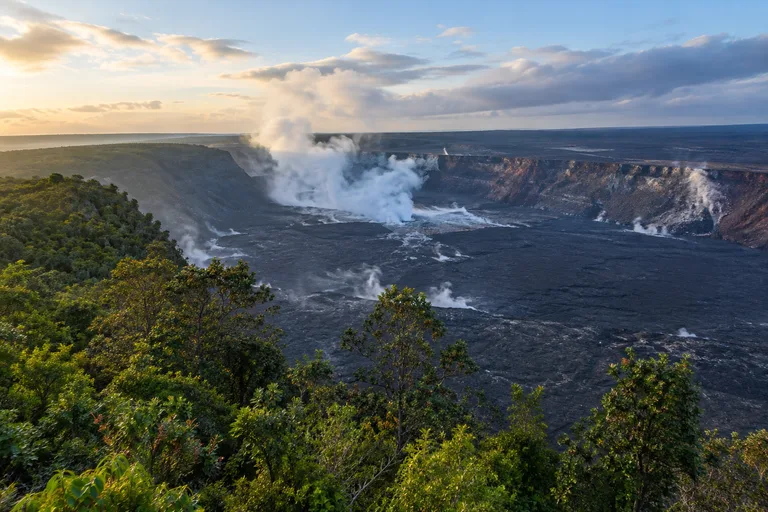
This Big Island Hawaii travel guide starts with the short answer: the Big Island is two trips in one. The sunny Kona side has the main airport, resort beaches, coffee farms and calm snorkeling bays. The green Hilo side has waterfalls, gardens and the shortest drive to Hawaii Volcanoes National Park, where Kilauea erupts in episodes. Most families and couples do best with about a week, split between the two sides.
This guide covers what the National Park Service says about Kilauea today, how to choose between Kona and Hilo, and the rules for visiting Maunakea. It also includes the beaches with lifeguards, a 7-day Big Island itinerary, hidden gems and insider tips. To compare the other islands, start with the Hawaii travel guide.
The Big Island at a Glance
| Question | Short answer |
|---|---|
| Official name | Hawaii Island, called the Big Island; the largest and youngest of the Hawaiian Islands |
| Regions | Kona, Kohala, Hamakua, Hilo, Puna and Kau |
| Airports | Ellison Onizuka Kona International Airport (KOA) on the west side; Hilo International Airport (ITO) on the east side |
| Top sight | Hawaii Volcanoes National Park, about 523 square miles, from sea level to more than 13,000 feet |
| Volcano status | Kilauea erupts in episodes with pauses between them; check the park and USGS on the day |
| Getting around | A rental car for most visitors; four-wheel drive only for the Maunakea summit road |
| Time needed | About 7 days for both sides of the island |
| Whale season | November through April |
The island's official visitor site is gohawaii.com, run by the Hawaii Tourism Authority.
Kona vs Hilo: Which Side of the Big Island?
The easy answer to Kona vs Hilo is to stay on both sides. Kona suits beach days and snorkeling. Hilo suits waterfalls, gardens and early starts at the volcano. A one-base trip means long drives, because the park puts Kona about 2 to 2.5 hours from the volcano.
| Compare | Kona side (west) | Hilo side (east) |
|---|---|---|
| Feel | Sunny, with resorts on the Kona and Kohala coasts | Green rainforest, waterfalls, gardens and museums |
| Airport | Ellison Onizuka Kona International Airport (KOA) | Hilo International Airport (ITO) |
| Drive to Hawaii Volcanoes National Park | About 95 miles, 2 to 2.5 hours on Highway 11 | About 30 miles, about 45 minutes |
| Lifeguarded beaches | Spencer, Hapuna, Kahaluu, White Sands | Leleiwi, Carlsmith, Richardson, Onekahakaha, Honolii, and Punaluu to the south |
| Highlights | Historic Kailua Village, Kealakekua Bay, Puuhonua o Honaunau, coffee country, manta ray night tours | Akaka Falls, Rainbow Falls, Liliuokalani Gardens, Imiloa Astronomy Center, Hilo Farmers Market |
| Best for | Beach time, snorkeling, resort stays, sunsets | Volcano visits, waterfall walks, a quieter town base |
Kona's airport has nonstop flights from major gateway cities. Hilo International Airport is also gaining nonstop transpacific service in fall 2026, according to gohawaii.com. That makes an open-jaw trip easier: fly into one side and out of the other.
Is Kilauea Erupting? What the Park Says Today
Kilauea is active, but it does not glow every night. It erupts in episodes instead of nonstop. The Hawaii Volcanoes National Park eruption viewing page, last updated September 8, 2026, says Kilauea continues to erupt intermittently from Halemaumau crater. The park adds that eruptions are separated by pauses of several days or weeks, and an episode can last only a few hours.
The park sends visitors to the USGS Hawaiian Volcano Observatory for the daily status. Here is what that update said on the morning of November 18, 2026 (8:45 am Hawaii time):
- Status: the Halemaumau eruption remained paused after episode 56, which fountained on November 5.
- Next episode: the forecast window for episode 57 was November 20 to 23.
- Alert level: Advisory, with the aviation color code Yellow.
- Where: activity stays within a closed area of the park, and lava erupting in Halemaumau remains in the crater.
This changes quickly. Check the park's current conditions page and the USGS Kilauea updates on the day you go. The park also posts live webcams, which show at a glance whether there is anything to see.
How to Watch an Eruption Safely
The park says the eruption area is closed because of significant hazards. Viewing happens from open overlooks on the caldera rim. Its advice for eruption days:
- Use the rim overlooks. Park at designated overlooks along Crater Rim Drive. The Welcome Center, Kilauea Overlook and Uekahuna usually have more open parking spots.
- Have a backup stop. If the first lot is full, move on to the next overlook.
- Come early or late. Parking lots can be full by 10 am. During an episode, lava fountains and glow show best at night.
- Cover up. Falling tephra (volcanic particles) is a hazard, so bring eye protection, long sleeves, long pants and a dust mask.
- Check the air. The park warns that volcanic gases can harm sensitive groups. Check air quality often during the visit.
- Stay behind the ropes. Rope lines and hazard signs mark cliff edges, ground cracks and closed areas.
Hawaii Volcanoes National Park: What to See
Even during a pause, Hawaii Volcanoes National Park is worth a full day. Gohawaii.com describes it as about 523 square miles, rising from sea level to more than 13,000 feet. It was established in 1916. The park has two main roads, Crater Rim Drive and Chain of Craters Road.
Crater Rim Drive
The park calls Crater Rim Drive a scenic drive around the summit of Kilauea. This is where the eruption overlooks are, and it is the place to start. Large vehicles have limits here. The park says vehicles more than 25 feet long or 8 feet wide cannot reach Uekahuna until repairs are done. The old Jaggar Museum building at Uekahuna has been removed and will not be rebuilt.
Chain of Craters Road
Chain of Craters Road runs down the slopes of Kilauea to the sea. The park lists it at 18.8 miles to the end of the road. Plan ahead, because the road has no services:
- No food, water or fuel anywhere along the road.
- Vault toilets at the Mauna Ulu parking area and at the end of the road.
- Limited cell service, with an emergency phone at the Puuloa petroglyph trailhead.
- Nene on the road. The Hawaiian goose is federally protected, and the park says cars are the leading cause of adult nene deaths there. Drive slowly and never feed them.
Short Walks and Day Hikes
Gohawaii.com lists Kilauea Iki Overlook and Nahuku (Thurston Lava Tube) among the park's suggested stops. The park also protects over 123,000 acres of wilderness for longer hikes. Its safety advice for any walk is simple:
- Wear sturdy shoes and long pants. Falling on lava rock is like falling on broken glass.
- Stay on marked routes and keep away from cracks and cliff edges.
- Do not hike after dark.
Kahuku Unit
The park's Kahuku Unit is a separate section away from the summit. The park describes it as a place of volcanic activity, rich Hawaiian traditions and a long history of ranching. Check the official site for its hours before driving there.
Construction at the Summit
The park warns of closures and delays from a two-year construction project. The Kilauea Visitor Center, its restrooms and about half its parking are closed for renovation from February 18, 2025 to late 2026. A temporary Welcome Center and the park store operate at Kilauea Military Camp. Overflow parking is at the ball field. See the construction closures page for updates.
Entrance Fees and Passes
Every visitor needs an entrance pass. The park's fees page does not list any entry reservation. A few facts help with planning:
- One pass per car: the private vehicle pass covers the passholder and up to 14 passengers.
- Walk-in and bicycle visitors pay per person, and youth 15 and under are free.
- Hawaii Tri-Park Annual Pass: good for 12 months at Hawaii Volcanoes, Haleakala and Puuhonua o Honaunau, for U.S. citizens and residents.
- No cash: the entrance station takes credit or debit cards only.
Prices change, so check the fees and passes page before you go. Passes can also be bought ahead on Recreation.gov.
Visit: Hawaii Volcanoes National Park, P.O. Box 52, Hawaii National Park, HI 96718 (park mailing address) | 808-985-6011 | nps.gov/havo
Maunakea: Summit Rules and Stargazing
Maunakea is a place of deep cultural meaning, and its summit area has strict access rules. The University of Hawaii at Hilo Center for Maunakea Stewardship manages visitor access. Most visitors stop at the Visitor Information Station, known as the VIS, at 9,200 feet. The road is reached from Daniel K. Inouye Highway, also called Saddle Road.
The Center's rules and advice for going above the VIS:
- Four-wheel drive only: 2-wheel drive vehicles are not permitted above the Visitor Information Station. Vehicles must be free of mud and invasive species.
- Children: people under the age of 13 should not go any further, because their bodies are still developing.
- Pregnancy: the Center does not recommend anyone who is pregnant go further than the VIS.
- Health: it does not recommend going above the VIS with a heart or breathing problem.
- Scuba: do not come up the mountain within 24 hours after a dive.
- Acclimate: stay at the VIS for at least 30 minutes before going higher.
- Summit hours: the summit is open from 30 minutes before sunrise to 30 minutes after sunset, and closed to visitors overnight.
The Center lists the VIS hours as 9:00 am to 9:00 pm daily, and it mentions free nightly stargazing programs with its telescopes. Hours can shift. On November 18, 2026 the VIS posted a later opening for that day. Check the official site before the long drive up.
Lake Waiau, near the summit, is described by the Center as a very sacred site in Hawaiian culture. Treat the whole mountain with the same care.
Visit: Onizuka Center for International Astronomy Visitor Information Station, Maunakea Access Road at Milepost 28, off Daniel K. Inouye Highway (Saddle Road) | 808-934-4550 | hilo.hawaii.edu/maunakea
Best Things to Do on the Kona Side
The Kona District covers nearly two-thirds of the island's west side, according to gohawaii.com. It is the sunny half of the island and the usual first base.
Historic Kailua Village
Kailua-Kona is the lively seaside town at the heart of Kona, with shops, restaurants and historic sites. On Alii Drive, Hulihee Palace lets visitors step back to the days of the Hawaiian monarchy. A stroll and a sunset in town make an easy first evening.
Kealakekua Bay
Captain James Cook first landed on the island at Kealakekua Bay in 1778, and he was later killed there. Today the bay is a Marine Life Conservation District, popular for snorkeling and diving. Go with a licensed tour or check conditions before entering the water.
Puuhonua o Honaunau National Historical Park
Gohawaii.com calls Puuhonua o Honaunau a well-restored Hawaiian place of refuge. It is a meaningful place for families to learn about traditional Hawaiian life. The park says its gates close 15 minutes after sunset. Entry is covered by the Hawaii Tri-Park Annual Pass.
Visit: Puuhonua o Honaunau National Historical Park, PO Box 129, Honaunau, HI 96726 (park mailing address) | 808-328-2326 | nps.gov/puho
Kona Coffee Country
The village of Holualoa sits in the heart of Kona coffee country. A coffee farm visit is a favorite Kona stop for couples and families. Hours vary by farm, so check each farm's own site.
Manta Ray Night Snorkel
Gohawaii.com lists manta ray boat tours, where visitors snorkel or scuba dive with these gentle sea creatures. The tours run at night off the Kona coast. Choose a licensed operator and follow the crew's rules in the water.
The Kohala Coast
North of Kona, the Kohala Coast holds the island's luxury resorts and Hapuna Beach. Hapuna Beach State Recreation Area makes a classic family beach day, with lifeguards, picnic areas and restrooms. Nonresidents pay entry and parking fees by credit card, so check the official site for current prices and hours. The park warns of rip currents and pounding shorebreak during high surf. Its camping cabins were closed in late 2026. Gohawaii.com also lists Puukohola Heiau National Historic Site, a Hawaiian heiau (temple) site, among the island's top sights.
Best Things to Do on the Hilo Side
Hilo sits on the island's northeast side, with rainforest, waterfalls, gardens and museums. It is also the nearest town to the volcano, about 45 minutes away.
Akaka Falls State Park
Akaka Falls plunges 442 feet, and nearby Kahuna Falls is about 100 feet, according to gohawaii.com. A 0.4-mile loop trail leads through the rainforest. State Parks lists hours of 8:30 am to 5:00 pm daily. Nonresidents pay entry and parking fees by credit card only, and the park suggests paying before arrival because cell service is weak. The park sits at the end of Akaka Falls Road (Highway 220), 3.6 miles southwest of Honomu. A State Parks notice on October 30, 2026 reported a partial trail closure from fallen trees, so check the notices first.
Rainbow Falls and Downtown Hilo
- Rainbow Falls (Waianuenue): an 80-foot waterfall in Wailuku River State Park, a short drive west of downtown.
- Liliuokalani Gardens: a 30-acre Japanese-style garden with fishponds, pagodas and rock gardens.
- Hilo Farmers Market: fresh produce, plants and local crafts.
- Pacific Tsunami Museum: the story of the tsunamis that struck Hilo.
- Imiloa Astronomy Center: housed in three titanium cones that stand for Maunakea, Maunaloa and Hualalai.
Puna and Kau
South of Hilo, the Puna and Kau districts hold the volcano park and the island's southern coast. Gohawaii.com lists Punaluu Black Sand Beach among the island's sights, and Punaluu Beach Park is on the state's lifeguarded list. Lava Tree State Monument in Puna was closed for storm damage in a State Parks notice of November 10, 2026.
Waipio Valley Lookout
On the Hamakua Coast north of Hilo, gohawaii.com lists the Waipio Valley Lookout among the island's top sights. Enjoy the valley from the lookout. Access to the valley floor is set by the County of Hawaii, so check the county's current rules before planning anything beyond the viewpoint.
Big Island Beaches With Lifeguards
Ocean conditions change fast on every Big Island shore. The safest choice is a beach with a lifeguard. The state's ocean safety site lists these Big Island beaches, guarded 9:30 am to 4:45 pm daily:
| West shore (Kona and Kohala) | East shore (Hilo and Kau) |
|---|---|
| Spencer Beach Park | Leleiwi Beach Park |
| Hapuna Beach Park | Carlsmith Beach Park |
| Kahaluu Beach Park | Richardson Ocean Park |
| White Sands (Laaloa) Beach Park | Onekahakaha Beach Park |
| Honolii Beach Park | |
| Punaluu Beach Park |
See the full lifeguarded beaches list before heading out.
Ocean Safety and Respect for the Land
Gohawaii.com asks every visitor to follow the same habits local families use. These are its key ocean tips:
- Talk to the lifeguard before swimming, about rip currents, hidden rocks and shorebreak.
- If in doubt, don't go out.
- Never turn your back to the ocean. Waves are unpredictable.
- Stay off wet rocks. If the rocks are wet, waves have already reached them.
- Know how to swim before snorkeling, and at least wear a flotation device.
- Caught in a rip current? Stay calm, go with the flow, then swim at an angle away from it.
Give sea life room. Federal law prohibits approaching within 100 yards of a humpback whale in Hawaii. NOAA also recommends staying at least 10 feet from sea turtles and 50 feet from monk seals. Follow posted signs at the beach.
Respect for the land matters just as much. Many places on the Big Island are sacred, from Lake Waiau on Maunakea to the heiau (temples) in the historic parks. Stay on marked trails, stay out of roped or closed areas, and never cross private land without permission. In the volcano park, closed areas protect visitors from gas, cracks and cliff edges.
Getting to and Around the Big Island
The island has two main airports, one on each side. Ellison Onizuka Kona International Airport (KOA) serves the Kona and Kohala coasts. Hilo International Airport (ITO) serves Hilo and is the closer airport for the volcano. Inter-island flights link the Big Island with the other islands, so check which airport each flight uses.
Most visitors rent a car, because the main sights are spread across a large island. The park's own drive figures make the point:
| Route | Distance | Time (park figures) |
|---|---|---|
| Hilo to Hawaii Volcanoes National Park | About 30 miles on Highway 11 | About 45 minutes |
| Kailua-Kona to the park, south route | About 95 miles on Highway 11 | 2 to 2.5 hours |
| Kailua-Kona to the park, north route via Waimea and Hilo | About 125 miles on Highways 19 and 11 | 2.5 to 3 hours |
The county's Hele-On bus stops at the intersection of Volcano House and the second entrance to Kilauea Visitor Center, according to the park. The park warns that schedules may change and there is no shuttle inside the park. For Maunakea, only a four-wheel-drive vehicle may go above the VIS. Check the rental agreement before driving any steep or rough road.
Best Time to Visit the Big Island
The best time to visit the Big Island depends on what matters most to the group. Gohawaii.com suggests January to May or September to November for good weather and fewer visitors. Each season has its own draw:
- Whale season: humpback whales can be seen from shore and at sea from November through April.
- Volcano viewing: eruption episodes follow the volcano, not the calendar. Check the USGS forecast window close to the trip.
- Stargazing: clear nights are best, and the summit closes 30 minutes after sunset. Plan the VIS for evening viewing.
- Big events: some Kona coast state parks closed for the Kona Ironman race on October 10, 2026. Check State Parks notices if traveling in October.
Pack for two climates. The Kona side is sunny. The Hilo side is rainforest country, and the volcano summit sits well above the coast. A rain jacket and a warm layer are smart in any month.
Where to Stay on the Big Island
| Base | Good for |
|---|---|
| Kailua-Kona | Town life, restaurants, Kealakekua Bay and manta ray tours; closest to KOA |
| Kohala Coast | Resort stays and sandy beaches such as Hapuna |
| Hilo | Waterfalls, gardens and the shortest drive to the volcano; closest to ITO |
A good split is three or four nights in Kona or Kohala and two or three nights in Hilo or near the volcano. For general booking tips, see the hotel and lodging guide.
Big Island Itinerary: 7 Days
This Big Island itinerary starts in Kona and ends in Hilo, which works well with an open-jaw flight.
- Day 1, Kailua-Kona: land at KOA, walk Historic Kailua Village and Alii Drive, and watch the sunset from town.
- Day 2, South Kona: morning at Kealakekua Bay, then Puuhonua o Honaunau. Stop at a coffee farm near Holualoa on the way back.
- Day 3, Kohala Coast: a beach day at Hapuna with lifeguards on duty. End with a manta ray night snorkel tour if booked.
- Day 4, across the island: drive Saddle Road to the Maunakea VIS and acclimate before going higher, if the group meets the rules. Continue to Hilo for the night.
- Day 5, Hilo and Hamakua: Akaka Falls, the Waipio Valley Lookout, then Rainbow Falls and Liliuokalani Gardens.
- Day 6, Hawaii Volcanoes National Park: arrive before 10 am. Drive Crater Rim Drive, then Chain of Craters Road with food and water packed. Return to the rim after dark if an episode is under way.
- Day 7, Hilo: the farmers market, Imiloa Astronomy Center or the Pacific Tsunami Museum, then fly out of ITO.
Short on Time? 3 Days
- Day 1: fly into Hilo, see Rainbow Falls and Akaka Falls, and stay in Hilo.
- Day 2: a full day at Hawaii Volcanoes National Park, with eruption viewing at night if active.
- Day 3: drive Highway 11 to Kona, with a stop at Puuhonua o Honaunau in South Kona, and fly out of KOA.
Hidden Gems on the Big Island
These quieter spots reward a little extra time:
- Kaloko-Honokohau National Historical Park: just south of the Kona airport, an easy first or last stop.
- The Kahuku Unit: a separate section of the volcano park, with a history of ranching and its own hours.
- Puuloa petroglyphs: a trailhead on Chain of Craters Road, on the way to the sea.
- Liliuokalani Gardens: 30 acres of fishponds, pagodas and rock gardens in Hilo.
- Holualoa: a village in the heart of Kona coffee country.
- Richardson Ocean Park: a lifeguarded shore park on the Hilo side.
- Imiloa Astronomy Center: an indoor stop in Hilo, in three titanium cones that stand for Maunakea, Maunaloa and Hualalai.
Insider Tips for the Big Island
- Split the stay. Two bases save hours of driving.
- Beat the 10 am rush. The park says its lots can be full by 10 am, especially during eruptions.
- Check two pages before the volcano: the park's conditions page and the USGS Kilauea update.
- Carry a card. The volcano park takes no cash, and Akaka Falls and Hapuna take cards only.
- Fill up first. Chain of Craters Road has no food, water or fuel.
- Pack tephra gear on eruption days: glasses, long sleeves and a dust mask.
- Plan Maunakea around diving. Wait 24 hours after scuba before going up.
- Watch for nene on park roads, and never feed them.
- Check State Parks notices. Several parks had storm-related closures in fall 2026; see the park notices page.
- Visiting Maui too? The Hawaii Tri-Park Annual Pass also covers Haleakala.
For packing help, see the weekend getaway packing list. For photo ideas across the country, see the best picture-taking trips.
Frequently Asked Questions About the Big Island
Is it better to stay in Kona or Hilo?
For most first visits, split the stay. Kona is the sunny west side with the main airport, the resort coast, coffee farms and calm south Kona bays. Hilo is the green east side, with waterfalls and gardens, and it sits about 45 minutes from Hawaii Volcanoes National Park.
Is Kilauea erupting right now?
Kilauea erupts in episodes with pauses between them. On November 18, 2026, the USGS Hawaiian Volcano Observatory said the eruption remained paused after episode 56 on November 5. It gave an episode 57 forecast window of November 20 to 23. Check nps.gov/havo and the USGS update on the day you go.
Can you see lava at Hawaii Volcanoes National Park?
Sometimes. The park says Kilauea continues to erupt intermittently from Halemaumau crater, with pauses of days or weeks. During an episode, visitors may see lava fountains and a strong glow from viewpoints on the caldera rim, best at night. The eruption area itself is closed.
How long is the drive from Kona to Hawaii Volcanoes National Park?
The park puts it at about 95 miles on Highway 11, roughly 2 to 2.5 hours. The northern route through Waimea and Hilo is about 125 miles and 2.5 to 3 hours. From Hilo it is about 30 miles, roughly 45 minutes.
Do you need a reservation for Hawaii Volcanoes National Park?
The park's fees page does not list any entry reservation, but every visitor needs an entrance pass. The entrance station does not take cash, so bring a card or buy a pass on Recreation.gov. Parking lots can be full by 10 am, so arrive early.
Can you drive to the top of Maunakea?
Only in a four-wheel-drive vehicle. The Center for Maunakea Stewardship says 2-wheel drive vehicles are not permitted above the Visitor Information Station at 9,200 feet. Children under 13, anyone pregnant and anyone with heart or breathing problems are advised not to go higher. The summit closes 30 minutes after sunset.
How many days do you need on the Big Island?
Plan on about a week. Three or four nights on the Kona side cover the beaches, coffee country and historic parks. Two or three nights in Hilo or near the volcano cover the waterfalls and Hawaii Volcanoes National Park without long drives every day.
What is the best time to visit the Big Island?
The Big Island works all year. Hawaii's official tourism site suggests January to May or September to November for good weather and fewer visitors. Humpback whales can be seen from November through April. Volcano viewing depends on eruption episodes, not the season.
Which Big Island beaches have lifeguards?
The state ocean safety site lists Spencer, Hapuna, Kahaluu and White Sands on the west shore. On the east shore it lists Leleiwi, Carlsmith, Richardson, Onekahakaha, Honolii and Punaluu. Guards are listed from 9:30 am to 4:45 pm daily.
Do you need a car on the Big Island?
For most visitors, yes. The island is large and the main sights are spread out. The county Hele-On bus stops near the volcano park entrance, but schedules can change and there is no shuttle inside the park. A four-wheel-drive vehicle is needed above the Maunakea Visitor Information Station.
Planning your next U.S. getaway? Explore more destination guides, road trips, and travel tips at Vacation Getaways US. Have a question or a spot we should cover? Email us at [email protected].