
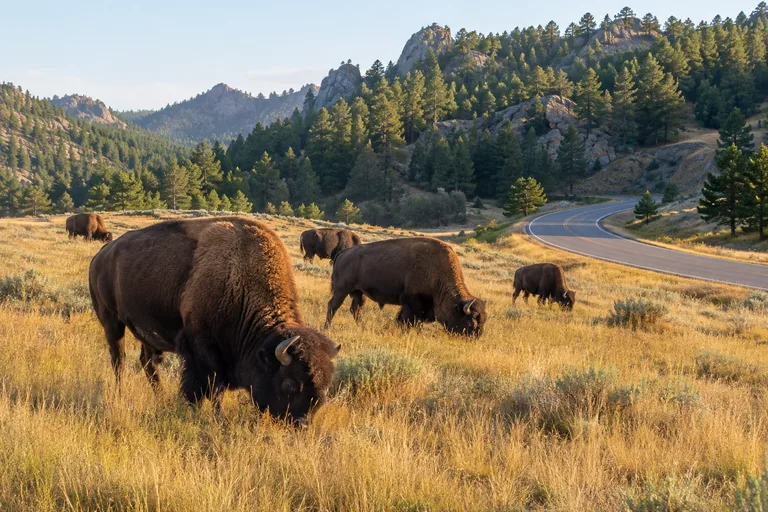
The top Custer State Park things to do are the 18-mile Wildlife Loop Road for bison, the 14-mile Needles Highway and Sylvan Lake. Plan at least one full day. Give it two or three days to add hikes like Black Elk Peak, a jeep tour or the Buffalo Roundup in late September.
Custer State Park covers 71,000 acres in the Black Hills of South Dakota. The state calls it "South Dakota's first and largest state park." This guide covers the drives, the wildlife, the lakes, the best hikes, the visitor centers and a simple itinerary. For lodging, see the guide to cabins near Custer State Park. For the whole state, start with the South Dakota travel guide.
Custer State Park at a Glance
| Question | Short answer |
|---|---|
| Where is it? | In the southern Black Hills, near the towns of Custer, Hill City, Keystone, Hermosa and Rapid City |
| How big is it? | 71,000 acres of granite peaks, pine forest and rolling prairie |
| Best-known sight | A free-roaming herd of roughly 1,300 to 1,400 bison |
| Top drives | Wildlife Loop Road (18 miles), Needles Highway (14 miles), Iron Mountain Road (17 miles) |
| Entry | A park entrance license for 1 to 7 days or a full year; check the official site for prices |
| Time needed | One full day for the highlights; two or three days with hikes |
| Open | All year; Needles Highway closes with the first snow |
| Big event | The Buffalo Roundup, held on the last Friday of September |
Visit: Custer State Park, 13329 US Highway 16A, Custer, SD 57730 | 605-394-2693 | gfp.sd.gov
The park warns that GPS can be unreliable in the area. Check a map or call the park office for directions before you set out.
Wildlife Loop Road: Where to See Custer State Park Bison
The Wildlife Loop Road is the number one thing to do in Custer State Park. It runs 18 miles through prairie and hills dotted with ponderosa pine. The park expects the drive to take about 1 hour 30 minutes, depending on "wildlife jams." It is open all year, though winter driving calls for care.
The loop meets SD Highway 87 on its western side, about five miles south of US Highway 16A. Its eastern end starts near the main Visitor Center, at the junction of US Highway 16A and Wildlife Loop Road.
What You Can See on the Loop
Bison are the park's most common animal. The park lists these animals along the road:
- Bison: about 1,350 free-roaming animals, according to the park's scenic drives page.
- Deer and elk: white-tailed deer, mule deer and elk, most visible early morning and late afternoon.
- Pronghorn and prairie dogs: Travel South Dakota lists pronghorn among the common sightings, and the park lists prairie dogs.
- Possible sightings: bighorn sheep, burrowing owls, coyotes and, rarely, mountain lions.
- Burros: a band of feral burros that often walk right up to cars.
The best time to see animals is early morning or late evening, just before sunset. Deer and elk are the hardest to spot at midday, since the park says they show best early and late.
Custer State Park Bison Safety
Bison look calm, but they are large and fast. The park asks visitors to stay in the vehicle or at least 100 yards from bison and elk. Its trails page warns that bison are dangerous all year. The risk is higher in spring, when calves are born, and in late summer, during the bulls' rut.
- Let bison cross the road on their own time. Do not honk or edge forward.
- Keep windows partly up if burros or bison come close.
- Feeding or disturbing wildlife is against park regulations, and that includes the burros.
The Bison Center and the Wildlife Station
Two stops on the loop explain what you are seeing. The Bison Center sits at the Buffalo Corrals in the southern prairie. Its displays tell the story of the herd, which the park calls one of the world's largest publicly owned bison herds. It is open daily in summer and closes for the season in early November.
The Wildlife Station Visitor Center is eight miles south of US Highway 16A on the loop. The building began as the herdsman's house, became a visitor center in 1987 and was renovated in 2017. It opens from Memorial Day through September 30.
Needles Highway: Granite Spires and the Needles Eye Tunnel
The Needles Highway is the park's most dramatic drive. It is a 14-mile stretch of SD Highway 87, and the park says to allow 60 minutes or more. The road is named for the needle-like granite spires along it.
Former Governor Peter Norbeck planned the road, and he marked the whole course on foot and on horseback. Construction was finished in 1922. The drive passes pine and spruce forest, meadows edged with birch and aspen, and Sylvan Lake.
The Needles Eye Tunnel
The famous stop is the Needle's Eye, a slim granite spire with an opening worn by wind, rain, freezing and thawing. Right beside it, the road squeezes through a tunnel only 8 feet wide, so cars take turns.
| Tunnel | Width | Height |
|---|---|---|
| Needles Eye Tunnel | 8 ft 0 in | 9 ft 9 in |
| Iron Creek Tunnel | 8 ft 9 in | 10 ft 10 in |
Measure an RV, trailer or tall van before you go. Many larger vehicles will not fit.
When Needles Highway Is Open
Needles Highway closes to vehicles with the first snow of the season. It does not reopen until April 1 or later, depending on conditions. When conditions allow, the closed road is open to hiking, biking, snowshoeing and skiing. Check South Dakota 511 for road status, as the park suggests.
Iron Mountain Road and the Peter Norbeck Scenic Byway
Iron Mountain Road links Custer State Park with Mount Rushmore National Memorial in 17 miles. The park says to allow 60 minutes or more. Its three tunnels frame Mount Rushmore in the distance, and its "pigtail bridges" let drivers gain or lose height quickly.
The road was built in the 1930s under Governor Peter Norbeck's direction. The park quotes his advice: "to do the scenery justice you should drive no more than 20 mph." It closes now and then in winter, depending on how fast crews can clear it.
Its tunnels are wider than the two on Needles Highway, but they are still tight:
| Iron Mountain Road tunnel | Width | Height |
|---|---|---|
| Doane Robinson Tunnel | 12 ft 0 in | 11 ft 4 in |
| C.C. Gideon Tunnel | 11 ft 6 in | 10 ft 9 in |
| Scovel Johnson Tunnel | 10 ft 9 in | 11 ft 0 in |
Together, Needles Highway, Iron Mountain Road and the Wildlife Loop form much of the Peter Norbeck National Scenic Byway.
Custer State Park Scenic Drives Compared
Most visitors drive all three. This table, built from the park's own figures, helps you pick the order.
| Drive | Length | Time | Season | Best for |
|---|---|---|---|---|
| Wildlife Loop Road | 18 miles | About 1 hour 30 minutes | All year | Bison, pronghorn, burros, prairie views |
| Needles Highway (SD 87) | 14 miles | 60+ minutes | About April to the first snow | Granite spires, Needles Eye, Sylvan Lake |
| Iron Mountain Road | 17 miles | 60+ minutes | All year, with winter closures | Pigtail bridges, tunnels that frame Mount Rushmore |
Sylvan Lake and the Park's Other Lakes
Sylvan Lake sits along Needles Highway, and Travel South Dakota calls it "postcard-perfect." Visitors can rent canoes, kayaks or paddleboards there in season.
The easy Sylvan Lake Shore Trail circles the water in a 1.1-mile loop. Travel South Dakota says it "typically takes less than half an hour." It suits families with older kids, and it is a good leg-stretch between drives.
More Lakes to Know
The park's campground list names several other lakes and lake areas:
- Legion Lake: home to Legion Lake Lodge. Poet Badger Clark built his cabin near it.
- Center Lake: with its own campground.
- Stockade Lake: with north and south campgrounds.
- Grace Coolidge and Game Lodge: two more campground areas in the park.
Swimming, fishing, boating, canoeing, kayaking and paddleboarding all appear on the park's activity list. Fishing needs a South Dakota license. Pets are not allowed on designated swim beaches.
Best Hikes in Custer State Park
The best hikes in Custer State Park range from a half-hour lake loop to a full morning on the highest summit in South Dakota. Figures below come from Travel South Dakota, the park and its lodge operator.
| Hike | Distance | Effort | Good to know |
|---|---|---|---|
| Sylvan Lake Shore Trail | 1.1-mile loop | Easy | Usually under half an hour |
| Cathedral Spires Trail | 1.6 miles out and back | Short; suits families | Granite spires off Needles Highway |
| Black Elk Peak | About 6.4 to 7.1 miles round trip | Steady climb | Starts at Sylvan Lake; plan 3 to 4 hours or more |
| Centennial Trail | 22 miles inside the park | Varies; steep near French Creek | Part of a 111-mile trail across the Black Hills |
| French Creek Natural Area | No marked trail | Moderate, wet feet | 2,200 acres; expect many creek crossings |
Black Elk Peak
Black Elk Peak is the highest peak in South Dakota. The Forest Service calls it the highest point between the Rockies and the Pyrenees in France. The hike starts at Sylvan Lake. Custer State Park Resort lists a 6.4-mile loop and 3 to 4 hours. Travel South Dakota lists a 7.1-mile loop.
A stone fire lookout tops the summit. The Civilian Conservation Corps built it from 1938 to 1940, and it was last staffed in 1967. From the top, visitors see parts of South Dakota, Nebraska, Wyoming and Montana. There are no restrooms and no drinking water at the summit, so carry plenty.
Cathedral Spires
The Cathedral Spires Trail climbs to a cluster of tall granite spires off Needles Highway. Travel South Dakota lists it as a 1.6-mile out-and-back walk suited to families. Summer days are busiest, so an early start helps.
Centennial Trail and French Creek
For longer days, the Centennial Trail covers 22 miles inside the park, with trailheads at Iron Creek, Badger Hole and French Creek. It is marked with brown posts and gray diamonds. The park calls the French Creek section the most strenuous part inside the park.
The French Creek Natural Area covers 2,200 acres with no marked trail. Hikers follow the creek and cross it many times. In drier months, the first mile from the east trailhead flows underground.
The Buffalo Roundup and Arts Festival
The Custer State Park Buffalo Roundup is a classic Western event. Riders on horseback drive the park's herd of about 1,300 bison into corrals. There, crews test, brand and sort the animals as part of herd care. Travel South Dakota lists it on the last Friday of September each year.
Here is how the 2026 roundup on September 25 worked, from the park's event page:
- Parking: lots opened at 6:15 a.m., and the park advised arriving early to pick a spot.
- Start: the roundup began at 9:30 a.m. MT, and viewers stayed in place until the herd was in the corrals, generally around noon.
- Viewing areas: North (south from the Game Lodge area on Wildlife Loop Road) and South (east on Wildlife Loop Road near Blue Bell campground). Pick one in advance.
- Crowds: as many as 20,000 or more spectators.
- Food: breakfast from 6:15 a.m. in both viewing areas and lunch at the corrals, both for a fee.
- What to bring: folding chairs, cameras, binoculars, layers, rain gear and sunscreen.
- Pets: they must stay in the vehicle, and the park encourages leaving them at home.
The Buffalo Roundup Arts Festival ran September 24 to 26 in 2026. It had up to 150 vendors, a pancake feed and Western and Native American entertainment under the big top. The festival grounds sit across from the Peter Norbeck Outdoor Education Center. Dates change each year, so check the Buffalo Roundup page before planning.
Visitor Centers and Family Programs
The park has four places to learn about its land and animals. Each is a good first stop for families.
| Center | Where | Season | Highlight |
|---|---|---|---|
| Custer State Park Visitor Center | US Highway 16A at Wildlife Loop Road | All year; closed Thanksgiving and Christmas | A 100-seat theater with a 20-minute film every half hour |
| Peter Norbeck Outdoor Education Center | One mile west of the Visitor Center | Memorial Day through September 30 | Family exhibits and an Outdoor Classroom for "unscripted play" |
| Wildlife Station Visitor Center | Eight miles south of US 16A on Wildlife Loop Road | Memorial Day through September 30 | A former herdsman's house on the prairie |
| Bison Center | Buffalo Corrals on Wildlife Loop Road | Memorial Day to early November | Displays about the bison herd |
The main Visitor Center opened in 2016. It keeps its longest hours from Memorial Day through Labor Day and shorter hours the rest of the year. Hours change, so check the official site.
Programs for Kids
Most of the park's naturalist programs take place at the Peter Norbeck Outdoor Education Center. The bulk run from Memorial Day to Labor Day. Families can also try these self-led options:
- Track Trail brochures: at both ends of the Creekside Trail, by the Visitor Center and Grace Coolidge Campground.
- Kids in Parks e-Adventures: digital versions of some Track Trail brochures.
- Summer Trail Challenge: collect medallion rubbings on a form and turn it in for a pin.
- Winter Trail Challenge: hike the listed trails and take a selfie at each challenge sign.
- The park app: self-guided audio tours on wildlife and the scenic drives.
Jeep Safaris, Trail Rides and Chuck Wagon Cookouts
A guided tour lets everyone in the car watch for wildlife. The park's lodge operator, Custer State Park Resort, runs several. Its activities page lists these:
- Buffalo Safari Jeep Tour: open-air trips in search of pronghorn, elk and bison. Travel South Dakota describes them as about two hours on the park's dirt back roads.
- Guided trail rides: horseback rides that leave from Blue Bell Lodge, according to Travel South Dakota.
- Hayride and Chuck Wagon Cookout: an evening wildlife hayride, then a steak dinner and live entertainment in the backcountry.
These book up in summer. Check the resort's site for seasons and prices.
Custer State Park History: Bison, Lodges and a Summer White House
A little history makes the park more fun to explore. These facts come from the park's own history page:
- A forest first: the land became Custer State Forest in 1912 and officially a state park on July 1, 1919.
- Peter Norbeck: the "prairie statesman" pushed the legislature to create the park. He later planned Needles Highway and directed the building of Iron Mountain Road.
- The first bison: in 1914, 36 bison were bought from the Scotty Philip herd near Pierre. The herd reached 100 by 1924.
- The State Game Lodge: C.C. Gideon opened it on August 8, 1921.
- The Summer White House: President Calvin Coolidge and Mrs. Coolidge spent three months at the Game Lodge in 1927. President Eisenhower visited in 1953.
- Bighorn sheep: eight Rocky Mountain bighorn sheep were introduced in 1922.
- The Civilian Conservation Corps: it completed Iron Mountain Road in 1933 and built the park's museum.
- A milestone year: 2020 brought over 2.4 million visitors.
Today the park manages its herd with an annual bison auction each November. The roundup each September is part of that care.
Entrance License, Pets and Park Rules
Every vehicle that stops in the park needs a park entrance license. Here is what the park's page says:
- Short visits: a license covers 1 to 7 days, with separate rates for vehicles, motorcycles and motorcoach passengers.
- Annual licenses: sold at one rate for residents and another for nonresidents.
- Driving through: vehicles passing nonstop through the park on US Highway 16A do not need a license.
- Buying: licenses can be bought online in advance through the Go Outdoors South Dakota system.
- Prices: they change, so check the official site.
Pets and Other Rules
- Pets must be on a leash no longer than 10 feet and must not be left alone.
- Pets are not allowed in park buildings or on designated swim beaches. Service animals are welcome.
- Feeding or disturbing wildlife is against park rules.
- From October 1 to April 30, showers, flush toilets and other water systems may be closed. Vault toilets usually stay open.
- Scenic drives can close for weather or hazards; check South Dakota 511.
Best Time to Visit Custer State Park
For most families and couples, the best time is late May through September. All four visitor centers are open, Needles Highway is clear and naturalist programs run. Late September adds the Buffalo Roundup. Winter is quiet, with the Wildlife Loop still open.
| Season | What is open | Watch for |
|---|---|---|
| Spring (April to May) | Needles Highway reopens April 1 or later; the Wildlife Loop is open | Bison calves and protective mothers; some centers not open until Memorial Day |
| Summer (Memorial Day to Labor Day) | Everything: all four centers, programs, rentals, tours | The busiest season; drive the loop early or late |
| Fall (September to October) | The Buffalo Roundup and Arts Festival; most drives | Smaller centers close September 30; the bulls' rut in late summer |
| Winter (November to March) | The main Visitor Center and the Wildlife Loop | Needles Highway closed; some water systems off; snowshoeing |
The park lists snowshoe checkout among its winter activities. Ask at the Visitor Center about current availability.
Getting There and Getting Around
A car is the only practical way to see Custer State Park, since the sights are spread across 71,000 acres. The park's address is 13329 US Highway 16A, Custer.
- By air: Rapid City Regional Airport serves the Black Hills, and Rapid City is one of the towns the park lists as nearby.
- Main road: US Highway 16A crosses the park. The Visitor Center sits where it meets Wildlife Loop Road, and Gordon Stockade sits by the west entrance.
- Nearby towns: the park lists Custer, Rapid City, Hill City, Keystone and Hermosa as the closest.
- From Mount Rushmore: Travel South Dakota puts the memorial about 40 minutes from the park, with Iron Mountain Road as the scenic link.
- GPS: the park warns it can be unreliable, so carry a paper map from a visitor center.
Plan your fuel and snacks before you enter. The roads are slow and twisty, and wildlife jams can add a lot of time. Drive in daylight when you can.
Custer State Park Itinerary: One Day or Two
This Custer State Park itinerary keeps the drives in a smooth order. It works best from late May through September, when Needles Highway and every center are open.
| Time | Day 1: The Classic Loop | Day 2: Hikes and Extras |
|---|---|---|
| Early morning | Visitor Center film, then the Wildlife Loop Road for bison | Black Elk Peak or Cathedral Spires from the Sylvan Lake area |
| Late morning | Bison Center and Wildlife Station on the loop | Picnic or lunch at Sylvan Lake |
| Midday | Needles Highway north to Sylvan Lake | A canoe, kayak or paddleboard on the lake |
| Afternoon | Sylvan Lake Shore Trail, then back along Needles Highway | Mount Coolidge lookout, Badger Hole or a Buffalo Safari Jeep Tour |
| Evening | Iron Mountain Road to Mount Rushmore for the lighting program | A second, slower drive of the Wildlife Loop at sunset |
With a third day, add Mount Rushmore and Crazy Horse by day. A fourth day fits Badlands National Park or historic Deadwood in the northern hills. The South Dakota travel guide shows how they fit together.
Where to Stay Near the Park
The park has four historic lodges: Blue Bell Lodge, State Game Lodge, Sylvan Lake Lodge and Legion Lake Lodge. It also runs 9 campgrounds, with camper cabins, tent sites, RV sites with electricity and a horse camp. Outside the park, Custer, Hill City and Keystone are close bases.
Lodging is covered in detail in the guide to cabins near Custer State Park. It compares the in-park lodges and nearby cabins, with booking tips. For a simpler camping style, see the guide to cabin camping.
Hidden Gems in Custer State Park
- Mount Coolidge Fire Tower: a stone lookout built by the Civilian Conservation Corps in 1939, at 6,023 feet. A 1.2-mile gravel road climbs to it, 3 miles south of US 16A on SD 87. On a clear day, the view takes in Mount Rushmore, Crazy Horse, the Needles and the Badlands about 60 miles east. The road opens Memorial Day into late September, and oversized vehicles are not allowed.
- Badger Hole: the cabin of Charles Badger Clark, South Dakota's first poet laureate, who lived in the park for his last 30 years. It is open Memorial Day to Labor Day, 10 a.m. to 5 p.m., south of US 16A on Badger Clark Road.
- Gordon Stockade: a rebuilt log fort just inside the west entrance, off US 16A. Custer's 1874 expedition found gold in French Creek. Gold seekers from Sioux City, Iowa, then built the original fort on its bank. It is open all year.
- The State Game Lodge: the "Summer White House" of 1927, where the Coolidges spent three months.
- Black Hills Playhouse: a theater presenting shows since 1946, on the site of a former Civilian Conservation Corps camp. A park entrance pass is needed to attend.
- French Creek Natural Area: 2,200 acres with no marked trail, for families who like wading and wandering.
Insider Tips for Custer State Park
- Drive the Wildlife Loop twice. Once at sunrise and once near sunset covers both of the park's best viewing times.
- Buy the license online. It is one less thing to do on a busy morning.
- Measure your vehicle. The Needles Eye Tunnel is only 8 feet wide.
- Bring binoculars. Pronghorn and bighorn sheep often stay far from the road.
- Carry water on Black Elk Peak. The summit has no water or restrooms.
- Hike before the heat. Morning starts on Cathedral Spires and Black Elk Peak beat the summer sun.
- Pick your roundup viewing area ahead of time. All vehicles leave the way they came in.
- Check road status first. South Dakota 511 shows closures on Needles Highway and Iron Mountain Road.
- Do not trust GPS alone. Grab a paper map at the Visitor Center.
More Black Hills Sights Near Custer State Park
Custer State Park sits at the center of the southern Black Hills, so other big sights are close. Each is covered in the South Dakota travel guide.
- Mount Rushmore National Memorial: at the north end of Iron Mountain Road.
- Crazy Horse Memorial: the mountain carving in progress.
- Wind Cave National Park: Travel South Dakota calls it "a short drive" from the park.
- Jewel Cave National Monument: near the town of Custer.
- Badlands National Park: a day trip east of Rapid City.
- Deadwood: the gold-rush town of the northern hills.
Frequently Asked Questions About Custer State Park
What are the top things to do in Custer State Park?
Drive the Wildlife Loop Road to see bison, then take Needles Highway to Sylvan Lake. Walk the Sylvan Lake Shore Trail, hike to Cathedral Spires or Black Elk Peak, and stop at the Visitor Center. In late September, the Buffalo Roundup is the big event.
How long is the Wildlife Loop Road in Custer State Park?
The Wildlife Loop Road is 18 miles long. The park expects the drive to take about 1 hour 30 minutes, depending on wildlife jams. It is open all year, but it needs careful driving in winter.
Where is the best place to see bison in Custer State Park?
The Wildlife Loop Road, through the prairie in the southern part of the park. Animals are most active in the early morning and in the late evening, just before sunset. Stay in your vehicle or at least 100 yards from bison and elk.
When is Needles Highway open?
Needles Highway closes to vehicles with the first snow of the season. It does not reopen until April 1 or later, depending on conditions. Check South Dakota 511 for current road status before you go.
Can an RV drive Needles Highway?
Check your vehicle size first. The Needles Eye Tunnel is 8 feet wide and 9 feet 9 inches high. The Iron Creek Tunnel is 8 feet 9 inches wide and 10 feet 10 inches high. Many larger RVs will not fit.
Do you need a pass for Custer State Park?
Yes. A park entrance license is required, either for 1 to 7 days or for a full year. Vehicles driving straight through on US Highway 16A without stopping do not need one. Check the official site for current prices.
When is the Custer State Park Buffalo Roundup?
Travel South Dakota lists it on the last Friday of September each year. In 2026 it was held on September 25 and began at 9:30 a.m. The Buffalo Roundup Arts Festival runs around the same days. Check the park site for the next date.
How many days do you need in Custer State Park?
One full day covers the Wildlife Loop Road, Needles Highway and Sylvan Lake. Two days leave time for a longer hike such as Black Elk Peak, plus a jeep tour or a quiet lake. Add more days for Mount Rushmore and the rest of the Black Hills.
Are dogs allowed in Custer State Park?
Yes, on a leash no longer than 10 feet. Pets are not allowed in park buildings or on designated swim beaches, and they must not be left alone. Service animals are welcome.
Where should you stay to visit Custer State Park?
The park has four historic lodges and 9 campgrounds, some with camper cabins. The nearby towns of Custer, Hill City and Keystone are also popular bases. See the guide to cabins near Custer State Park for options.
Planning your next U.S. getaway? Explore more destination guides, road trips, and travel tips at Vacation Getaways US. Have a question or a spot we should cover? Email us at [email protected].