
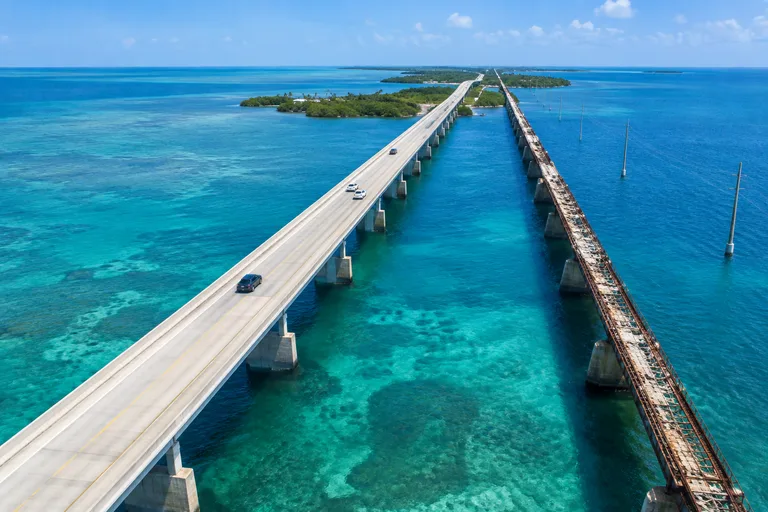
A Florida Keys road trip follows the Overseas Highway for 113 miles and 42 bridges, from Key Largo to Key West. The drive can be done in one day, but three to five days is the right length for a first trip. That leaves time to snorkel in Key Largo, feed tarpon in Islamorada, walk the Old Seven Mile Bridge at Marathon, swim at Bahia Honda and watch the sunset in Key West.
This guide lists the best Overseas Highway stops in order by mile marker, with a 5-day plan, things to do in Key West, where to stay, and the best time to visit the Florida Keys. For theme parks, the Everglades and the Gulf beaches, see the Florida travel guide.
Florida Keys Road Trip at a Glance
The route is simple: one road, U.S. Highway 1, runs the whole way. The official Florida Keys visitor site calls it the "Highway that Goes to Sea". These are the numbers to know before leaving.
| Quick fact | Details |
|---|---|
| Route | Overseas Highway (U.S. 1), Key Largo to Key West |
| Length | 113 miles and 42 bridges |
| Longest bridge | Seven Mile Bridge at Marathon, 6.79 miles |
| Start from Miami | Florida's Turnpike south to U.S. 1 in Florida City, then about 22 miles to Key Largo |
| Best length of trip | 3 to 5 days; a week with Dry Tortugas and extra beach time |
| Easiest season | December through April, the dry season |
| Scenic status | Florida's only All-American Road, named in 2009 |
Travel writers put the nonstop drive from Miami to Key West at a little over three hours. Traffic can add to that, so treat the clock loosely. As the official site puts it, a hurried drive misses the easygoing character of the place.
How the Overseas Highway and Its Mile Markers Work
Mile markers are the key to every stop on this trip. Small signs along the road count the miles left to Key West, from 127 near Florida City down to 0 at the end of the road. Locals give directions by "MM", and many street addresses match the marker. John Pennekamp Coral Reef State Park, at 102601 Overseas Highway, sits at Mile Marker 102.5.
The official visitor site divides the islands into five regions:
| Region | Mile markers | Known for |
|---|---|---|
| Key Largo | 108 to 90 | Reefs, snorkeling and diving; the gateway to the Keys |
| Islamorada | 90 to 63 | Sport fishing, tarpon and waterside dining |
| Marathon | 63 to 40 | Family stops, sea turtles and the Seven Mile Bridge |
| Big Pine Key and the Lower Keys | 40 to 4 | Quiet islands, Key deer and Bahia Honda |
| Key West | 4 to 0 | History, sunsets and the end of the road |
The road has a story of its own. Henry Flagler spent seven years building the Florida Keys Over-Sea Railroad from Miami to Key West, and the first train arrived in 1912. A hurricane in 1935 badly damaged the line and ended train service. The Overseas Highway opened three years later, in 1938, on a base that used some of the old railway spans. In 1982, 37 of the original bridges were replaced with wider ones. Some old spans still stand beside the new road, and the best known, Old Seven at Marathon, is now a walking and fishing pier.
Before the Keys: Miami, Tolls and Two National Parks
Most trips start at Miami International or Fort Lauderdale-Hollywood International Airport with a rental car. From Miami, take Florida's Turnpike south to U.S. 1 in Florida City. From Fort Lauderdale, take Interstate 595 west to the Turnpike and head south.
- Tolls: Florida's Turnpike Extension and Card Sound Road use cashless electronic tolling. Tolls are paid by SunPass, a compatible transponder or Toll-By-Plate, so ask the rental desk how it bills them.
- Fuel and supplies: Florida City is the last town before the Keys on this route. It is a sensible place to fill the tank and buy water and sunscreen.
- Flying one way: Key West International Airport has direct and connecting flights, so some travelers drive down and fly home. Check the rental company's one-way fee first.
- By sea: the Key West Express passenger ferry links Southwest Florida with Key West.
Two national parks sit near the start of the drive. Everglades National Park has an entrance near Homestead, covered in the Florida travel guide. Biscayne National Park is based in Homestead too, and the National Park Service presents it as a park of fish and their underwater world. Either makes a good half day before heading south. Check each park's site for boat tours and fees.
Contact, Biscayne National Park: 9700 SW 328th Street, Sir Lancelot Jones Way, Homestead, FL 33033. Phone: 786-335-3620. Web: nps.gov/bisc.
Overseas Highway Stops by Mile Marker
This table lists the main Overseas Highway stops in the order a southbound driver meets them. Nobody should try them all in one day. Pick two or three per day and leave room for an unplanned swim.
| Mile marker or address | Stop | Region | Time to allow |
|---|---|---|---|
| MM 102.5 | John Pennekamp Coral Reef State Park | Key Largo | Half a day with a boat tour |
| 93600 Overseas Highway | Laura Quinn Wild Bird Sanctuary | Tavernier | 45 minutes |
| MM 84.5 | Theater of the Sea | Islamorada | 2 to 3 hours |
| 82990 Overseas Highway | History of Diving Museum | Islamorada | 1 hour |
| MM 77.5 | Robbie's of Islamorada | Islamorada | 1 hour, more with a kayak |
| 58901 Overseas Highway | Dolphin Research Center | Grassy Key | 2 hours |
| 5550 Overseas Highway | Crane Point | Marathon | 1 to 2 hours |
| MM 48.5 | The Turtle Hospital | Marathon | 90 minutes with a program |
| Just past Marathon | Old Seven Mile Bridge and Pigeon Key | Marathon | 1 to 3 hours |
| MM 37 | Bahia Honda State Park | Lower Keys | 2 hours to a full day |
| 30587 Overseas Highway | National Key Deer Refuge | Big Pine Key | 1 to 2 hours |
| MM 0 | Key West | Key West | 2 to 3 days |
Key Largo: Reefs and the First Undersea Park
Key Largo is the first island of the drive, an easy hour from Miami, and the place to get in the water. The Florida Keys National Marine Sanctuary covers 3,800 square miles around the islands. NOAA says it holds the only coral barrier reef in the continental United States and more than 6,000 kinds of animals.
John Pennekamp Coral Reef State Park
John Pennekamp is the first undersea park in the United States and covers about 70 nautical square miles. Most of it is underwater, so the boat tours are the main event. The park's tour company runs these trips:
- Glass bottom boat: a 65-foot catamaran that carries up to 130 passengers, a good choice for young children and anyone who would rather stay dry.
- Snorkeling tours: about 2.5 hours round trip, with about an hour and a half in the water.
- Scuba trips: for certified divers. The Christ of the Deep statue and the Spiegel Grove wreck are the famous dive sites off Key Largo.
- Kayaks and canoes: rentals for the park's 50 miles of mangrove trails.
On land, the visitor center has a 30,000-gallon saltwater aquarium and a theater that shows nature films. There are swimming beaches, picnic areas, short walking trails and campsites, and beach wheelchairs are offered at no cost. Boat tours can sell out and can be cancelled by wind, so book ahead and keep the plan flexible. Check the official site for current tour times and prices.
Contact: 102601 Overseas Highway (MM 102.5), Key Largo, FL 33037. Phone: (305) 451-6300. Web: pennekamppark.com.
More Key Largo Stops
Film fans can climb aboard the African Queen, a piece of film history that the official visitor site says still sails today. A few miles on, in Tavernier, the Laura Quinn Wild Bird Sanctuary has a boardwalk past pelicans and other rescued birds that cannot return to the wild. The Florida Keys Wild Bird Center, which has been saving birds since 1988, runs it, and it is open from sunrise to sunset.
Contact, Laura Quinn Wild Bird Sanctuary: 93600 Overseas Highway, Tavernier, FL 33070. Phone: (305) 852-4486. Web: keepthemflying.org.
The Key Largo Chamber of Commerce runs a visitor center at 106000 Overseas Highway, Key Largo, FL 33037, phone 1-800-822-1088. See the official Key Largo page.
Islamorada: Tarpon, Fishing Boats and Diving History
Islamorada is a village of six islands between Key Largo and Marathon, and it calls itself the Sport Fishing Capital of the World. Anglers come for tarpon and bonefish on the flats and for mahi and sailfish offshore. Travelers who do not fish still find plenty to do.
Robbie's of Islamorada
Robbie's is the classic Keys roadside stop. Visitors buy a bucket of fish and hand-feed the big tarpon that gather at the dock. The marina also has an open-air market, a waterfront restaurant, and kayak and paddle board rentals. Paddling trips go to Indian Key and Lignumvitae Key, two small islands offshore.
Contact: 77522 Overseas Highway (MM 77.5, bayside), Islamorada, FL 33036. Phone: (305) 664-8070. Web: robbies.com.
Theater of the Sea
Theater of the Sea is a family-owned marine park that has welcomed visitors since 1946. Its lagoons and gardens are home to dolphins, sea lions, sea turtles, sharks, stingrays and parrots. General admission includes the dolphin, sea lion and parrot shows and access to a small lagoon beach. Check the official site for show times and prices.
Contact: 84721 Overseas Highway (MM 84.5), Islamorada, FL 33036. Phone: 305-664-2431. Web: theaterofthesea.com.
History of Diving Museum
This nonprofit museum tells the story of how people learned to work and explore underwater, with a focus on South Florida and the Keys. It is a smart stop on a rainy or windy day, when boat tours are cancelled.
Contact: 82990 Overseas Highway, Islamorada, FL 33036. Phone: (305) 664-9737. Web: divingmuseum.org.
The Islamorada Chamber of Commerce visitor center is at Mile Marker 87, bayside. Within the village, a free on-demand electric shuttle called Freebee can be called by app or phone.
Marathon: Dolphins, Sea Turtles and the Seven Mile Bridge
Marathon sits in the middle of the Keys, and the official visitor site calls it a top pick for family vacations. Three of the best family stops on the whole road are here, and the most famous bridge begins at its western edge.
Dolphin Research Center
The Dolphin Research Center on Grassy Key is a nonprofit education and research center founded in 1984. Dolphins, California sea lions and harbor seals live here, along with parrots and tortoises. Its stated goal is peaceful coexistence between marine mammals, people and the sea they share. Check the official site for hours and for what general admission includes.
Contact: 58901 Overseas Highway, Grassy Key, FL 33050. Phone: (305) 289-1121. Web: dolphins.org.
Crane Point
Crane Point protects 63 acres of hardwood hammock in the middle of town. Boardwalks and trails lead to a small museum, butterfly gardens, the Adderley House of 1904 and the Marathon Wild Bird Center. It is a shady break from the sun and the road.
Contact: 5550 Overseas Highway, Marathon, FL 33050. Phone: 305-743-9100. Web: cranepoint.net.
The Turtle Hospital
The Turtle Hospital is a working veterinary hospital for sick and injured sea turtles. Its motto is "Rescue, rehab, release". The hospital sits on the grounds of the old Hidden Harbor Motel, and its old rooms now house rehab staff. The hospital takes reservations for its educational programs, so reserve ahead by phone or on the official site.
Contact: 2396 Overseas Highway (MM 48.5), Marathon, FL 33050. Phone: (305) 743-2552. Web: turtlehospital.org.
The Seven Mile Bridge and Old Seven
The Seven Mile Bridge is the highlight of the drive. The modern bridge opened in 1982, runs 6.79 miles and has 440 spans, with open water on both sides the whole way. Beside it stands the old bridge, built for Flagler's railroad and turned into a road in 1938.
A restored 2.2-mile section of the old bridge, known as Old Seven, is closed to cars and open for walking, running, biking and fishing. It ends at Pigeon Key, a 5-acre island where up to 400 railroad workers lived from 1908 to 1912. Today the island is a National Historic Landmark with a small museum and guided tours. Each April the Seven Mile Bridge Run brings up to 1,500 runners to the bridge, so check the date when planning a spring trip.
The Greater Marathon Chamber of Commerce visitor center is at 12222 Overseas Highway, Marathon, FL 33050, phone 1-800-262-7284.
Big Pine Key and the Lower Keys: Beaches and Key Deer
West of the Seven Mile Bridge the islands grow quieter. The official visitor site calls the Lower Keys the most unspoiled part of the chain. This is the stretch for beaches, wildlife and dark night skies.
Bahia Honda State Park
Bahia Honda is the best beach stop on the Overseas Highway. The park covers more than 500 acres at Mile Marker 37 and is known for its award-winning beach and its historic bridge. The park's concession runs a snack bar, a gift shop, kayak rentals and daily snorkeling tours to the reef at Looe Key, which the official visitor site names as one of the most colorful reefs in the Keys. Check the official state park page for entrance fees, camping and any beach closures.
Contact: 36850 Overseas Highway (MM 37), Big Pine Key, FL 33043. Phone: 305-872-3210. Web: bahiahondapark.com.
National Key Deer Refuge
The National Key Deer Refuge was set up in 1957 to protect the endangered Key deer and 22 other threatened or endangered species. The refuge covers about 9,200 acres, and the deer wander freely through it and through the neighborhoods of Big Pine Key. The U.S. Fish and Wildlife Service says early morning and the hour before sunset are the best times to see them.
- Blue Hole: an old limestone quarry filled with fresh water, three miles north of U.S. 1 on Key Deer Boulevard. A short, shaded, paved path leads to a viewing platform. Look for alligators, ospreys and wading birds.
- Watson Trail: a loop of about two thirds of a mile through pine rockland and hammock, a quarter mile past Blue Hole.
- Mannillo Trail: an 800-foot path of crushed limestone with benches and a platform over a wetland.
- Nature center: on the Overseas Highway, with maps and advice. Check the official site for its open days.
The refuge is free to visit and open from half an hour before sunrise to half an hour after sunset. Drive slowly in deer country, pull fully off the road to watch wildlife, and keep dogs on a leash.
Contact: 30587 Overseas Highway, Big Pine Key, FL 33043. Phone: (305) 872-0774. Web: fws.gov/refuge/national-key-deer.
The Lower Keys Chamber of Commerce visitor center is at 31020 Overseas Highway, Big Pine Key, FL 33043, phone 1-800-872-3722.
Things to Do in Key West
Key West is the reward at Mile Marker 0. The best things to do in Key West are the sunset celebration at Mallory Square, the Ernest Hemingway Home, the Truman Little White House, the Southernmost Point and a slow walk through Old Town. Give it at least two full days.
Ernest Hemingway Home and Museum
The writer's former home on Whitehead Street is one of the island's iconic attractions. Cats roam the house and garden, and some descend from Snow White, a white six-toed cat that a ship's captain gave to Hemingway. The museum is open daily. Check the official site for current hours, rates and tour details.
Contact: 907 Whitehead Street, Key West, FL 33040. Phone: (305) 294-1136. Web: hemingwayhome.com.
Harry S. Truman Little White House
Florida's only presidential museum began in 1890 as the command headquarters of the naval station. It became President Truman's winter retreat in 1946, and he spent 175 days here between 1946 and 1952. The museum is open daily for guided tours. Check the official site for times and prices.
Contact: 111 Front Street, Key West, FL 33040. Phone: (305) 294-9911. Web: trumanlittlewhitehouse.org.
Mallory Square Sunset Celebration
Every evening, about one hour before sunset, crowds gather at the water's edge in Mallory Square. Street performers, craft sellers and food carts fill the dock while the sun drops into the Gulf. It is the signature Key West experience and an easy win for families. Arrive early for a spot at the rail. The Sunset Celebration site has details.
More Key West Favorites
- The Southernmost Point: the marker for the southernmost point in the continental United States. Go early in the day for a calmer visit.
- Duval Street: the famous main street of Old Town, known for live music.
- Fort Zachary Taylor Historic State Park: a historic fort with a beach for snorkeling and sunsets.
- Key West Butterfly and Nature Conservatory: hundreds of free-flying butterflies under a glass dome, plus two flamingos. Find it at 1316 Duval Street, Key West, FL 33040, phone (305) 296-2988, keywestbutterfly.com.
- Key lime pie: the classic Keys dessert turns up on menus along the whole road. Trying a slice or two is part of the trip.
The Greater Key West Chamber of Commerce is at 510 Greene Street, Key West, FL 33040, phone 1-800-527-8539. See the official Key West page. From March through October, sea turtles nest on local beaches, and the city asks visitors to follow its beach and lighting rules.
Day Trip to Dry Tortugas National Park
Dry Tortugas National Park lies about 70 miles west of Key West, and no road reaches it. The National Park Service says visitors arrive by ferry, seaplane, private boat or permitted charter. The park is a cluster of seven small islands. Its centerpiece, Fort Jefferson on Garden Key, is one of the largest masonry forts of the 1800s in the nation.
Most visitors take the Yankee Freedom, the park's authorized ferry. Its day runs like this:
- check in at 7:00 AM and depart at 8:00 AM;
- arrive at Fort Jefferson about 10:15 AM;
- join the narrated fort tour, eat lunch, then swim or snorkel off the beach with the gear provided;
- leave the park at 3:00 PM and reach Key West about 5:15 PM.
The ferry fare includes the park entrance fee. Seats are limited, so book as soon as the trip dates are set. The park itself does not accept cash, and services are very limited. Bring sun protection, a towel and a change of clothes.
Contact, Yankee Freedom ferry: 100 Grinnell Street, Key West, FL 33040. Phone: 800-634-0939. Web: drytortugas.com. Park information: 305-242-7700 and nps.gov/drto.
A 5-Day Florida Keys Road Trip Plan
This plan suits a first visit, and it works for families and couples alike. It puts a water activity early in each day, leaves the afternoons loose, and keeps each day's driving short.
| Day | Route | Main stops | Sleep |
|---|---|---|---|
| 1 | Miami to Key Largo and Islamorada | Morning snorkel or glass bottom boat at John Pennekamp; Laura Quinn Wild Bird Sanctuary; sunset in Islamorada | Islamorada |
| 2 | Islamorada to Marathon | Tarpon at Robbie's; History of Diving Museum or Theater of the Sea; Dolphin Research Center; the Turtle Hospital | Marathon |
| 3 | Marathon to Key West | Sunrise walk on Old Seven; drive the Seven Mile Bridge; beach time at Bahia Honda; Key deer at Blue Hole near sunset | Key West |
| 4 | Key West | Southernmost Point early; Hemingway Home; Truman Little White House; Mallory Square at sunset | Key West |
| 5 | Dry Tortugas or Key West | Ferry to Fort Jefferson, or a beach morning at Fort Zachary Taylor and the Butterfly Conservatory | Key West, or drive back |
With 3 days: combine days 1 and 2 with a night in Marathon, drive to Key West on day 2, and spend day 3 in Key West. With a week: add a second night in Islamorada for a fishing charter and a full beach day at Bahia Honda. The site's list of best fishing trips in the USA includes the Florida Keys.
Remember the drive back. Allow at least half a day to return to Miami, and use it for one or two stops that were missed on the way down.
Where to Stay on a Florida Keys Road Trip
Splitting the nights is the best approach: one or two nights in the Upper or Middle Keys, then the rest in Key West. Each area has its own feel.
- Key Largo: best for divers and snorkelers who want an early boat.
- Islamorada: best for couples, anglers and waterfront resorts.
- Marathon: best for families, with a central spot for day trips in both directions.
- Lower Keys: best for campers and quiet seekers. The official site lists waterfront campgrounds and cozy cottages here.
- Key West: best for walkers. Lodging runs from Victorian bed and breakfasts to oceanfront resorts.
Book early for the dry season, from December through April, and for holiday weekends. For current listings, use the official Florida Keys visitor site. Travelers on a budget can find more ideas in this guide to low-cost vacations in the USA.
Best Time to Visit the Florida Keys
The best time to visit the Florida Keys is the dry season, from December through April. The National Weather Service says those months bring just under a quarter of the year's rain. The wet season, June through October, brings about 65 percent. May and November are in-between months.
| Month | Average high in Key West | Average low | Water temperature |
|---|---|---|---|
| January | 75°F | 65°F | 69°F |
| March | 79°F | 69°F | 75°F |
| May | 85°F | 76°F | 83°F |
| July | 89°F | 80°F | 87°F |
| September | 88°F | 79°F | 86°F |
| November | 80°F | 71°F | 76°F |
The figures come from the official Florida Keys weather page. A few points help with the choice:
- Winter is almost completely dry. The water is cooler, and snorkelers often wear a short wetsuit.
- Summer is hot and the water is warmest. Showers start in late May and rarely last all day.
- Hurricane season runs from June 1 to November 30, with the highest storm potential from August 15 to October 15. Buy flexible bookings and watch the forecast in those months.
Hidden Gems Along the Overseas Highway
The famous stops are famous for good reason, but these quieter places give a truer sense of the Keys. Each one is a hidden gem that most drivers pass at full speed.
- Blue Hole at dusk: the official visitor site calls it the largest body of fresh water in the Keys. Watch for deer along Key Deer Boulevard on the way in.
- Indian Key and Lignumvitae Key: two small islands reached by kayak trips from Robbie's, a side of the Keys that drivers never see from the road.
- Pigeon Key: the little island under the old bridge. The walk out is as good as the museum.
- The Laura Quinn boardwalk: a calm, short stop that most cars skip on the way to Islamorada.
- Crane Point's Adderley House: a simple home of 1904 hidden in the hammock, a rare look at life here before the railroad.
- Green Turtle Hammock Nature Preserve: short hammock trails and bay views in Islamorada.
- The Lower Keys after dark: the official site recommends stargazing here, far from city lights.
- Underwater pumpkin carving: Key Largo's odd contest appears in this list of weird competitions in the USA.
Insider Tips for the Drive
- Learn "bayside" and "oceanside". Heading south, the bay or Gulf is on the right and the Atlantic is on the left. Addresses and directions use those words.
- Book the big three first. The Dry Tortugas ferry, Pennekamp boat tours and Turtle Hospital programs fill before anything else.
- Keep a backup for windy days. Boat tours depend on the weather. Hold an indoor stop, such as the History of Diving Museum, in reserve.
- Carry a card. Tolls on the mainland are cashless, and Dry Tortugas National Park does not accept cash.
- Slow down on Big Pine Key. Key deer wander freely, and they are most active early in the morning and near sunset.
- Walk Old Seven at sunrise or sunset. Bring water and a hat for the walk.
- Park once in Key West. Old Town is compact, and the visitor site lists park and ride and car-free options.
- Eat along the way. The Keys are one of the routes in this guide to the best restaurant road trips.
- Pack for sun and salt. Sunscreen, a hat, water shoes and a dry bag earn their place. This weekend getaway packing list covers the basics.
Frequently Asked Questions
How long does a Florida Keys road trip take?
Plan three to five days for a first Florida Keys road trip. The Overseas Highway itself is only 113 miles from Key Largo to Key West, so the drive can be done in a day. The stops are the point, though. Five days allow one night in the Upper or Middle Keys, two or three in Key West and a day for Dry Tortugas National Park.
How many miles is the drive from Key Largo to Key West?
The Overseas Highway runs 113 miles from Key Largo to Key West and crosses 42 bridges. From Florida City on the mainland, the official visitor site says it is about 22 more miles to Key Largo. Mile markers count down from 127 near Florida City to 0 in Key West.
What are the best Overseas Highway stops?
The best Overseas Highway stops are John Pennekamp Coral Reef State Park in Key Largo, Robbie's of Islamorada, the Dolphin Research Center and the Turtle Hospital in Marathon, the Old Seven Mile Bridge, Bahia Honda State Park and the National Key Deer Refuge on Big Pine Key. Key West waits at Mile Marker 0.
What is the best time to visit the Florida Keys?
The dry season from December through April is the easiest time to visit the Florida Keys, with average highs of 75 to 82 degrees in Key West. May and November are transition months. The wet season runs from June through October, and hurricane season lasts from June 1 to November 30, with the highest storm potential from mid August to mid October.
How do mile markers work in the Florida Keys?
Small signs along the Overseas Highway count the miles to Key West. They run from 127 near Florida City down to 0 in Key West. Locals give directions by mile marker, and many street addresses match it. Key Largo covers markers 108 to 90, Islamorada 90 to 63, Marathon 63 to 40, the Lower Keys 40 to 4 and Key West 4 to 0.
Can you walk on the Seven Mile Bridge?
Not on the modern bridge, which carries traffic. Next to it, a restored 2.2-mile section of the Old Seven Mile Bridge at Marathon is open for walking, running, biking and fishing. It leads to Pigeon Key, a small historic island that once housed railroad workers.
Are there tolls on the way to the Florida Keys?
Yes, on the way there. The official Keys visitor site says Florida's Turnpike Extension and Card Sound Road use cashless electronic tolling, paid by SunPass, a compatible transponder or Toll-By-Plate. Ask the rental car company how it bills tolls before leaving the lot.
Do you need a car in Key West?
A car is needed for the drive down, but not for Old Town Key West itself. The main sights sit close together, and the official visitor site lists park and ride lots, on-demand local transit and other car-free options. Many travelers park once at their lodging and walk or cycle.
How do you get to Dry Tortugas National Park?
There are no roads to Dry Tortugas National Park, which lies about 70 miles west of Key West. The National Park Service says visitors travel by ferry, seaplane, private boat or permitted charter. The Yankee Freedom ferry leaves from 100 Grinnell Street in Key West. Book well ahead, and note that the park does not accept cash.
Is a Florida Keys road trip good for families?
Yes. Drives between stops are short, and many stops suit children: the glass bottom boat at John Pennekamp, tarpon feeding at Robbie's, the Turtle Hospital, the Dolphin Research Center, the beach at Bahia Honda and the Key West Butterfly and Nature Conservatory. The official visitor site calls Marathon a top pick for family vacations.
Planning your next U.S. getaway? Explore more destination guides, road trips, and travel tips at Vacation Getaways US. Have a question or a spot we should cover? Email us at [email protected].