
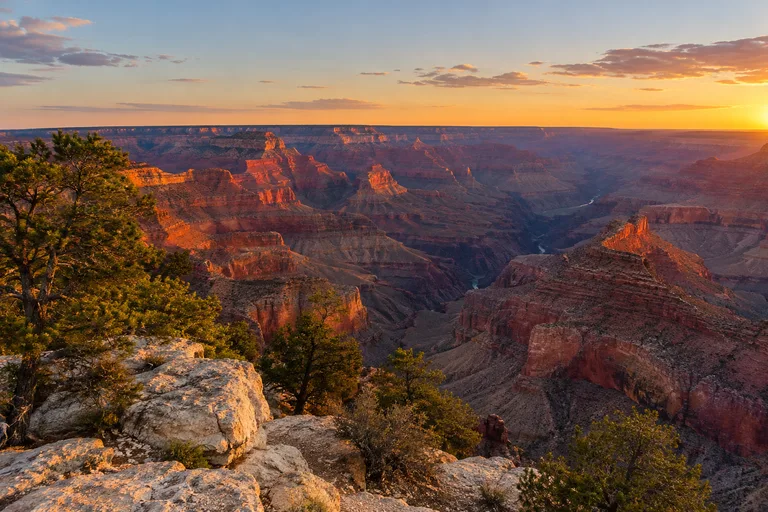
The Grand Canyon has three rims that travelers talk about, and each one is a very different trip. The South Rim is the heart of the national park, open all year with the most viewpoints, trails and services. The North Rim is higher, quieter and seasonal, and it is still recovering from the 2025 Dragon Bravo Fire. Grand Canyon West, home of the Skywalk, is run by the Hualapai Tribe, not the National Park Service. For a first visit, this Grand Canyon travel guide points most families and couples to the South Rim.
This guide compares the three rims side by side and shares what the park says about the North Rim today. It also covers fees, the free shuttles and the best things to do. Then come the best time to visit and a Grand Canyon day trip from Phoenix. For the rest of the state, see the Arizona travel guide.
Grand Canyon at a Glance
| Question | Short answer |
|---|---|
| Where is it? | Northern Arizona; the South Rim is 63 miles north of Williams and 81 miles from Flagstaff |
| How big is it? | About a mile deep, and an average of 10 miles from rim to rim |
| Main area | South Rim, open 24 hours a day, 365 days a year |
| North Rim | Seasonal; road closed to vehicles December 1 to May 14; limited day use in fall 2026 |
| Grand Canyon West | Skywalk and viewpoints on the Hualapai Reservation, outside the national park |
| Entrance | Pass required for every visitor, no timed entry, cards only at the gates |
| Getting around | Free South Rim shuttle buses, included with park entrance |
| Time needed | One full day for the South Rim highlights; two days to add a hike and Desert View Drive |
Contact: Grand Canyon National Park, PO Box 129, Grand Canyon, AZ 86023 (park mailing address). Phone: 928-638-7888. Web: nps.gov/grca.
South Rim vs North Rim vs West Rim: Side by Side
The short answer to South Rim vs North Rim is simple for most travelers: pick the South Rim. It is open all year and closest to Phoenix and the interstates. The North Rim rewards return visitors in its short season. Grand Canyon West suits travelers based in Las Vegas who want the glass Skywalk.
| South Rim | North Rim | West Rim (Grand Canyon West) | |
|---|---|---|---|
| Who runs it | National Park Service | National Park Service | Hualapai Tribe, through Grand Canyon Resort Corporation |
| Season | Open all year, 24 hours a day | Seasonal; vehicles barred December 1 to May 14 | Open daily; check the official site for hours |
| Height above sea level | About 7,000 feet | About 8,000 feet | Not listed by the operator |
| Nearest big city | Phoenix, 231 miles; Las Vegas, 278 miles | About 212 miles by road from the South Rim | Las Vegas, about a two-hour drive (operator figure) |
| Services in late 2026 | Lodges, restaurants, visitor centers, free shuttles | None in fall 2026; no food or drinking water | Food, shuttles, zipline and cabins on site |
| Ticket | National park entrance pass | National park entrance pass | Grand Canyon West passes; Skywalk not in General Admission |
| Best for | First visits, families, hikes, sunrise and sunset | Quiet forest views in season, return visitors | The Skywalk and a day trip from Las Vegas |
One more difference matters for planning. The South Rim and the North Rim face each other across the canyon, but no road crosses it. The park puts the drive between the two villages at about 4.5 to 5 hours.
Is the North Rim Open? What the Park Service Says Now
The Dragon Bravo Fire began with a lightning strike on July 4, 2025, and burned across the North Rim. On July 12, 2025, an aerial assessment found severe damage and loss of buildings in the park's administration area. The next day, the park confirmed that the historic Grand Canyon Lodge, the North Rim Visitor Center and many historic cabins were destroyed.
Here is exactly what the National Park Service says on its North Rim status page, last updated November 16, 2026:
- Status: "OPEN through Nov. 30, 2026 (or the first major snowstorm of the season)."
- Campground: the North Rim Campground has closed for the 2026 season. The tentative reopening date is May 15, 2027.
- Fuel: there is no fuel on the North Rim. Gas is available at the North Rim Country Store and Jacob Lake.
- Lodging: overnight lodging is available outside the park.
- Trails: the Bridle Trail is open from the North Kaibab Trailhead to the former Grand Canyon Lodge parking area. The overlook above Angels Window is closed.
The park's conditions pages add more detail for this fall. They describe the North Rim as "Limited Fall Day-use Only" with "NO SERVICES." The park also says drinking water and food are not available from October 16 through November 30, 2026. Bring everything you need for the day, and fill the tank before you leave the highway.
The entire North Kaibab Trail is closed after flash flooding on August 29, 2026, with no estimated reopening. From December 1 to May 14 each year, the North Rim and State Route 67 are closed to all vehicles.
Conditions change quickly here, so read the North Rim status page on the day you plan to drive. The park also keeps a road recording at 928-638-7496.
How to Reach the North Rim
The North Rim Entrance Station sits on State Route 67, 30 miles south of Jacob Lake. The rim area is 14 miles beyond the gate. From the South Rim, the park's route runs east out the East Entrance on State Route 64 to Cameron. Then it follows Highway 89 north to Bitter Springs, Highway 89A west to Jacob Lake, and Highway 67 south. That is about 212 miles, or about 4.5 hours.
Grand Canyon West and the Skywalk
Grand Canyon West is not part of Grand Canyon National Park. It sits on the sovereign Hualapai Reservation. Its official site says Grand Canyon Resort Corporation "is owned and operated by the Hualapai Tribe in Peach Springs, AZ." The National Park Service also notes that the Skywalk is on tribal land outside the park. Plan it as a separate trip with its own tickets.
The site groups its viewpoints into three areas:
- Eagle Point: home to the Skywalk, Eagle Rock and a Native American village.
- Guano Point: wide canyon views and short hiking trails.
- Hualapai Point: a zipline, cabins and food. Hualapai Ranch offers overnight stays and horseback riding.
Grand Canyon West sells its own passes. General Admission covers Eagle Point, Guano Point and the shuttle, but it does not include the Skywalk. Higher passes add the Skywalk and other activities. Prices and hours change, so check the official site before you go.
The operator describes Grand Canyon West as about a two-hour drive from Las Vegas. Its hours run on Arizona time. From early November to mid-March, Arizona is one hour ahead of Las Vegas; the rest of the year the clocks match. The rafting gateway town of Peach Springs is about two hours away by road.
Contact: Grand Canyon West, 5001 E. Diamond Bar Road, Meadview, AZ 86444. Phone: 1-888-868-9378 or 928-769-2636. Web: grandcanyonwest.com.
The Waterfalls of Havasupai are also on tribal land outside the national park. They are not covered in this guide.
Entrance Fees, Passes and Reservations
Every visitor to the national park needs an entrance pass. No reservation or timed entry is needed to drive in. Fees change, so check the official fees page before you go. In November 2026 the park listed these options:
- Private vehicle, 7 days: $35, covering everyone in one vehicle.
- Motorcycle, 7 days: $30.
- Per person, 7 days: $20 for hikers, cyclists and walkers.
- Grand Canyon annual pass: $70, for this park only.
- America the Beautiful pass: covers this park and other federal sites, with resident, senior and nonresident versions.
Visitors who are not U.S. residents and are 16 or older pay an extra $100 per person. The exception is anyone entering on an annual pass or an America the Beautiful pass. The entrance stations take cards only, not cash. Automated fee machines in Williams, Valle and Tusayan let drivers buy a pass before reaching the gate.
Lodging and camping are different. The park strongly recommends reservations for South Rim lodging and camping in spring, summer and fall. Details are on the Grand Canyon fees and passes page.
Getting to the Grand Canyon
Most visitors drive to the South Rim. The South Entrance, just north of Tusayan, and the East Entrance at Desert View are both open 24 hours a day, all year. Here are the park's own distances and routes to the South Rim:
| From | Distance | Route |
|---|---|---|
| Phoenix | 231 miles | I-17 north to Flagstaff, I-40 west to Williams, Highway 64 north |
| Flagstaff | 81 miles | I-40 west to Williams and Highway 64 north; or Highway 180 to Valle; or Highway 89 to Cameron and the East Entrance |
| Williams | 63 miles | Highway 64 north |
| Las Vegas | 278 miles | Highway 93 south to Kingman, I-40 east to Williams, Highway 64 north |
Flying In
- Phoenix, Flagstaff and Las Vegas have commercial flights.
- Grand Canyon Airport, about 7 miles south of the park, has limited air service.
- Amtrak serves Flagstaff, with connecting bus service to the canyon.
The Grand Canyon Railway
For a day without driving the last stretch, take the Grand Canyon Railway. It runs a daily train from Williams to the historic depot in Grand Canyon Village. Riders get over three hours at the South Rim before the train heads back. Departure times change by season, so check the official site.
Contact: Grand Canyon Railway Hotel, beside the Williams Depot, 233 N. Grand Canyon Blvd., Williams, AZ 86046. Phone: 1-800-843-8724. Web: thetrain.com.
Getting Around the South Rim: Free Shuttles
The South Rim has free shuttle buses, included with the entrance fee. The park suggests parking once and riding to trails and viewpoints. The Visitor Center Shuttle Bus Terminal is the main transfer point. In fall 2026, four routes ran from September 12 through November 30:
- Village (Blue): loops between the visitor center, lodges, campgrounds, the Backcountry Information Center and Market Plaza.
- Kaibab Rim (Orange): goes east to South Kaibab Trailhead, Yaki Point and Pipe Creek Overlook, and west to Mather Point and the Yavapai Geology Museum.
- Hermit Road (Red): serves the 7-mile Hermit Road and its overlooks.
- Hikers' Express: early morning buses from Bright Angel Lodge to South Kaibab Trailhead.
The Tusayan (Purple) route runs only in summer, between the town of Tusayan and the visitor center. Times change by season, so check the park's shuttle page. Expect lines at busy times of day.
Best Things to Do on the South Rim
The South Rim packs a lot into a small area. Most of the best things to do are short walks or shuttle rides from Grand Canyon Village.
Grand Canyon Visitor Center and Mather Point
The Grand Canyon Visitor Center is the natural first stop, with the main shuttle terminal and a park store. Mather Point sits nearby and is the classic first look into the canyon. The park lists it as a good place to start a walk along the rim. Visitor center hours change by season, so check the official site.
Rim Trail and the Trail of Time
The park describes the Rim Trail as well defined and mostly level. It is the easiest way for families to see many viewpoints without a car. Along the way, the Trail of Time runs 1.2 miles between the Yavapai Geology Museum and Verkamps Visitor Center. It displays samples of the canyon's rock layers along the path.
Hermit Road
Hermit Road is a 7-mile scenic road west of the village with 9 overlooks. From March 1 through November 30 it is closed to private cars, so the free Red shuttle is the way to ride it. Walkers and cyclists can use it all year. In December, January and February, private vehicles may drive it unless snow closes the road.
Desert View Drive
Desert View Drive runs 23 miles east from Grand Canyon Village to Desert View and the East Entrance. Every viewpoint has parking. From west to east, the named stops are:
- Pipe Creek Vista
- Duck on a Rock
- Grandview Point
- Moran Point
- Lipan Point: closed to all visitors from June 22 to December 23, 2026, for repair work.
- Navajo Point
- Desert View: a quarter-mile walk from the parking area to the rim, past the historic Desert View Watchtower. The view takes in the Colorado River as it bends west.
Yaki Point, near the start of the drive, is reached only on foot, by bike or on the Orange shuttle. Tusayan Pueblo, about 3 miles west of Desert View, holds the remains of a small Ancestral Puebloan village with a self-guiding trail. It is open seasonally, so check the Desert View Drive page.
Mule Rides, Rafting and Bikes
- Mule rides: the Canyon Vistas Ride is a 2-hour trip along the rim. The Havasupai Gardens Ride is a 7-hour trip with a sack lunch. Overnight rides to Phantom Ranch are cancelled through February 2027.
- Smooth-water rafting: half-day and full-day trips float from Glen Canyon Dam to Lees Ferry, near Page, with transport from the lodges.
- Whitewater rafting: trips through the canyon last 3 to 21 days and need an advance booking or a weighted lottery entry.
- Bikes: rentals and guided rides are available near the visitor center, and Hermit Road stays open to cyclists.
Ranger Programs and Junior Rangers
Rangers lead programs on the South Rim, and the park posts each day's schedule on its digital calendar. Kids can earn a Junior Ranger badge, which makes a good goal for a family day on the rim.
Hiking Below the Rim
A short walk below the rim is the best way to feel the canyon's size. The key rule is that the way down is the easy part. The park says temperatures rise about 5.5 degrees for every 1,000 feet you drop. In summer, it advises against hiking between 10 am and 4 pm.
Bright Angel Trail
The Bright Angel Trail starts in Grand Canyon Village and is open from the trailhead to the River Resthouse. Along the way are the Mile-and-a-Half and Three-Mile resthouses, so pick a turnaround point before you start. From November 18, 2026, rock work may cause delays of 30 to 45 minutes just above Three-Mile Resthouse.
South Kaibab Trail
The South Kaibab Trail starts east of the village and is reached by the Orange shuttle or the Hikers' Express. The park lists it as open, but the bridges across the river are closed. Confirm current conditions before any long hike.
Water and Closures
- Water: drinking water is available at the Bright Angel and South Kaibab trailheads. The inner-canyon stations at Havasupai Gardens and both resthouses are turned off.
- Phantom Ranch: fully closed, including Bright Angel Campground, the canteen and the cabins, with no estimated reopening.
- Bridges and North Kaibab: the Black and Silver bridges are closed, and so is the whole North Kaibab Trail.
Carry plenty of water and a way to treat more. Read the park's key hiking messages the morning you hike.
Best Time to Visit the Grand Canyon
The best time to visit the Grand Canyon for most families and couples is spring or fall. The rim is mild, and the inner canyon is not at its summer peak. The canyon's height changes everything. The South Rim sits at about 7,000 feet, the North Rim at about 8,000 feet, and Phantom Ranch at about 2,400 feet.
| Season | South Rim weather (park figures) | Good to know |
|---|---|---|
| Spring | Highs in the 50s and 60s in April, warming to the 70s and 80s by June; frosty nights into May | Dry season; North Rim road opens May 15 in a normal year |
| Summer | Highs generally in the 80s; inner canyon over 100 degrees | Busiest season; storms in July, August and early September, mostly 11 am to 6 pm |
| Fall | Highs in the 60s in September, falling to the 50s by November; nights below freezing | Fewer crowds; North Rim limited to day use in fall 2026 |
| Winter | Highs in the 40s, lows in the teens; heavy snow some years | Quiet rim and snowy views; Hermit Road open to cars; North Rim closed |
Sunrise and sunset are the busiest times at the viewpoints, and for good reason. The low light brings out the colors in the rock. In winter, the park says roads may close for a time while snow is cleared. Call the road recording at 928-638-7496 before you drive.
Grand Canyon Day Trip from Phoenix
A Grand Canyon day trip from Phoenix is possible, but it is a long day. The park lists the South Rim at 231 miles from Phoenix, about a four-hour drive each way. That leaves roughly half the day for the canyon itself. Here is a simple plan:
- Leave Phoenix before sunrise. Take I-17 north to Flagstaff, I-40 west to Williams and Highway 64 north to the South Entrance.
- Buy the pass ahead at the fee machine in Williams, or have a card ready, since the gates take no cash.
- Park at the visitor center and walk to Mather Point.
- Walk the Rim Trail west toward Yavapai Geology Museum and Grand Canyon Village.
- Ride the Red shuttle on Hermit Road in season, or drive part of Desert View Drive.
- Head south by late afternoon so most of the drive home is in daylight.
Two tips make the day easier. First, the Grand Canyon Railway from Williams lets the driver rest for part of the trip. Second, one night in Tusayan, Williams or Flagstaff turns a rushed day into an easy two-day visit with sunrise included.
Grand Canyon Itineraries
One Day on the South Rim
- Morning: sunrise at Mather Point, then the Rim Trail and the Trail of Time to the Yavapai Geology Museum.
- Midday: lunch in Grand Canyon Village and a short walk down the Bright Angel Trail.
- Afternoon: the Red shuttle along Hermit Road, stopping at a few of its 9 overlooks.
- Evening: sunset from a Hermit Road overlook, then the shuttle back to the village.
Two Days: South Rim and Desert View
- Day 1: follow the one-day plan above.
- Day 2: drive Desert View Drive east, stopping at Grandview, Moran and Navajo points, Tusayan Pueblo in season and the Desert View Watchtower. Leave by the East Entrance.
Five Days: Northern Arizona Loop
This loop links the Grand Canyon with Sedona and Page, starting and ending in Phoenix.
- Day 1, Phoenix to Sedona: red rock hikes and scenic drives. See the Sedona guide for first-time visitors.
- Day 2, Sedona to the South Rim: drive north through Flagstaff and reach the rim for sunset.
- Day 3, South Rim: the Rim Trail, Hermit Road and a short hike below the rim.
- Day 4, Desert View Drive to Page: leave by the East Entrance, follow Highway 64 to Cameron and Highway 89 north to Page.
- Day 5, Page: a guided Antelope Canyon tour and the Horseshoe Bend overlook, then the drive back to Phoenix.
Where to Stay Near the Grand Canyon
Staying inside the park puts sunrise a short walk away. Grand Canyon Village has several historic lodges, and the park strongly recommends booking early for spring, summer and fall.
| Base | Distance to the South Rim | Good for |
|---|---|---|
| Grand Canyon Village | In the park | Sunrise and sunset on foot, shuttles at the door |
| Mather Campground | In the park | Families who camp; reservations highly encouraged |
| Tusayan | Just south of the South Entrance | The closest town, with the summer Purple shuttle |
| Williams | 63 miles | The Grand Canyon Railway and Route 66 |
| Flagstaff | 81 miles | A bigger town with the airport and Amtrak |
Desert View Campground is closed for the rest of 2026. The park lists its 2027 season as April 10 through October 15, 2027, with reservations required. For the North Rim, the park says overnight lodging is available outside the park.
Hidden Gems at the Grand Canyon
Most visitors stop at Mather Point and Grand Canyon Village. These quieter spots reward a little extra time:
- Tusayan Pueblo: a small Ancestral Puebloan village site with a self-guiding trail on Desert View Drive, open in season.
- Navajo Point: the last named viewpoint before Desert View, a good stand-in while Lipan Point is closed.
- Duck on a Rock and Pipe Creek Vista: two of the first stops on Desert View Drive, easy to add on the way east.
- The Trail of Time: a flat 1.2-mile walk that turns the rock layers into a timeline kids can follow.
- Hermit Road by bike: from March through November, the road is closed to private cars, so cyclists share it mainly with shuttles.
- Yaki Point: closed to private cars, and reached on foot, by bike or on the Orange shuttle.
- The North Rim Bridle Trail: open in season from the North Kaibab Trailhead to the former Grand Canyon Lodge parking area.
Insider Tips for Visiting the Grand Canyon
- Bring a card. The entrance stations do not take cash.
- Park once. Leave the car at the visitor center and let the free shuttles do the work.
- Check three pages the morning you go: the North Rim status page, the key hiking messages and the shuttle schedule.
- Turn around early on hikes. The climb out takes far longer than the walk down.
- Carry more water than you think. Most inner-canyon taps are off.
- Plan for Lipan Point. It is closed through December 23, 2026, so pick Navajo Point or Moran Point instead.
- Fuel up for the North Rim. There is no gas at the rim; the nearest is at the North Rim Country Store and Jacob Lake.
- Watch the clock at Grand Canyon West. Its hours run on Arizona time, one hour ahead of Las Vegas in winter.
- Book rooms early. In-park lodges fill fast in spring, summer and fall.
Frequently Asked Questions About the Grand Canyon
Which rim of the Grand Canyon is best for a first visit?
The South Rim. It is open 24 hours a day all year, has free shuttles, the main visitor center, two scenic drives and the most lodging. The North Rim is seasonal with very limited services after the 2025 fire, and Grand Canyon West is a separate tribal attraction.
Is the North Rim of the Grand Canyon open?
The National Park Service North Rim status page was last updated November 16, 2026. It lists the North Rim as open through November 30, 2026, or until the first major snowstorm. Fall visits are limited day use with no services, food or drinking water. The campground is closed until a tentative May 15, 2027 reopening. Check the page before you go.
What is the difference between the South Rim and the North Rim?
The South Rim sits at about 7,000 feet, is open all year and has nearly all the services. The North Rim sits at about 8,000 feet and closes to vehicles from December 1 to May 14. It lost Grand Canyon Lodge in the 2025 Dragon Bravo Fire. The drive between them is about 212 miles.
Is Grand Canyon West part of Grand Canyon National Park?
No. Grand Canyon West, home of the Skywalk, is on the Hualapai Reservation and is owned and operated by the Hualapai Tribe through Grand Canyon Resort Corporation. It sells its own tickets. The National Park Service notes that the Skywalk is on tribal land outside the national park.
Can you do a Grand Canyon day trip from Phoenix?
Yes, but it is a long day. The South Rim is 231 miles from Phoenix, about a four-hour drive each way by I-17, I-40 and Highway 64. Start before sunrise, use the free shuttles at the rim, and consider a night in Tusayan, Williams or Flagstaff instead.
What is the best time to visit the Grand Canyon?
Spring and fall bring the mildest weather on the South Rim and cooler conditions below the rim. Summer is busy, with South Rim highs in the 80s, inner canyon highs over 100 degrees and afternoon storms. Winter is quiet and snowy on the South Rim, and the North Rim road is closed.
Do you need a reservation to enter Grand Canyon National Park?
No reservation or timed entry is needed to enter, but every visitor needs an entrance pass. Entrance stations take cards only. Lodging and camping reservations are strongly recommended in spring, summer and fall. Check the official site for current fees.
Is Phantom Ranch open?
No. The park's key hiking messages, updated November 13, 2026, list Phantom Ranch as fully closed with no estimated reopening. That includes Bright Angel Campground, the canteen and the cabins. The whole North Kaibab Trail is also closed after flash flooding on August 29, 2026.
How many days do you need at the Grand Canyon?
One full day covers the main South Rim viewpoints, the Rim Trail and one scenic drive. Two days add Desert View Drive, a short hike below the rim and both sunrise and sunset. Add more days to include Grand Canyon West, the North Rim in season or Page.
Can you drive your own car on Hermit Road?
Only in winter. Hermit Road is closed to private vehicles from March 1 through November 30, when the free Hermit Road shuttle serves its 9 overlooks. Walking and biking are allowed all year. In December, January and February it opens to private vehicles unless snow closes it.
Planning your next U.S. getaway? Explore more destination guides, road trips, and travel tips at Vacation Getaways US. Have a question or a spot we should cover? Email us at [email protected].