
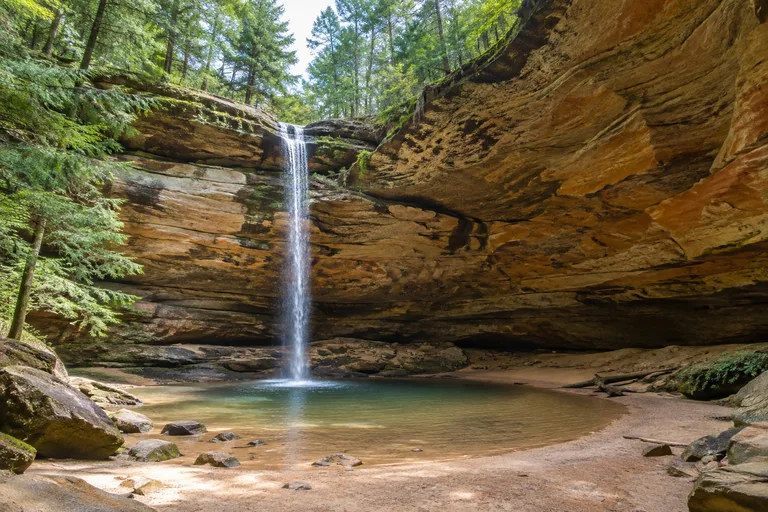
The best Hocking Hills things to do start on foot. Hocking Hills State Park, near Logan in southeastern Ohio, links sandstone gorges, giant recess caves and seasonal waterfalls. Old Man's Cave, Ash Cave and Cedar Falls are the classic first stops. Conkle's Hollow, Rock House and Cantwell Cliffs reward a second day. The park is free and open all year from dawn to dusk, so families and couples can plan a visit in any season.
This guide covers the hikes and activities, starting with a side by side trail table. Then come each area, the park rules, Hocking Hills in winter and a one or two day plan. For lodging, see the cabins near Hocking Hills State Park guide. For the rest of the state, start with the Ohio travel guide.
Hocking Hills at a Glance
| Question | Short answer |
|---|---|
| Where is it? | Hocking County in southeastern Ohio, near Logan; about an hour from downtown Columbus |
| What is it? | Hocking Hills State Park, plus nearby state nature preserves, state forests and small towns |
| Park areas | Six natural areas: Ash Cave, Cantwell Cliffs, Cedar Falls, Lake Logan, Old Man's Cave, and Whispering Cave and Hemlock Bridge with Rock House |
| Hours | Open all year from dawn to dusk; most trails close at dusk |
| Cost | Free to hike and to park, per the park's visitor guide |
| Dogs | Allowed on a 6-foot leash or shorter, except at Conkle's Hollow |
| Time needed | A two-day stay is suggested |
Visit: Hocking Hills State Park, 19852 St. Rt. 664 S., Logan, OH 43138 | (740) 385-6842 | Ohio DNR park page
Hocking Hills Trails Compared
Most Hocking Hills hikes are short, but they are not flat. Stone steps, wet rock and steep climbs are part of almost every trail. The table below compares the main trails so you can match each one to your group.
| Area | Trail | Distance | Time | Difficulty | Wheelchair or stroller |
|---|---|---|---|---|---|
| Old Man's Cave | Upper Falls to the Old Man's Cave exit | About 1.0 mile | About 60 minutes | Moderate to difficult | Gorge trail no; a separate accessible path reaches the Upper Falls observation area |
| Ash Cave | Gorge and rim loop | 0.6 mile | About 40 minutes | Easy paved lower trail; steep steps beyond the cave | Yes, on the paved lower trail to the cave and waterfall |
| Cedar Falls | Gorge loop | About 0.6 mile | About 40 minutes | Moderate | No |
| Rock House | Upper Rim Trail | About 0.6 mile | Not listed | Difficult | No |
| Rock House | Lower Gorge Trail | About 0.2 mile | Not listed | Moderate | No |
| Conkle's Hollow | Lower Gorge Trail | About 0.7 mile out and back | About 1 hour | Easy on the paved part; rugged beyond it | Paved part only, ending before the waterfall |
| Conkle's Hollow | Upper Rim Trail | About 2.5 miles | Several hours | Difficult | No |
| Cantwell Cliffs | Upper Rim Loop | 1.1 miles | 60 to 80 minutes for the full hike | Difficult | No |
| Whispering Cave | Main loop from Upper Falls | About 3.3 miles | Several hours | Difficult | No |
| Whispering Cave | Out and back from the state park lodge | About 1.0 mile | Not listed | Difficult | No |
Distances and ratings come from the GPS-recorded trail guide published by The Hocking Hills Organization at thehockinghills.org. The Ohio Department of Natural Resources publishes the official park trail map. Trails here are mostly one-way loops, so follow the trail markers from the start.
Old Man's Cave
Old Man's Cave is the best-known area in the park and a natural first hike. The trail follows a gorge cut through the full 150-foot thickness of the Blackhand sandstone. Along the way are the Upper Falls, Upper Gorge, Middle Falls, Lower Falls and Lower Gorge.
The hike enters at the kiosk by the Upper Falls parking lot. Highlights include:
- Upper Falls: the first waterfall, with an observation area.
- Devil's Bathtub: a well-known spot in the creek, crossed by a rock bridge.
- Stone tunnels and the Sphinx Head: tunnels, cliffs and rock formations along the gorge.
- The cave itself: a recess cave with overhanging ledges and detailed erosion in the sandstone.
- Lower Falls: farther down the gorge, where longer routes continue toward Cedar Falls.
The shortest loop is about 1.0 mile and takes about 60 minutes. The trail guide rates it moderate to difficult, because steps descend into the gorge and climb back out. Restrooms sit near the Visitor Center and parking area. The gorge trail is not wheelchair or stroller accessible. A separate accessible trail passes the Visitor Center on the way to the Upper Falls observation area.
How Old Man's Cave Got Its Name
The name comes from a legend. The park history credits a trapper, named as Retzler, who came to be called the Old Man of Old Man's Cave. The earliest written version is a 1907 story in a Logan newspaper, the Democrat Sentinel. Ohio bought the first 146-acre parcel, which included Old Man's Cave, in the 1920s. The area became part of the state forest park in 1927.
Ash Cave
Ash Cave is the largest recess cave east of the Mississippi, according to the Hocking Hills Tourism Association. Its horseshoe-shaped rim spans about 700 feet, with rock about 100 feet overhead. It is also the easiest big sight in the park for strollers, wheelchairs and young kids.
- Trail: a 0.6-mile one-way loop that starts and ends at the parking lot, about 40 minutes.
- Access: the paved lower gorge trail is wheelchair and stroller accessible to the cave and waterfall area.
- Return: most visitors walk through the cave and climb the steps to a wooded rim trail back to the lot. Visitors with mobility needs can return the way they came.
- Waterfall: a seasonal plunge from the rim. It is most dependable in winter, spring and after heavy rain, and some days it does not run at all.
Ash Cave is the southernmost of the six natural areas. Early settlers named it for a huge pile of ashes found in the shelter, and the source of those ashes is still a mystery. In the early 1900s it was a popular gathering spot for churchgoers. Preachers used a large rock near the entrance as a pulpit.
Cedar Falls
Cedar Falls is the tourism association's pick for the most famous waterfall in Hocking Hills. Water drops about 50 feet over Blackhand sandstone into a hemlock-shaded gorge. The loop is about 0.6 mile, takes about 40 minutes and is rated moderate.
The trail begins at Trail Marker H, across from the restrooms. Uneven stone and wooden steps lead down to the creek, and a rugged path continues past the falls. It is not wheelchair or stroller accessible.
The names have a story too. Early explorers called the creek Queer Creek for its winding route through the gorge. Settlers mistook the hemlocks for cedars, which gave the falls their name. The tourism association suggests a winter visit, when the falls can freeze.
Whispering Cave and Hemlock Bridge
Whispering Cave holds one of the larger recess caves on the trail system, with a seasonal waterfall that runs best after heavy rain. The route also crosses Hemlock Bridge, a swinging bridge. The trail connects to Old Man's Cave and Cedar Falls.
This is a harder hike than the short loops. The main loop is about 3.3 miles from the Upper Falls entrance to an exit near the Visitor Center. Plan for several hours. Expect repeated climbs, rock scrambles and many steps. There are three ways in:
- From the Visitor Center: take the steps near the kiosk and follow the markers to the purple Whispering Cave Trail.
- From the Upper Falls kiosk: follow the blue markers about 1.5 miles to the purple trail.
- From the state park lodge: the shortest option, about 1.0 mile out and back, with limited parking.
Rock House
Rock House is the only true cave in Hocking Hills State Park. It sits midway up a 150-foot cliff, a long sandstone corridor with large openings that let in daylight. Kids tend to love exploring its rock rooms.
Two trails meet at the shelter house at the top. The Upper Rim Trail runs about 0.6 mile and is rated difficult, with rugged climbs and dangerous cliff edges. The Lower Gorge Trail is about 0.2 mile and rated moderate. Neither is wheelchair or stroller accessible.
The area has a long visitor history. In the 1830s, settlers built a powder mill nearby. In the early 1900s, the Rock House Hotel stood near the current shelter house, and remnants of it remain.
Conkle's Hollow State Nature Preserve
Conkle's Hollow is a state nature preserve, not one of the six state park areas. Its cliffs rise nearly 200 feet above a narrow gorge. The lower trail ends at a waterfall of about 20 feet.
- Lower Gorge Trail: about 0.7 mile out and back, about one hour. The first section is paved and wheelchair accessible, but the paving ends before the waterfall.
- Upper Rim Trail: about 2.5 miles as a one-way loop, with steep steps, roots and cliff drops of about 70 to 100 feet in places. Allow several hours.
- Pets: not allowed anywhere in the preserve.
The rim trail suits confident hikers who want the view from above. Families with small children usually do better on the gorge trail.
Cantwell Cliffs
Cantwell Cliffs is a remote area of Hocking Hills State Park, and it is usually less crowded. Expect high cliffs, narrow passages and gorge views. The Upper Rim Loop is 1.1 miles and rated difficult, with exposed cliff edges. A short Lower Gorge Trail of 0.1 mile is rated moderate. Allow 60 to 80 minutes for the complete hike.
Hiking Between the Gorges: Old Man's Cave to Ash Cave
Old Man's Cave, Cedar Falls and Ash Cave are linked by trail. The full route runs about 6 miles one way. It passes Upper Falls, Devil's Bathtub and Old Man's Cave, then crosses part of Hocking State Forest to Cedar Falls and on to Ash Cave.
This is a rugged day with steep hills. Unless a shuttle is running, a one-way hike needs a second car or a ride back. The trail guide rates the link from Ash Cave to Cedar Falls as longer and more rugged than the short loops. It passes forested ridges, sandstone formations and seasonal waterfalls. Most visitors drive between the trailheads instead.
Hocking Hills in Winter
Hocking Hills in winter is quieter, and the trails stay open all year from dawn to dusk. Cedar Falls can freeze, and the Ash Cave waterfall runs most reliably in winter and spring. Short days mean an early start, because the park areas close at dusk.
The Annual Winter Hike
The Winter Hike is the area's best-known event. It began in 1965, led by park naturalist Norv Hall. The 2026 hike was held on January 17. In 2010 it drew a record of over 5,400 visitors.
- Route: about 6 miles one way, from Old Man's Cave to Cedar Falls and on to Ash Cave.
- Start: continuous starts from 9:00 to 11:00 AM at the Old Man's Cave area.
- Return: a shuttle brings hikers from Ash Cave back to Old Man's Cave.
- Cost: free. Bring cash for a donation at the food stops: bean soup and cornbread at Cedar Falls, the halfway point, and hot chocolate and doughnuts at Ash Cave.
- Difficulty: difficult, with steep hills. Hikers with bad knees or health concerns do better walking one segment only.
The date for the next Winter Hike was not on the event page checked for this guide. Check the park and the tourism association in December.
Winter Hiking Tips
- Wear ice cleats over sturdy, broken-in boots. Stone steps freeze.
- Dress in layers, with a hat, gloves and a warm coat.
- Pick the short loops on icy days: Ash Cave on its paved lower trail, or Cedar Falls with care.
- Finish before dusk. Winter daylight is short, and the trails close at dusk.
Best Time to Visit Hocking Hills
There is no bad season in Hocking Hills, but each one brings a different trip. Fall color and spring waterfalls are the big draws. Weekdays and very early mornings are the quietest times all year, according to the park's visitor guide.
| Season | What to expect | Good to know |
|---|---|---|
| Spring | The fullest waterfalls, since falls are best in the rainy season | Trails can be wet and muddy; wear shoes with grip |
| Summer | Shaded gorges with hemlock, black birch and Canada yew | Busy weekends; paddling and lake days add variety |
| Fall | Peak color, usually from the second weekend of October through the fourth | The busiest weekends of the year; hike early |
| Winter | Ice formations, frozen falls and fewer people | Winter Hike in January; ice cleats and early finishes |
The gorges have their own plant life. Glaciers never reached the park, but cool-loving plants such as hemlock, black birch and Canada yew survive in the deep, shaded hollows. The rock itself is Blackhand sandstone, shaped by water and erosion over millions of years.
Park Rules and Trail Safety
The rules are simple, and they exist because the cliffs are real. Park guides say the trails are beautiful but can be dangerous. The tourism association notes that trails at all the state park sites have been modified for safety. Follow these rules on every hike:
- Stay on the marked trails at all times, and follow the one-way direction.
- No swimming or wading in waterfalls, creeks or natural bodies of water. Designated beaches at Lake Logan and Lake Hope State Park are the exceptions.
- Pets on a leash of 6 feet or less, and no pets in the creeks. No pets at all in Conkle's Hollow.
- Watch children closely, especially near cliff edges and on wet steps.
- Leave by dusk. Most areas and trails close at dusk.
- Carry out trash. Picnic areas are carry-in, carry-out, with no trash cans.
- Fish with a license. Fishing is allowed at Rose Lake with a valid Ohio fishing license.
Rock climbing and rappelling have their own place. Hocking State Forest, next to the park, has a designated climbing and rappelling area. Check the state forest rules before you go.
More Hocking Hills Things to Do Beyond the Gorges
Hiking is the main event, but the region has plenty for a rest day or a rainy afternoon. These are some of the best options for families and couples.
Stargazing at John Glenn Astronomy Park
Named for the Ohio astronaut, John Glenn Astronomy Park sits along State Route 664 near the state park. Its observatory lets visitors see the night sky through a large telescope and with their own eyes. Program times change, so check the official site.
Visit: John Glenn Astronomy Park, 20531 St. Rt. 664 S., Logan, OH 43138 | (877) 403-4477 | jgap.info
Paddling and Lake Days
- The Hocking River: several liveries rent canoes, kayaks and rafts for river trips. The tourism association lists current outfitters.
- Lake Logan: part of the state park. The lake was developed for recreation in 1955 and is known for its fishing. Pontoons, pedal boats, paddle boards and kayaks rent by the hour.
- Guided kayaking: guided trips on local waters are offered too, a good choice for beginners.
Ziplines and Canopy Tours
Zipline and canopy tour companies run courses near the park. The Hocking Hills Tourism Association lists two current operators, and family tours are offered. Check age and weight rules when you book.
Hocking State Forest
The state forest covers 9,815 acres next to the park. It holds 59 miles of hiking on three trails, 40 miles of bridle trails and 23 horse campsites. It also has a fire tower and the designated climbing and rappelling area.
Visit: Hocking State Forest, 19275 St. Rt. 374, Rockbridge, OH 43149 | (740) 385-4402 | Ohio DNR forest page
Lake Hope State Park and Zaleski State Forest
About 30 minutes away, Lake Hope State Park covers 2,983 acres inside Zaleski State Forest. Its trails include the Peninsula Trail and the Hope Furnace Trail, which passes the ruins of an old iron furnace. The tourism association describes Zaleski State Forest as nearly 28,000 acres.
Start at the Welcome Center
The Hocking Hills Regional Welcome Center in Logan is the place to pick up brochures, ask for directions and check lodging availability. It is open Monday through Saturday from 9 a.m. to 5 p.m., and Sunday from 11 a.m. to 5 p.m. Hours can change, so check the official site.
Visit: Hocking Hills Regional Welcome Center, 13178 St. Rt. 664 S, Logan, OH 43138 | 740-385-9706 or 1-800-462-5464 | explorehockinghills.com
Getting There and Getting Around
Hocking Hills is about an hour from downtown Columbus. A car is a must. The park areas are spread along country roads, and each one has its own parking lot:
- Old Man's Cave and the Visitor Center: on State Route 664, the main hub.
- Cedar Falls, Rock House and Cantwell Cliffs: along State Route 374.
- Ash Cave: on State Route 56, at the south end.
- Conkle's Hollow: on Big Pine Road, near Rockbridge.
Cell service is weak or missing in parts of Hocking and Vinton counties. Download maps and directions before you leave town. The Visitor Center at Old Man's Cave has WiFi. The tourism association also points hikers to the DETOUR Ohio Trails app for trail maps.
Parking fills on busy weekends, and the park has no real limit on visitor numbers. Keep a backup plan. The park's visitor guide suggests Wayne National Forest or Lake Hope State Park when the main lots are full.
Hocking Hills Itineraries
The park's visitor guide suggests a two-day stay. Day one covers the four areas that sit close together. Day two adds the quieter cliffs to the north.
One Day: The Classic Gorges
- Early morning: Old Man's Cave, starting at the Upper Falls kiosk before the lots fill.
- Late morning: drive to Cedar Falls for the 0.6-mile loop.
- Lunch: a picnic at one of the park's picnic areas, or a meal in Logan.
- Afternoon: Ash Cave, with its paved trail and giant recess cave.
- Before dusk: a short walk to Whispering Cave from the lodge, if legs allow.
Two Days: Add the Cliffs
- Day 1: follow the one-day plan above.
- Day 2 morning: Conkle's Hollow, gorge trail for families or the rim trail for confident hikers.
- Day 2 midday: Rock House and its sandstone corridor.
- Day 2 afternoon: Cantwell Cliffs, the quietest of the main areas.
- Day 2 evening: stargazing at John Glenn Astronomy Park on a clear night.
A Winter Day
- Mid morning: Ash Cave, whose waterfall is most dependable in winter and spring.
- Midday: Cedar Falls, which can freeze in cold snaps.
- Afternoon: Old Man's Cave with ice cleats, finishing well before dusk.
Where to Stay
This page sticks to hikes and activities. Hocking Hills has cabins, lodges and campgrounds, and fall weekends book up early. For lodging picks, see the cabins near Hocking Hills State Park guide. For tips on cabin trips in general, see the cabin camping guide.
Hidden Gems in Hocking Hills
Most visitors stop at Old Man's Cave and Ash Cave. These quieter spots reward a little extra driving:
- Cantwell Cliffs: a remote park area, with narrow passages and fewer people.
- Rock House: the park's only true cave, with daylight streaming through its sandstone windows.
- Whispering Cave from the lodge: a short route to a big recess cave and the swinging Hemlock Bridge.
- Rockbridge State Nature Preserve: a natural rock bridge more than 100 feet long that arches 50 feet across a ravine.
- Christmas Rocks State Nature Preserve: a vista from the Jacob's Ladder rock formation.
- Boch Hollow State Nature Preserve: a 7-mile trail system with a renovated west trailhead.
- Rhododendron Cove State Nature Preserve: near Sugar Grove, with a strenuous ridge hike.
- Shallenberger State Nature Preserve: a preserve with geology from a former inland ocean.
- Butterfly Ridge Butterfly Conservation Center: a one-mile trail, guided tours and a gift shop.
- Moonville Tunnel: a railroad tunnel tied to the history of a former railroad town.
- Rose Lake: a quiet park lake where fishing is allowed with an Ohio license.
Insider Tips for Hocking Hills
- Go early or go on a weekday. The park has no visitor limit, and lots fill on busy days.
- Wear real trail shoes. Steps are steep and can be slippery, even in summer.
- Follow the one-way loops. Turning back against the flow on narrow steps causes jams.
- Save maps offline. Cell service drops out in the hills.
- Chase waterfalls after rain. Ash Cave and Whispering Cave falls may be dry in a dry spell.
- Pack out what you bring. Picnic areas have no trash cans.
- Leave the dog home for Conkle's Hollow. Pets are not allowed in the preserve.
- Watch the clock. Trails close at dusk, which comes early from November to February.
- Keep a backup trail. Lake Hope State Park is about 30 minutes away if lots are full.
Frequently Asked Questions About Hocking Hills
What are the best things to do in Hocking Hills?
Hiking comes first. The classic stops are Old Man's Cave, Ash Cave and Cedar Falls in Hocking Hills State Park, then Conkle's Hollow, Rock House and Cantwell Cliffs. Add stargazing at John Glenn Astronomy Park, paddling, ziplining and the January Winter Hike.
How long is the Old Man's Cave trail?
The shortest loop runs about 1.0 mile from Upper Falls to the Old Man's Cave exit and takes about 60 minutes. The trail guide rates it moderate to difficult because steps descend into the gorge and climb back out. Longer routes continue to Cedar Falls and Ash Cave.
Is Ash Cave wheelchair accessible?
Yes, in part. The paved lower gorge trail is wheelchair and stroller accessible to the cave and waterfall area. The steps and the upper rim return are not. Visitors with limited mobility can return the way they came.
Is Hocking Hills State Park free?
Yes. The park's visitor guide says the state park is free, with no fees to walk the trails or to park. Some nearby attractions, tours and rentals charge their own fees, so check each one before you go.
Are dogs allowed in Hocking Hills?
Dogs are allowed in the state park areas on a leash of 6 feet or less, and they cannot swim in the creeks. Pets are not allowed anywhere in Conkle's Hollow State Nature Preserve. Steep steps and cliff edges can be hard for some dogs.
Is Hocking Hills worth visiting in winter?
Yes. The trails stay open all year, Cedar Falls can freeze, and the Ash Cave waterfall runs most reliably in winter and spring. The free Winter Hike, first held in 1965, covers about 6 miles from Old Man's Cave to Ash Cave each January. Bring ice cleats for icy steps.
When is the best time to see fall colors in Hocking Hills?
Timing depends on the weather. The park's visitor guide says some of the best colors usually come from the second weekend of October through the fourth. Those weekends are busy, so arrive early or hike on a weekday.
Can you swim in the waterfalls at Hocking Hills?
No. Swimming and wading are not allowed in the park's waterfalls, creeks or natural bodies of water. The exceptions are the designated beach areas at Lake Logan and Lake Hope State Park.
How many days do you need in Hocking Hills?
Two days is the suggested stay. Day one covers Ash Cave, Cedar Falls, Whispering Cave and Old Man's Cave, which sit close together. Day two adds Conkle's Hollow, Rock House and Cantwell Cliffs, with stargazing in the evening.
How far is Hocking Hills from Columbus?
Hocking Hills is about an hour from downtown Columbus by car. The park areas are spread along country roads near Logan, so a car is needed to move between trailheads. Cell service is weak in places, so download maps before you leave.
Planning your next U.S. getaway? Explore more destination guides, road trips, and travel tips at Vacation Getaways US. Have a question or a spot we should cover? Email us at [email protected].