
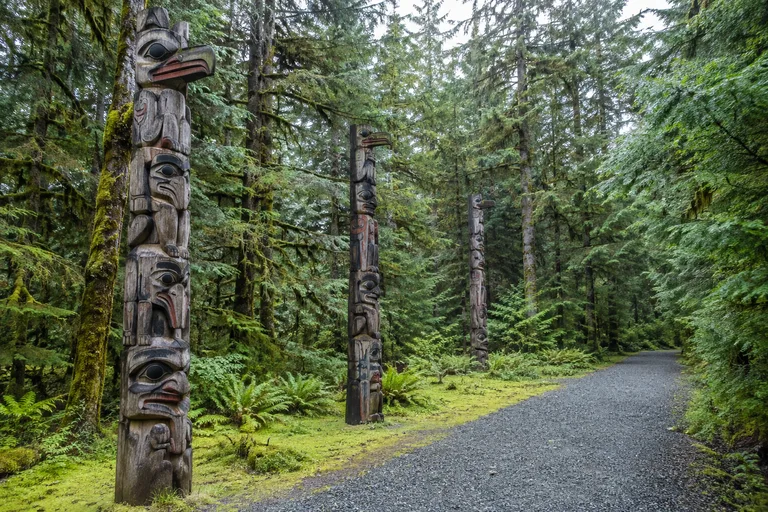
Sitka National Historical Park is a free national park on the edge of downtown Sitka, Alaska. It preserves the site of the 1804 battle between the Kiks.ádi Tlingit and Russian traders. Visitors walk the Totem Trail past 18 totem poles, see Tlingit and Haida art at the visitor center and tour the 1842 Russian Bishop's House. Created in 1890, it is the oldest national park unit in Alaska.
This guide covers the Sitka Totem Trail, the visitor center, the Russian Bishop's House and the Tlingit history of the site. It ends with the best time to visit, getting there, a half-day plan and answers to common questions. For the rest of town, see the Sitka, Alaska travel guide, and for the whole state, the Alaska travel guide.
Sitka National Historical Park at a Glance
The park has two parts. The visitor center and the Totem Trail sit near the mouth of the Indian River on Sitka Sound. The Russian Bishop's House stands in downtown Sitka, about a 10-minute walk away.
| Question | Short answer |
|---|---|
| What is it? | A national historical park on Baranof Island, created in 1890; the oldest national park unit in Alaska |
| Size | About 113 acres of temperate rainforest and shoreline, with about two miles of trails |
| Entrance fee | None; the National Park Service says no entrance pass is required |
| Totem Trail | 18 replica and original poles; 1.6 miles for both loops |
| Russian Bishop's House tours | May through September, ranger-led, 20 to 60 minutes |
| Time needed | About half a day for all three stops |
| Pack | Rain gear and layers in any season |
Park contact: Sitka National Historical Park, 103 Monastery St., Sitka, AK 99835 (mailing address) | 907-318-2170 | nps.gov/sitk
Plan Your Sitka National Historical Park Visit
A Sitka National Historical Park visit is easy on foot. The Park Service says most of the park is an easy walk from downtown. A paved route with curb cuts runs from downtown to the visitor center. The walk takes 15 to 25 minutes from the major hotels and the main cruise docks.
- Start at the visitor center for exhibits, the park video and a look at the original carvings.
- Walk the Totem Trail, which begins right outside the visitor center door.
- Walk back toward town for a ranger-led tour of the Russian Bishop's House.
Activities change by season, so check the park calendar on nps.gov/sitk before you go. The Park Service does not post fixed hours on the pages checked for this guide, so call 907-318-2170 for current times.
What Each Stop Offers
| Stop | Time to allow | Best for | Indoors or outdoors |
|---|---|---|---|
| Visitor center | 30 to 45 minutes | Original carvings, the park video, artists at work | Indoors |
| Totem Trail | 30 to 90 minutes | Totem poles, the battle site, rainforest and shore views | Outdoors |
| Russian Bishop's House | About 50 minutes: 20 for the museum, 30 for the tour | Russian America history, a furnished home and chapel | Indoors |
On a rainy day, start indoors and walk the trail when the rain eases. On a clear day, do the trail first.
The Sitka Totem Trail
The Sitka Totem Trail is the heart of the park. The National Park Service lists 18 replica and original totem poles carved by Alaska Native carvers along the trail and grounds. Poles come from several Tlingit and Haida villages.

The Trail at a Glance
| Detail | What the Park Service says |
|---|---|
| Length | Two loops joined by a footbridge over the Indian River, 1.6 miles in total |
| Surface | Broad, relatively flat crushed gravel, about six feet wide |
| Time | 30 to 90 minutes |
| Season | Year-round |
| Trailhead | Right outside the visitor center |
| Pets | Allowed on the trails on a leash no longer than six feet; not allowed indoors |
| Access | Two accessible parking spaces at the visitor center; accessible restrooms, a lowered water fountain and a picnic table outside |
| Bus | City buses stop at the visitor center's upper lot hourly |
What You See Along the Way
- Totem poles: poles from several Haida and Tlingit villages.
- The battle site: at the trail's midpoint, a contemporary pole and marker at the Kiks.ádi Memorial and a grassy field mark the site of the 1804 battle.
- The K'alyáan pole: the battleground is honored at the mouth of the Indian River with a totem pole for K'alyáan, the Tlingit war chief.
- Rainforest: Sitka spruce and western hemlock, with views of Sitka Sound and the tide flats.
- Wayside signs and benches: signs explain the natural and cultural history, with places to rest.
For a pole-by-pole walk, the Park Service points visitors to the free NPS App. Choose Sitka National Historical Park and the Totem Trail self-guided tour.
How to Read a Totem Pole
Totem poles tell stories, and each one has a purpose. The National Park Service describes three kinds of poles at the park:
- House posts: carved as support poles of Tlingit and Haida houses.
- Frontal poles: placed against or near the front of a house.
- Detached poles: placed anywhere in or near villages.
The Park Service adds that poles generally show the ancestry of a clan (crest poles) or its history (history poles). Others carry folklore or real experiences (legend poles). Some honor important people (memorial or mortuary poles).
How the Poles Came to Sitka
The collection has an unusual story. The Park Service says the poles were gifts from Tlingit and Haida chiefs. John Brady, governor of the District of Alaska, began gathering them in Sitka in 1903.
- 1904: poles acquired by Governor Brady traveled to the St. Louis World's Fair.
- 1906: after repairs by local carvers, the poles were placed along the path then called Lover's Lane in Sitka.
- 1916: responsibility for the park passed to the National Park Service.
- 1930s: the Civilian Conservation Corps led a major effort to repair and recarve weathered poles.
- 1969: the Southeast Alaska Indian Cultural Center was founded. It has overseen repair and recarving, and the carving of several new poles.
Over time the poles weathered and were repaired or recarved, so the trail today mixes originals and replicas. Another pole is the Holding Hands Centennial Totem Pole, Wooch Jin Dul Shat Kooteeya, designed by Tlingit carver Tommy Joseph. Original carvings are shown inside the visitor center.
The Sitka National Historical Park Visitor Center
The visitor center is the best first stop. The Park Service says it holds exhibits, a 15-minute park video, and Tlingit and Haida art. It also houses original carvings alongside exhibits on how the collection arrived in Sitka.
- Totem Hall: a traditional dugout canoe carved by Tommy Joseph and his apprentice Tim Flanery is on display.
- Demonstrating artists: the park recruits local artists to demonstrate their craft. Most days in summer, visitors can watch them work and chat about it.
- Carving shed: some demonstrations take place in the outdoor carving shed beside the visitor center.
- Park video: if the center is closed, the Park Service offers the film online.
- Museum collection: the park cares for about 154,000 items.
Demonstration times change, so check the park calendar. Outside summer, call ahead to confirm the center is open.
Russian Bishop's House in Sitka
The Russian Bishop's House is the park's downtown unit. The Park Service says it was completed in 1842 and calls it one of four remaining buildings from Russian America. It was home to Ivan Veniaminov, later known as Saint Innocent.
The Park Service describes the house as a center of missionary work. It was also a place of learning and exchange between Russian, Tlingit and other Alaska Native people. It also notes that Finnish men and women contributed greatly to Russian America, as the house shows.
Why the House Matters
Imperial Russia dominated the North Pacific for more than 125 years, the Park Service says, and Sitka, then called New Archangel, was its colonial capital. The Bishop's House was the center of Russian Orthodox Church authority in a diocese that stretched from California to Kamchatka in Siberia.
- 1842: the house was completed.
- 1969: the Russian Orthodox Church closed the house. By then the roof leaked, the spruce walls had rotted and the building was in danger of collapse.
- 1973: the National Park Service obtained the property.
- After 1973: a 16-year project restored the building to its 1853 appearance.
Touring the House
- First floor: a museum on Russian exploration and settlement that visitors can browse. Allow at least 20 minutes.
- Second floor: a furnished home seen on a ranger-led tour of about 30 minutes. Rooms hold historic, period and reproduction pieces.
- The chapel: the Chapel of the Annunciation on the second floor is still used for worship services today.
- Season: the Park Service says tours are offered May through September.
- Booking: no reservations are needed. The Park Service says guided tour tickets are free at the front desk.
- Pets: not allowed inside.
The first floor is wheelchair accessible, and a staircase leads to the second floor. The Park Service notes that floors are uneven and lighting is dim to protect historic objects. Virtual tour tablets are available at the front desk. When the house is closed, a virtual tour is online.
Visit: Russian Bishop's House, 501 Lincoln Street, Sitka, AK 99835 | 907-318-2170 | nps.gov tour page
Tlingit History at Sitka
This park sits on the ancestral land of the Kiks.ádi clan. The Park Service says modern Tlingit culture can trace its heritage in Sitka back more than 10,000 years. The Sitka Tribe of Alaska calls the town Sheet'ká, and it notes that clans remain an important part of Tlingit culture.
The Park Service says the Tlingit, sustained by the ocean for centuries, built villages along the panhandle. One was Shee Atika on Baranof Island. The Park Service translates the name as people on the outside of Shee.
The Battle of 1804
The account below follows the National Park Service's own pages on the battle.
| Date | What happened, per the National Park Service |
|---|---|
| 1802 | The Battle of Old Sitka. Afterward, Tlingit clan leaders chose K'alyáan, who had proven his bravery, as their war chief. |
| 1802 to 1804 | The Sitka clans built Shís'gi Noow, a fort at the mouth of the Indian River. The name means Sapling Fort or Green Wood Fort. |
| September 28, 1804 | Alexander Baranov, Captain Lisianskii of the sloop Neva and their war party sailed into Sitka Sound. |
| Before the assault | The Tlingit reserve of gunpowder was lost when it exploded in a canoe. |
| October 1, 1804 | The Russians landed in front of the fort and attacked. The Tlingit defeated the assault, and cannon fire from the Neva covered the Russian landing party. |
| The withdrawal | The Tlingit moved to the east side of Chichagof Island, a journey now known as the Survival March. |
| After the battle | The Russians fortified Noow Tlein, the hill now called Castle Hill, and renamed the settlement New Archangel. |
| 1822 | The Kiks.ádi returned to Sitka after 18 years away. |
The Park Service says K'alyáan and a group of warriors crushed the Russian right flank in 1804. It also says the battle was not truly over until the Kiks.ádi came home in 1822. In the years that followed, the Park Service describes Russians and Tlingit as contentious neighbors, trading partners and intermittent enemies. Decades later, it adds, Ivan Veniaminov of the Bishop's House helped ease tensions between Russian fur traders and the Kiks.ádi.
When you reach the Kiks.ádi Memorial on the trail, you are standing at the heart of that story. Take a quiet moment there. To learn more about the region's Native and Russian past, read the guide to Southeast Alaska culture and history.
Tlingit Culture Today
Tlingit culture is a living culture in Sitka, not only a story in a museum. The Sitka Tribe of Alaska is a federally recognized tribal government. It runs the Naa Kahídi Dancers, who perform a 30-minute Tlingit cultural show in a modern take on a traditional clan house.
- Shows open with a box drum and the scent of burning cedar.
- Dancers in regalia perform songs passed down through generations.
- A storyteller shares a Raven origin story.
- Visitors can meet the dancers after the show for photos and questions.
- Tickets are sold at the door half an hour before the show. No reservations are taken.
The tribe's page does not list show dates, so check with the Sitka Tribe of Alaska for the schedule.
Nature in the Park: Rainforest, River and Shore
The park is small, but it holds three habitats in one short walk. The Park Service describes a wet, closed-canopy temperate rainforest, the Indian River with its estuary and wetlands, and a marine shoreline.
- Forest: large Sitka spruce and western hemlock. Some stands show old-growth traits, such as several canopy layers, downed wood and a thick shrub layer.
- Fish: pink and chum salmon enter the lower river to spawn in late summer. Coho and Chinook salmon, Dolly Varden char and steelhead trout also pass through the park.
- Birds: waterfowl and shorebirds stop along the shore in spring and fall. Bald eagles, gulls, crows and ravens feed along the tide flats and river, most of all during the herring spawn and the salmon runs.
- Sea life: seals, sea lions, sea otters and whales can be seen from shore.
Bring binoculars for the shoreline stretch of the trail, and check a tide table to catch the flats at low water.
Salmon, Bears and Wildlife Safety
Salmon run in the Indian River from mid-July until late September, per the Park Service. The footbridge on the Totem Trail is a fine place to watch for them.
- Bears: the Park Service says encounters with brown bears are unlikely in the park. Bears are most active in late summer, when salmon are in the river.
- Trail alerts: check the green, amber and red alert signs at the trailheads before you walk.
- Bear safety: the Park Service recommends basic bear safety knowledge for every visitor.
- Dogs: keep them leashed at all times, and put waste in a trash can.
For a longer walk, the Indian River Trail runs 4.5 miles one way from the end of Indian River Road. The Park Service calls it a great place to see spawning salmon from late July to late September. It also warns hikers to watch for bears there. For more, see wildlife in Sitka and outdoor adventures in Sitka.
Best Time to Visit Sitka National Historical Park
The best time to visit is May through September, when Russian Bishop's House tours run and artists demonstrate most summer days. The Totem Trail is open year-round.
| Season | Weather, per the Park Service | What is on |
|---|---|---|
| May and June | Rain gear and layers advised, as in every month | Bishop's House tours begin in May |
| July and August | Summer temperatures from the high 50s to high 60s | Artist demonstrations most days; salmon arrive from mid-July |
| September | Start of the wettest months, September to November | Last month of house tours; salmon in the Indian River |
| October to April | High teens to 40s in winter; October averages 14.8 inches of rain | The trail stays open; call ahead for building hours |
Sitka Airport gets about 90 inches of precipitation a year, mostly as rain, and September through November are the wettest months. The Park Service advises rain gear and layered clothing at any time of year. For the wider region, see the best time to visit Southeast Alaska.
Getting to the Park and Getting Around
No road links Sitka to other towns, so visitors arrive by air or by sea. Once in town, the park is a walk, a bus ride or a short taxi ride away.
| Arriving by | Where you land | Distance to the park |
|---|---|---|
| Plane | Sitka airport | 1 mile from downtown and 1.5 miles from the park; taxis available |
| State ferry | Terminal at the end of Halibut Point Road | 6 miles from downtown; taxis available |
| Cruise ship | Cruise terminal, a downtown harbor or a tender boat | The terminal is 7 miles from downtown; ask your cruise line |
- By air: some local hotels offer airport pickup and drop-off, and taxis meet flights.
- By ferry: schedules are on the Alaska Marine Highway website.
- By cruise ship: see the Southeast Alaska cruise guide for routes and ports.
- On foot: the Russian Bishop's House is a 5 to 15 minute walk from major hotels and the main cruise ship docks. The visitor center is 15 to 25 minutes.
- By bus: city buses stop hourly at the visitor center's upper lot.
Half-Day Plan for Sitka National Historical Park
This plan fits a cruise day or a morning in town. It follows the order most visitors find easiest.
- Russian Bishop's House, 45 to 60 minutes: browse the first-floor museum, then join a ranger-led tour of the second floor and chapel.
- Walk to the visitor center, about 10 minutes: follow the paved route from downtown.
- Visitor center, 30 to 45 minutes: watch the 15-minute video, see the original carvings and the canoe in Totem Hall, and stop by any artist at work.
- Totem Trail, 30 to 90 minutes: walk the loop, pause at the Kiks.ádi Memorial and cross the Indian River footbridge.
With a full day, add the Naa Kahídi Dancers, Castle Hill and other sights from the Sitka travel guide.
Visiting with Kids
The park suits families. The trail is flat and short enough for small legs, and the totem poles give children something to look for around each bend. In late summer, the footbridge turns into a fish-spotting stop. Inside, the 15-minute video is short enough for young attention spans, and most summer days children can watch an artist at work and ask questions. Keep children close in late summer, when bears are most active near the river.
More to See Near the Park
Several other Sitka sights tie into the park's story or make an easy add-on.
- Castle Hill: Noow Tlein, the hilltop the Russians fortified after 1804.
- The Old Sitka Historical Site: near the ferry terminal at the end of Halibut Point Road, according to the Park Service's directions page.
Fortress of the Bear
An educational bear rescue center that cares for bears orphaned as cubs. Its site lists eight resident bears in three enclosures. Check the official site for the season and tickets.
Visit: Fortress of the Bear, 4639 Sawmill Creek Rd., Sitka, AK 99835 | 907-747-3550 | fortressofthebear.org
Alaska Raptor Center
The center rescues and rehabilitates birds of prey, including eagles, hawks, owls, falcons and ravens. Hours change by season, so check the official site.
Visit: Alaska Raptor Center, 1000 Raptor Way, Sitka, AK 99835 | 907-747-8662 | alaskaraptor.org

Hidden Gems at Sitka National Historical Park
These quieter details reward a slower pace:
- The Russian Memorial Loop: cross the Indian River footbridge to the park's second loop.
- The footbridge in salmon season: from mid-July, look down for fish in the river.
- Artists at work: most summer days, local artists demonstrate their craft at the visitor center.
- The dugout canoe in Totem Hall: carved by Tommy Joseph and his apprentice Tim Flanery.
- The original carvings indoors: the visitor center shows original carvings beside exhibits on the collection's history.
- The Chapel of the Annunciation: a working chapel on the Bishop's House tour.
- Tide flats at low tide: the trail looks over the intertidal zone of Sitka Sound, where eagles and ravens feed.
Insider Tips for Visiting Sitka National Historical Park
- Go early on cruise days. Downtown and the trail are busiest when ships are in port.
- See the visitor center first. The video and exhibits make the poles on the trail far more meaningful.
- Download the NPS App before you go. Its Totem Trail tour works as a pocket guide.
- Bring rain gear. Sitka gets about 90 inches of precipitation a year.
- Pick up a tour ticket first. At the Bishop's House, ask for a free tour ticket at the front desk, then browse the museum while you wait.
- Call ahead outside summer. Building hours change with the season.
- Show respect. The park sits on Kiks.ádi ancestral land, and the chapel is still used for worship. Stay on the trail and keep voices low at the memorial.
- Check bear alerts in late summer. Read the trailhead signs before you set out.
More Sitka and Southeast Alaska Guides
- Sitka, Alaska travel guide: things to do, history and travel tips.
- Outdoor adventures in Sitka: hiking, kayaking and more.
- Sitka wildlife: whales, bears and eagles.
- Southeast Alaska culture and history: Tlingit, Haida and Russian heritage.
- Southeast Alaska guide: the Inside Passage region.
- Alaska travel guide: every region and the best time to visit.
Frequently Asked Questions About Sitka National Historical Park
What is Sitka National Historical Park known for?
It preserves the site of the 1804 battle between the Kiks.ádi Tlingit and Russian traders. Visitors come for the Totem Trail, with 18 Tlingit and Haida totem poles, and the 1842 Russian Bishop's House. Created in 1890, it is the oldest national park unit in Alaska.
Is Sitka National Historical Park free?
Yes. The National Park Service says an entrance pass is not required. It also says guided tour tickets for the Russian Bishop's House are free at the front desk. Call the park at 907-318-2170 to confirm before you go.
How long is the Totem Trail in Sitka?
The Totem Trail and the Russian Memorial Loop together cover 1.6 miles, joined by a footbridge over the Indian River. The trail is relatively flat crushed gravel. The Park Service suggests 30 to 90 minutes.
How many totem poles are at Sitka National Historical Park?
The National Park Service lists 18 replica and original totem poles along the trail and grounds. A 2013 survey documented nineteen standing totem poles and house posts along the Totem Trail. Original carvings are shown inside the visitor center.
When can you tour the Russian Bishop's House?
The Park Service says tours are offered May through September. A ranger leads the tour of the furnished second floor, which takes 20 to 60 minutes. No reservations are needed. The first floor holds a museum.
Where is the Russian Bishop's House?
It is at 501 Lincoln Street in downtown Sitka. The Park Service says it takes most people about 10 minutes to walk between the house and the park visitor center.
What happened at the Battle of Sitka in 1804?
Russian forces landed in front of the Tlingit fort Shís'gi Noow on October 1, 1804, and the Tlingit defeated that assault. Short of gunpowder after an accidental explosion, the Tlingit then made a planned withdrawal now known as the Survival March.
Can you walk to the park from a cruise ship?
It depends on where your ship docks. The Park Service says the cruise terminal is seven miles from downtown, while some ships use a downtown harbor or tender passengers ashore. The Russian Bishop's House is a 5 to 15 minute walk from the main cruise ship docks.
Are there bears on the Sitka Totem Trail?
The Park Service says encounters with brown bears are unlikely in the park. Bears are most active in late summer, when salmon are in the Indian River. Check the green, amber and red alerts at the trailheads.
How much time do you need at Sitka National Historical Park?
Plan about half a day. Allow 30 to 90 minutes for the Totem Trail, plus time for the visitor center and its 15-minute video. The Russian Bishop's House takes up to an hour.
Ready to see the rest of town? Continue with the Sitka, Alaska travel guide for Castle Hill, wildlife tours, hiking and where to stay.
Planning your next U.S. getaway? Explore more destination guides, road trips, and travel tips at Vacation Getaways US. Have a question or a spot we should cover? Email us at [email protected].