
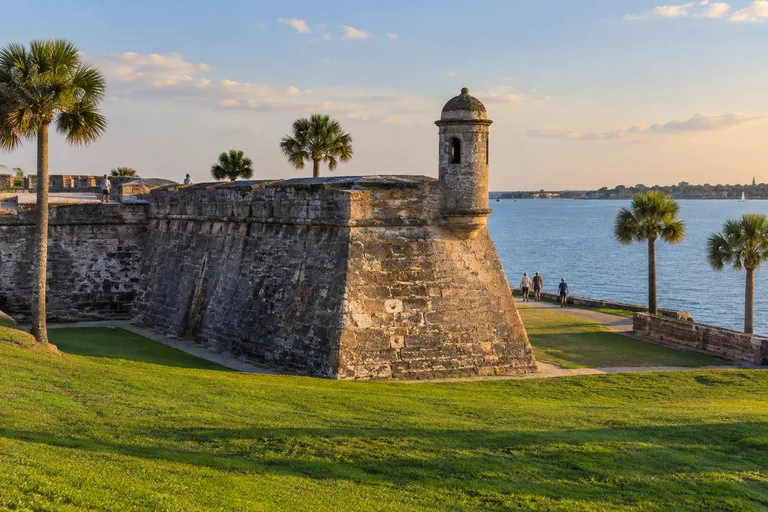
The best things to do in St. Augustine are to tour Castillo de San Marcos, walk St. George Street and the historic district, see Henry Flagler's grand hotels at Flagler College and the Lightner Museum, climb the lighthouse on Anastasia Island and spend an afternoon on the beach. The old city is compact, so most of it can be seen on foot in a weekend.
St. Augustine was founded by the Spanish on September 8, 1565. The city describes itself as the oldest continuously occupied settlement of European and African American origin in the United States. This guide covers the top sights, free things to do, beaches, parking, the best time to visit and a day by day St. Augustine weekend plan. For the rest of the state, see the Florida travel guide.
Is St. Augustine Worth Visiting?
Yes. St. Augustine offers something rare in Florida: more than 450 years of history in a small, walkable center, with Atlantic beaches a short drive away. Couples come for the brick lanes and inns, families for the fort, the pirates and the alligators, and budget travelers for the long list of free sights.
| Quick fact | Details |
|---|---|
| Where it is | Northeast Florida, on the Atlantic coast between Jacksonville and Daytona Beach |
| Founded | September 8, 1565, by Pedro Menéndez de Avilés |
| Top sight | Castillo de San Marcos National Monument |
| Time needed | 2 to 3 days |
| Nearest big airport | Jacksonville International, about 50 minutes north |
| Beaches | More than 42 miles of coast in the St. Augustine and Ponte Vedra area |
| Most comfortable seasons | Spring and fall |
A Short History of St. Augustine
The city's story explains its streets. The City of St. Augustine gives this outline.
- 1565: Pedro Menéndez de Avilés arrives with about 600 settlers and founds St. Augustine on September 8.
- 1695: The Spanish finish Castillo de San Marcos. English forces besiege it seven years later, in 1702, and again in 1740. It never falls in battle.
- 1738: The Spanish governor charters Fort Mose, a free African settlement near the city.
- 1763: A treaty gives Florida to Britain. Another treaty returns it to Spain twenty years later, and the Spanish come back in 1784.
- 1821: Florida passes peacefully from Spain to the United States.
- The 1880s: Henry Flagler turns the city into a winter resort and builds grand hotels, among them the Ponce de Leon and the Alcazar.
- 1964: Dr. Martin Luther King Jr. comes to St. Augustine and helps lead protests that support the Civil Rights Act of 1964.
Castillo de San Marcos: The Top Sight
Castillo de San Marcos is the first place to go in St. Augustine. The National Park Service says it preserves the oldest masonry fortification in the continental United States. The Spanish built it to defend Florida and the Atlantic trade route, and it stands on the bay at the northern edge of downtown.
The walls are made of coquina, a local stone, which the park says proved an excellent choice. English forces from Carolina tested it in 1702, and James Oglethorpe of Georgia tried again in 1740. Neither siege took the fort. Later, under the United States, it was known as Fort Marion and held Seminole, Plains and Apache prisoners in the 1800s. The park tells those stories too.
What to see and do:
- The entrance: a drawbridge over a dry moat was the only way in.
- The gun deck: walk the top of the walls for views of the bay and the city. It closes during thunderstorms.
- Cannon firings: demonstrations take place five times a day on Fridays, Saturdays and Sundays, and re-enactors portray the first Spanish period.
- The hot shot furnace: on the east side, a furnace heated cannonballs red hot to fire at wooden ships.
- The exhibits: displays and videos tell the fort's story, and iron and bronze cannon and mortars from the period line the walls.
The fort is open seven days a week, with first admission at 9:00 AM and last admission at 5:00 PM. It is closed on Thanksgiving Day and Christmas Day. The park says a busy Saturday draws about 3,500 visitors, so arrive at opening time or late in the day. Check the park's fees page before going.
Contact: 1 South Castillo Drive, St. Augustine, FL 32084. Phone: 904-829-6506. Web: nps.gov/casa.
The St. Augustine Historic District on Foot
The St. Augustine historic district is best seen slowly and on foot. Start at the City Gate at the entrance to St. George Street, walk to the Plaza de la Constitución, then wander the side streets.
St. George Street
St. George Street was the city's main street in its early days, and the official visitor site still calls it the heart of the city. It is closed to vehicles. Many of its buildings date to the 1700s or were rebuilt on their original foundations. Today they hold shops, galleries, taverns and courtyard restaurants. Look for the Oldest Wooden School House and the Peña-Peck House, a coquina home built about 1750.
Most shops open between 9 and 10 AM. The street is paved and generally wheelchair accessible, though some old shops have limits. Weekday mornings are the least crowded time.
The Plaza and Aviles Street
The Plaza de la Constitución is the old town square, and the official visitor site names it one of the top photo spots in the city. Just off it, Aviles Street is a brick lane that the visitor site bills as the "Oldest Street in the USA". Two house museums stand on it: the Ximenez-Fatio House, which tells the story of the women who ran boarding houses here, and the Father Miguel O'Reilly House, which dates from 1691.
The Oldest House
The González-Alvarez House on St. Francis Street, known as the Oldest House, was built in the early 1700s. The St. Augustine Historical Society has owned it since 1918. Its rooms show how one owner after another, Spanish and British among them, changed the building.
The Bridge of Lions and the Bayfront
The Bridge of Lions crosses the bay from downtown to Anastasia Island, and the official visitor site names it a top photo spot. The bayfront walk between the bridge and the Castillo is free and scenic. Carriage rides leave from the bayfront, and several boat operators run harbor cruises and sunset sails.
Flagler's Gilded Age Hotels
Two of the grandest buildings in Florida face each other across King Street, and both began as hotels for Henry Flagler's wealthy winter guests.
Flagler College, the Former Hotel Ponce de Leon
The Hotel Ponce de Leon opened in 1888 and is now the heart of Flagler College. It is a National Historic Landmark. Historic tours run daily and last about 45 to 60 minutes. Highlights include:
- The Rotunda: a domed ceiling about 68 feet high, held up by hand-carved oak figures.
- The Dining Hall: one of the largest collections of Louis Comfort Tiffany stained glass windows in the world.
- The Flagler Room: the former Women's Grand Parlor, with its chandeliers.
Tours cover the ground floor only, because this is a working campus. Buy tickets online, and check the tour site for times.
Lightner Museum, the Former Hotel Alcazar
Across the street, the Lightner Museum fills the former Hotel Alcazar, another Flagler resort hotel. Its galleries show Gilded Age treasures, ceramics and early photographs of Florida. The museum is open daily from 9:00 AM to 5:00 PM, with last admission at 4:00 PM. Check the official site for prices and guided tours.
Contact: 75 King Street, St. Augustine, FL 32084. Phone: 904-824-2874. Web: lightnermuseum.org.
More Top Things to Do in St. Augustine
St. Augustine Lighthouse and Maritime Museum
The lighthouse stands on Anastasia Island, a short drive over the Bridge of Lions. The light station was built from 1871 to 1874. Visitors climb a 219-step spiral staircase for views in every direction. Admission also covers the 1876 Keepers' House, a boat building shop, nature trails and play areas. Children must be at least 44 inches tall to climb the tower, and they cannot be carried. Parking is free.
Contact: 100 Red Cox Drive, St. Augustine, FL 32080. Phone: (904) 829-0745. Web: staugustinelighthouse.org.
St. Augustine Alligator Farm Zoological Park
The Alligator Farm is a family favorite near the lighthouse. The official visitor site says it is home to all 24 species of crocodilians. It also has a wading bird rookery beside the alligator swamp, and the Crocodile Crossing zip line lets braver visitors zip past the alligators and crocodiles.
Contact: 999 Anastasia Blvd., St. Augustine, FL 32080. Phone: 904-824-3337. Web: alligatorfarm.com.
Fountain of Youth
This 15-acre park is built around the spring linked by legend to Ponce de León. Its site describes 15 lush acres to stroll, and it is open daily. Check the official site for hours and prices.
Contact: 11 Magnolia Avenue, St. Augustine, FL 32084. Phone: 904-829-3168. Web: fountainofyouthflorida.com.
Mission Nombre de Dios
Mission Nombre de Dios marks the place where Menéndez landed in 1565 and where a Mass of thanksgiving was said soon after. The quiet grounds hold a small historic chapel, a rustic altar and a tall cross raised in the 1960s for the city's 400th anniversary.
Trolley Tours, Ghost Tours and Pirates
Three more favorites round out a first visit:
- Old Town Trolley Tours: a narrated 90-minute loop with 22 stops, where riders hop on and off all day. The ticket includes the St. Augustine History Museum. See trolleytours.com.
- Ghost tours: the old city is known for its after-dark tours on foot and by trolley. Book ahead for weekend nights.
- St. Augustine Pirate and Treasure Museum: a family museum that takes visitors back more than 300 years to the Golden Age of Piracy. See thepiratemuseum.com.
St. Augustine Distillery
For adults, the St. Augustine Distillery makes bourbon, rum, gin and vodka inside what it calls Florida's oldest ice plant. Tours run seven days a week.
Contact: 112 Riberia Street, St. Augustine, FL 32084. Phone: 904-825-4962. Web: staugustinedistillery.com.
Black History and Civil Rights Sites
St. Augustine's Black history runs from the 1500s to the Civil Rights Act, and two sites tell it well.
Fort Mose Historic State Park
Fort Mose marks the first legally sanctioned free African settlement in what is now the United States. The Spanish governor chartered it in 1738 for people who had fled slavery in the English colonies to the north. About 100 people are thought to have made it their home. The 40-acre park has a visitor center with an interactive museum, boardwalks over the marsh and a three-story replica of the fort that was completed in 2025. It is a National Historic Landmark.
Contact: 15 Fort Mose Trail, St. Augustine, FL 32084. Phone: (904) 823-2232. Web: Fort Mose on the official visitor site.
Lincolnville Museum and Cultural Center
The Lincolnville neighborhood was founded in 1866 by free men and women. Its museum covers about 450 years of the Black experience in St. Augustine. The city's own history notes that Dr. Martin Luther King Jr. helped lead protests here in 1964.
Contact: 102 M. L. King Avenue, St. Augustine, FL 32084. Phone: (904) 824-1191. Web: lincolnvillemuseum.org.
Beaches and the Outdoors
The beaches start a short drive from the old city. The official visitor site counts more than 42 miles of them in the St. Augustine and Ponte Vedra area. These are the ones to know.
| Beach | Best for | Good to know |
|---|---|---|
| St. Augustine Beach | Families | Beachside restaurants, a splash park, a pavilion and sand volleyball |
| Anastasia State Park | Nature and camping | About four miles of white quartz sand, trails and 139 campsites |
| Vilano Beach | Sunsets and surfing | A small beach town with shops, dining and a pier on the river |
| Crescent Beach | Quiet days | Wide sand, easy parking and fewer crowds |
| Butler Beach | History and dunes | Roots in the civil rights movement, seasonal lifeguards and free parking |
| Mickler's Landing, Ponte Vedra | Beach walks | A boardwalk over 20-foot dunes to pink coquina sand |
No alcohol or glass is allowed on the beaches. Dogs are welcome on most of them on a leash. Some beaches allow cars on the sand, with a pass in peak season. Check the St. Johns County site for the current rules.
Contact, Anastasia State Park: 300 Anastasia Park Rd., St. Augustine, FL 32080. Phone: (904) 461-2033. Web: Anastasia State Park on the official visitor site.
Fort Matanzas National Monument
South of the city on Highway A1A, Fort Matanzas is a coquina watchtower that the Spanish finished in 1742 to guard the southern river approach to St. Augustine. It stands on Rattlesnake Island in the Matanzas River, so the visit includes a short ferry ride. The whole park is free, ferry included. The park also protects about 300 acres of dunes, marsh and maritime forest, with a raised boardwalk and a river beach.
- There is no ferry service on Tuesdays or Wednesdays.
- Every person needs a free boarding pass, handed out at the Fort Matanzas Visitor Center, not at the city's visitor center.
- Call or check the park site for the day's ferry times before driving down.
Contact: 8635 A1A South, St. Augustine, FL 32080. Phone: 904-471-0116. Web: nps.gov/foma.
Free Things to Do in St. Augustine
St. Augustine is kind to a budget. These cost nothing:
- walking St. George Street, Aviles Street and the Plaza de la Constitución;
- the bayfront walk and the Bridge of Lions;
- Fort Matanzas National Monument, with its ferry and boardwalk;
- the beaches, with free parking at Butler Beach;
- the STAR Circulator shuttle around downtown;
- Nights of Lights in winter.
St. Augustine also appears in this list of low-cost vacations in the USA.
Nights of Lights
Nights of Lights is the city's best known event. More than 3 million white lights cover about 20 blocks of the historic district, from the sidewalks to the rooftops. This season it runs every evening from November 21, 2026 through January 18, 2027, its 33rd year. The lights come on at dusk. Admission is free, and no tickets are needed.
- Walk it: the official site says the display is meant to be seen on foot, not from a car. The Plaza and the Bridge of Lions are the top photo spots.
- Park and ride: on shuttle nights, park free at a satellite lot and ride the free shuttle to the Visitor Information Center. The lots are at 200 San Sebastian View, 198 West King Street and 301 San Marco Avenue.
- Know the shuttle days: shuttles run on Fridays, Saturdays and most Sundays, and daily from December 18 through January 2. There is no shuttle on Christmas Day.
- Tours: trolley, boat, carriage and walking tours all run special evening trips. Reserve early.
Dates and shuttle times change each year. See the official Nights of Lights page before going.
Where to Eat and Where to Stay
The old city has no shortage of places to eat. St. George Street and the lanes around it are lined with courtyard restaurants, bakeries, taverns with live music, and shops selling candy and gelato. San Marco Avenue has wine bars and seafood too. Book dinner ahead on weekends and all through Nights of Lights.
For lodging, pick the area that fits the trip:
- Historic district: inns and hotels within a walk of everything. Best for couples and a car-free St. Augustine weekend.
- Anastasia Island and St. Augustine Beach: beach hotels and rentals near the lighthouse and the Alligator Farm. Best for families.
- Vilano Beach: a small beach town with its own shops and dining.
- Anastasia State Park: campsites for tents and RVs in the shade, a short walk from the sand.
- Ponte Vedra Beach: resorts and championship golf, to the north.
For current listings, use the official St. Augustine and Ponte Vedra visitor site. St. Augustine also features in this roundup of couples weekend trips.
Getting to St. Augustine and Getting Around
St. Augustine is easiest to reach by car. Interstate 95, U.S. Highway 1 and scenic Highway A1A all run north and south past the city. The official visitor site gives these travel times.
| From | Time to St. Augustine | Good to know |
|---|---|---|
| Jacksonville International Airport (JAX) | About 50 minutes | Served by national and regional airlines |
| Daytona Beach International Airport (DAB) | About 50 minutes | South of the city |
| Orlando International Airport (MCO) | About 90 minutes | Pairs well with a theme park trip |
| Amtrak station, Palatka | About 45 minutes | Nearest train stop |
| Amtrak station, Jacksonville | About 60 minutes | A second train option |
| Savannah, Georgia | Less than four hours | An easy two-city road trip |
Parking and the Free Shuttle
Parking is the one real headache in the old city, and a little planning removes it.
- The garage: the Historic Downtown Parking Facility has 1,200 spaces next to the Visitor Information Center. It is open 24 hours a day, every day. It charges a flat fee per entry, with a lower evening rate.
- Street and lot parking: city lots and metered spaces have a 4 hour limit. Pay at a kiosk or with the ParkStAug app, which sends an alert before time runs out.
- The STAR Circulator: a free shuttle runs daily from 10 AM to 10 PM, about every 15 minutes. It stops at the Visitor Information Center, at Cuna Street and Avenida Menendez, and at Cathedral Place.
- During Nights of Lights: the downtown circulator ends at 3 PM, and the park and ride shuttles take over on their running nights.
Contact, Historic Downtown Parking Facility: 1 Cordova Street, St. Augustine, FL 32084. Phone: 904-484-5160. Web: official parking page. Rates change, so check the page.
Best Time to Visit St. Augustine
Spring and fall are the best times to visit St. Augustine. The National Park Service calls them the most temperate seasons at the Castillo, and it reports the lightest crowds from mid September through mid November.
| Season | Average highs | What to expect |
|---|---|---|
| Winter (December to February) | 65 to 67°F | Cool days and Nights of Lights; busy from Christmas to New Year |
| Spring (March to May) | 72 to 82°F | Warm, pleasant days; school groups and spring break crowds |
| Summer (June to August) | 87 to 89°F | Hot and humid with afternoon thundershowers; beach season |
| Fall (September to November) | 73 to 85°F | Cooling days and the lightest crowds |
The temperatures come from the official visitor site. Hurricane season runs from June through November, so watch the forecast and book flexible stays in those months.
Hidden Gems in St. Augustine
Beyond the famous sights, these quieter places give a true sense of the old city. Each is a hidden gem that many visitors miss.
- Fort Mose at the marsh boardwalk: the walk out to the land where the settlement stood is peaceful, and birders look for great blue herons and white ibis.
- Tolomato Cemetery: this old burial ground opens to the public on the third Saturday of each month.
- The Peña-Peck House: a coquina house of about 1750 on St. George Street that housed British governors.
- Vilano Pier at sunset: the official site recommends it for sunsets over the river.
- The Fort Matanzas boardwalk: many visitors come only for the ferry. The raised boardwalk through the barrier island habitat is just as good.
- The Keepers' House: the 1876 house at the foot of the lighthouse holds shipwreck and shrimping exhibits that many climbers skip.
- Highway A1A: the coastal road past the city is the A1A Scenic and Historic Coastal Byway, one of Florida's two All-American Roads.
- The monthly bird walk: Anastasia State Park holds a guided morning walk for birders of all levels.
A St. Augustine Weekend: Day by Day
This plan fits a Friday evening to Sunday afternoon. It puts the Castillo on a cannon firing day and keeps the car parked for most of the trip.
| When | Plan | Why then |
|---|---|---|
| Friday evening | Park at the garage, walk St. George Street, dinner in the old city | The garage has a lower evening rate, and the streets are lively |
| Saturday, 9:00 AM | Castillo de San Marcos at opening time | Beat the Saturday crowd and catch a cannon firing |
| Saturday, 11:00 AM | St. George Street, the Plaza and Aviles Street; lunch | All within a short walk |
| Saturday, 2:00 PM | Flagler College tour, then the Lightner Museum | The museum's last admission is at 4:00 PM |
| Saturday evening | Bayfront walk, dinner, then a ghost tour or, in winter, Nights of Lights | The old city is at its best after dark |
| Sunday, 9:00 AM | St. Augustine Lighthouse, then the Alligator Farm | Climb before the heat; both are on Anastasia Island |
| Sunday afternoon | St. Augustine Beach or Anastasia State Park | End the weekend with sand and surf |
With a third day: drive south on A1A to Fort Matanzas for the free ferry, on any day except Tuesday or Wednesday. Stop at Crescent Beach or Butler Beach on the way back, then visit Fort Mose and the Fountain of Youth in the afternoon.
With only one day: see the Castillo at opening time, walk St. George Street to the Plaza, take the Flagler College tour, and finish with sunset on the bayfront.
Insider Tips for Visiting St. Augustine
- Go to the Castillo on a Friday, Saturday or Sunday. Those are the cannon firing days.
- Park once. Use the garage and the free STAR Circulator instead of hunting for a meter.
- Choose weekday mornings for St. George Street. The official site calls them the least crowded time.
- Check the height rule. Children under 44 inches cannot climb the lighthouse.
- Skip Tuesday and Wednesday for Fort Matanzas. The ferry does not run on those days.
- Watch the afternoon sky in summer. Thunderstorms close the Castillo's gun deck and can close the lighthouse tower.
- Come in early fall for calm. Mid September to mid November is the quiet season at the fort.
- Pack for brick streets and sun. Flat shoes, a hat and water matter here. This weekend getaway packing list covers the rest.
Frequently Asked Questions
What are the best things to do in St. Augustine?
Tour Castillo de San Marcos, walk St. George Street and the rest of the historic district, and see Henry Flagler's grand hotels at Flagler College and the Lightner Museum. Then cross to Anastasia Island to climb the lighthouse, visit the Alligator Farm and relax on the beach. In winter, add Nights of Lights.
How many days do you need in St. Augustine?
Two to three days is ideal. One day covers the Castillo and the historic district on foot. A second day adds the lighthouse, the Alligator Farm and a beach on Anastasia Island. A third day allows Fort Matanzas, Fort Mose and a slower pace.
Is Castillo de San Marcos worth visiting?
Yes. The National Park Service says it preserves the oldest masonry fortification in the continental United States. Visitors walk the gun deck, see period cannon and can watch cannon firing demonstrations on Fridays, Saturdays and Sundays. It is open daily from 9 AM, with last admission at 5 PM, except Thanksgiving and Christmas Day.
What is free to do in St. Augustine?
Walking St. George Street, the Plaza de la Constitucion and the bayfront costs nothing. Fort Matanzas National Monument is free, including its ferry. The beaches are free to enjoy, the STAR Circulator shuttle is free, and Nights of Lights needs no ticket.
Where do you park in the St. Augustine historic district?
The Historic Downtown Parking Facility at 1 Cordova Street has 1,200 spaces next to the Visitor Information Center and is open 24 hours a day. City lots and metered street spaces have a 4 hour limit. From the garage, the free STAR Circulator runs to stops around downtown. Check the official parking page for current rates.
What is the best time to visit St. Augustine?
Spring and fall are the most comfortable seasons, with average highs in the 70s and low 80s. The National Park Service says the Castillo is least crowded from mid September through mid November. Summer is hot and humid with afternoon thundershowers. Late November through mid January brings Nights of Lights and bigger evening crowds.
Is St. Augustine walkable?
Yes, the historic district is. St. George Street is closed to vehicles, and the Castillo, the Plaza, Flagler College and the Lightner Museum are all a short walk apart. A car, a trolley tour or the free shuttle helps for the lighthouse, the Alligator Farm and the beaches on Anastasia Island.
When is Nights of Lights in St. Augustine?
This season, Nights of Lights runs every evening from November 21, 2026 through January 18, 2027. More than 3 million white lights cover about 20 blocks of the historic district from dusk. It is free, with no tickets. On busy nights, park at a satellite lot and ride the free shuttle.
Is St. Augustine good for kids?
Yes. Children enjoy the cannon firings at the Castillo, the alligators and zip line at the Alligator Farm, the pirate museum and the beaches. Children must be at least 44 inches tall to climb the lighthouse tower. A trolley tour saves small legs between stops.
How far is St. Augustine from Jacksonville and Orlando?
The official visitor site puts Jacksonville International Airport about 50 minutes north of St. Augustine and Orlando International Airport about 90 minutes south. Daytona Beach International Airport is about 50 minutes south. Most major Florida cities are less than two hours away by car.
Planning your next U.S. getaway? Explore more destination guides, road trips, and travel tips at Vacation Getaways US. Have a question or a spot we should cover? Email us at [email protected].