
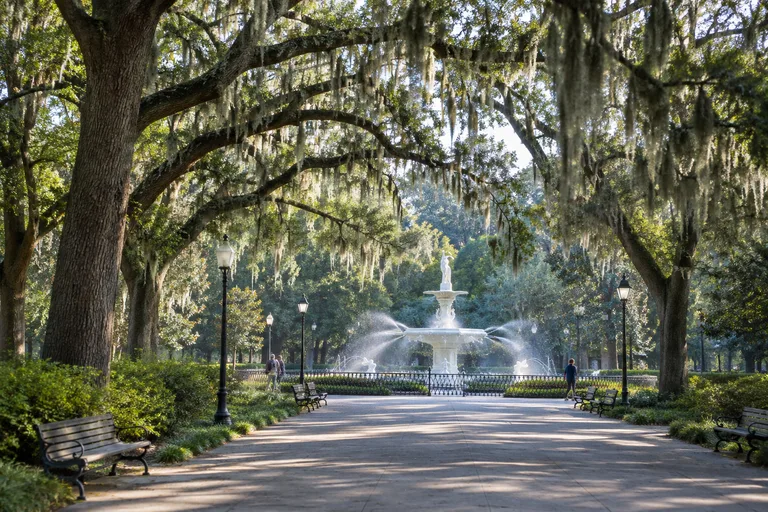
The best things to do in Savannah, GA, start on foot. Walk the shaded squares of the historic district, see the 1858 fountain in Forsyth Park, and stroll the riverfront on River Street. Then add Bonaventure Cemetery, the oak avenue at Wormsloe, the Telfair Museums and Fort Pulaski. With a third day, a Tybee Island day trip puts a lighthouse and a beach within easy reach.
This guide is part of the Georgia travel guide. It covers the squares one by one, a two-day weekend itinerary and getting around without a car. It also covers the best time to visit and a Tybee day trip. Whether the trip is a couples getaway or a family weekend, the main stops below list their official address, phone and website.
Savannah at a Glance
Savannah sits on the Savannah River on the Georgia coast, just across the water from South Carolina. General James Edward Oglethorpe founded the city in 1733 and laid out its old center. Explore Georgia calls it the "Hostess City of the South" and one of the country's oldest planned cities.
- Founded: 1733, by James Edward Oglethorpe.
- Historic district: runs from the Savannah River south to Gwinnett Street. East to west, it spans East Broad Street to Martin Luther King, Jr. Boulevard, per the Historic Savannah Foundation. It was designated in 1966.
- Squares: 22 by most counts today (more on the count below).
- Nearest beach: Tybee Island, 18 miles from historic Savannah.
- Nearest airport: Savannah/Hilton Head International Airport, 12 miles northwest of the historic district.
- From Atlanta: about four hours by car, according to Explore Georgia.
Top Things to Do in Savannah, GA
Short on time? These are the stops that the top travel guides and the city's own visitor bureau return to again and again. Each one has its own section further down.
- Walk the historic district squares, ideally down Bull Street to Forsyth Park.
- See the Forsyth Park fountain, the 1858 centerpiece of a 30-acre park.
- Stroll River Street and ride the free Savannah Belles Ferry across the river.
- Tour the Telfair Museums, three sites on one ticket, including the Owens-Thomas House and Slave Quarters.
- Visit the Juliette Gordon Low Birthplace, the home museum of the Girl Scouts founder.
- Walk Bonaventure Cemetery, a riverside cemetery of more than 100 acres.
- See the oak avenue at Wormsloe State Historic Site and the colonial tabby ruin.
- Explore Fort Pulaski National Monument, where rifled cannon changed military history.
- Take a Tybee Island day trip for the lighthouse, the marine science center and the beach.
- Catch a spring festival, such as St. Patrick's Day or the Savannah Music Festival.
Savannah Historic District Squares
The squares are the heart of any Savannah trip, and walking them costs nothing. Oglethorpe's plan was built from repeating units called wards. Each ward is a neighborhood set around a central open square. Four larger tything blocks sit on the north and south sides of each square. Four smaller trust blocks front it on the east and west, according to the New Georgia Encyclopedia.
The result is a city where a green, shaded square appears every couple of blocks. Each one has its own monument, fountain or story. On a hot afternoon, the canopy of live oaks makes the walk far more pleasant than open streets.
How Many Squares Are There?
The count depends on the source. The New Georgia Encyclopedia says 22 squares remain, each about one acre. That figure includes Ellis Square, which was reclaimed in 2010. Visit Savannah's home page also invites visitors to stroll through 22 park squares. Visit Savannah's own squares guide says 23 of the original 24 remain, because it adds a restored Yamacraw Square. Either way, a visitor can see most of them in a long morning.
Squares Worth Finding First
The table below uses the dates, monuments and buildings listed in Visit Savannah's guide to the squares. It is a good shortlist for a first walk.
| Square | Laid out | What to look for |
|---|---|---|
| Johnson Square | 1733 | The Greene monument and Christ Episcopal Church, at Bull and St. Julian Streets |
| Wright Square | 1733 | The William Washington Gordon monument and the grave marker of Tomochichi |
| Reynolds Square | 1733 | A monument to John Wesley, with the Olde Pink House and the Lucas Theatre on the square |
| Ellis Square | 1733 | The former site of the Old City Market, now a restored square |
| Telfair Square | 1733 | First called St. James Square; home to the Telfair Academy and the Jepson Center |
| Oglethorpe Square | 1742 | The Owens-Thomas House |
| Franklin Square | 1791 | First African Baptist Church, at the west end of City Market |
| Columbia Square | 1799 | The Davenport House and the Kehoe House |
| Chippewa Square | 1815 | A bronze statue of Oglethorpe and the Savannah Theatre; the bus stop scenes in Forrest Gump were filmed on its north end |
| Madison Square | 1837 | The Sergeant William Jasper monument, the Green-Meldrim House and the Sorrel-Weed House |
| Monterey Square | 1847 | The Casimir Pulaski monument, Temple Mickve Israel and the Mercer House |
| Taylor Square | 1851 | Formerly Calhoun Square; the only square where all the original historic buildings remain |
Lafayette Square belongs on the list too. It holds a fountain given by the Colonial Dames, and the Cathedral of St. John the Baptist faces it. The childhood home of writer Flannery O'Connor is on the same square.
A Self-Guided Bull Street Walk
The easiest route for a first visit follows Bull Street. Five squares sit on it: Johnson, Wright, Chippewa, Madison and Monterey. Walk them from the river end toward the south, and the route ends at Forsyth Park and its fountain.
- Start early, before the day warms up and the tour groups arrive.
- Pause in each square to read the monument plaques.
- Detour a block or two east to Abercorn Street for Reynolds, Oglethorpe and Lafayette squares.
- Finish with a picnic or a rest on a shaded bench in Forsyth Park.
Savannah has also earned a place on the site's list of movie film locations in the USA, and Chippewa Square is the stop film fans look for first.
Forsyth Park
Forsyth Park is Savannah's great green lawn, at the southern end of the Bull Street walk. The City of Savannah says the park was established in the 1840s on a 10-acre plot and has grown to 30 acres. It is named for Governor John Forsyth. The 1858 fountain stands at the north end, the natural place to start a visit.
Beyond the fountain, the city lists historic monuments, sports courts, walking paths and open green space. The layout stays close to the original 19th-century plan. The park playground has reopened, which makes this an easy stop for families. Couples tend to come back at sunset, when the light filters through the oaks.
Visit Savannah places the park in the Victorian District, a 50-block area it calls the city's first suburb. Wander a few streets south or east of the park to see the district's ornate wooden houses.
River Street and the Riverfront
River Street runs along the Savannah River at the north edge of the historic district. It is lined with shops and restaurants and is a natural place to end the day with a river view. Savannah is home to one of the busiest ports in the United States, so large container ships often glide past.
Ride the Free Savannah Belles Ferry
One of the best small pleasures in town is free. Chatham Area Transit's Savannah Belles Ferry offers free passage across the Savannah River to Hutchinson Island and the Savannah Convention Center. Visit Savannah lists landings at City Hall, Waving Girl and Trade Center. Service runs daily, though it may pause for weather or river traffic. Bikes are allowed on board.
Contact: Chatham Area Transit, 900 E. Gwinnett St., Savannah, GA 31401. Phone: (912) 233-5767. Web: catchacat.org.
Plant Riverside District and City Market
At the west end of the riverfront, the Plant Riverside District fills a 1912 power plant. Explore Georgia describes it as an entertainment district with a riverwalk. A few blocks south of the river, City Market fills the streets between Ellis Square and Franklin Square with galleries, shops and places to eat. It makes a good bridge between the riverfront and the squares.
River Street Visitor Information Center
The visitor center on the riverfront is a handy stop for maps and tour advice. Visit Savannah lists it as open daily. A second small center sits in City Market.
Contact: 1 West River Street, Savannah, GA 31401. Phone: (912) 651-6662. Web: visitsavannah.com.
Savannah Tours: Walking, Trolley, Ghost and Riverboat
A guided tour is the fastest way to get a feel for the city on a first day. Every top travel guide to Savannah suggests at least one. The main kinds are easy to tell apart:
- Walking tours: a guide leads a small group through the squares and tells the stories behind the monuments and houses.
- Trolley tours: hop-on, hop-off loops suit visitors who want to see a lot without a long walk. They are a kind choice for grandparents and small children.
- Ghost tours: evening walks and rides share the city's spooky folklore. Ask about the age guidance before booking for young kids.
- Riverboat cruises: sightseeing and dinner cruises leave from the riverfront.
Operators, routes and prices change often. Compare several, and book through the official Visit Savannah site or at a visitor center.
Museums and Historic Houses
Savannah's museums are small enough to enjoy in an hour or two each. That makes them easy to fit between square walks or to save for a rainy afternoon.
Telfair Museums
The Telfair runs three sites in the historic district, and one ticket covers unlimited visits to all three for one week. That suits a weekend trip well.
- Telfair Academy: a historic mansion that the museum calls the oldest art museum in the South, with American and European art. 121 Barnard St., Savannah, GA 31401.
- Owens-Thomas House and Slave Quarters: a historic house that tells the layered stories of the people who lived and worked there. 124 Abercorn St., Savannah, GA 31401.
- Jepson Center: the home of changing exhibitions by contemporary artists and CAM, the Children's Art Museum, a hands-on space for kids. 207 W. York St., Savannah, GA 31401.
Contact: addresses above. Phone: (912) 790-8800. Web: telfair.org. Check the official site for hours, prices and private-event closures.
Juliette Gordon Low Birthplace
This National Historic Landmark is the birthplace museum of Juliette Gordon Low, the founder of the Girl Scouts. Guided and self-guided tours explore her life and the era that shaped her. Girl Scout troops can book their own program.
Contact: 10 East Oglethorpe Ave., Savannah, GA 31401. Phone: (912) 233-4501. Web: juliettegordonlowbirthplace.org.
Savannah History Museum and the Coastal Heritage Society Sites
The Coastal Heritage Society runs several museums that suit a family day. The Savannah History Museum is next to the main visitor center on Martin Luther King, Jr. Boulevard. The society also runs these sites:
- the Georgia State Railroad Museum
- the Savannah Children's Museum
- Old Fort Jackson
- the Pin Point Heritage Museum
- the Harper Fowlkes House
Days and hours differ by site, so check before going.
Contact (Savannah History Museum and main office): 303 Martin Luther King, Jr. Blvd., Savannah, GA 31401. Phone: (912) 651-6840. Web: chsgeorgia.org.
More Landmarks on the Squares
Several of the sights that travel guides list most often sit right on a square, so they fit into the walk. The Cathedral of St. John the Baptist faces Lafayette Square. The Mercer House stands on Monterey Square, and the Davenport House on Columbia Square. The Savannah Theatre on Chippewa Square still stages shows. The SCAD Museum of Art, run by the Savannah College of Art and Design, adds contemporary art to the mix. Check each venue's own site for tour times and tickets.
Bonaventure Cemetery
A quiet walk through Bonaventure is one of the classic things to do in Savannah. It sits on the site of the old Bonaventure Plantation, on a bluff above the Wilmington River east of the city. The land was bought for a private cemetery in 1846 and became a public cemetery in 1907.
At more than 100 acres, it is the largest of Savannah's city cemeteries. The City of Savannah notes it has been a tourist destination for more than 150 years. Tree-lined roadways, sculpture and local folklore draw visitors. The city posts maps of the grounds by section on its cemetery page. Wear comfortable shoes, and treat the grounds with the respect any cemetery deserves. Bonaventure also appears on the site's list of the most beautiful graveyards in the USA.
Contact: 330 Bonaventure Rd., Savannah, GA 31404. Phone: (912) 651-6843. Web: savannahga.gov. The city lists the grounds as open daily, 8 a.m. to 5 p.m.
Wormsloe State Historic Site
Wormsloe is famous for its entrance: an avenue sheltered by live oaks and Spanish moss. Bring a camera. At the end, a tabby ruin from the colonial estate survives. Georgia State Parks calls it one of the oldest standing structures in Savannah.
The estate belonged to Noble Jones, a carpenter who arrived in Georgia in 1733 with Oglethorpe. Jones later served the colony as a doctor, constable, Indian agent and surveyor. His descendants kept the land until the state acquired most of it in 1973.
There is more to do than photograph the oaks:
- A museum shows artifacts unearthed on the site.
- A nature trail leads past the tabby ruins and along the marsh to the Colonial Life Area.
- Costumed interpreters show colonial tools and skills during programs.
- The Colonial Faire and Muster in February brings 18th-century music, dancing, crafts and military drills.
Leashed pets are allowed on the trails but not inside buildings. Admission is charged, and prices change, so check the official site before going.
Contact: 7601 Skidaway Road, Savannah, GA 31406. Phone: (912) 353-3023. Web: gastateparks.org/Wormsloe.
Fort Pulaski National Monument
Fort Pulaski sits on Cockspur Island, off Highway 80 on the way to Tybee, so it pairs well with a beach day. Its defining moment came in the Civil War. The National Park Service explains that U.S. Army forces used rifled cannon to force the Confederate garrison to surrender. The new technology proved stronger than the masonry forts that had guarded the coast for much of the 19th century.
Today the park offers more than the fort itself:
- The fort: walk the fort at the center of the Civil War siege. Volunteers in period uniforms fire a 30-pound Parrott rifle during programs.
- Visitor center and park store: the place to start and get a map.
- McQueens Island Trail: a trail with its own parking west of the entrance station.
- Nature: hiking, biking, birdwatching and fishing.
- Cockspur Island Lighthouse: it stands guard over the south channel of the Savannah River.
Pets are welcome on a leash of six feet or less, but not in the visitor center. An entrance fee applies, so see the NPS site for current amounts and hours.
Contact: 41 Cockspur Island Road, Savannah, GA 31410. Phone: (912) 219-4233. Web: nps.gov/fopu.
Tybee Island Day Trip
A Tybee Island day trip is the easy way to add a beach to a Savannah weekend. The official Tybee visitor site puts the island 18 miles from historic Savannah, and Explore Georgia says the drive takes about 30 minutes. The road out is Highway 80, and the Tybee visitor center sits where it meets Campbell Avenue. This section keeps to what fits in a single day.
Tybee Island Light Station
The light station calls itself Georgia's oldest and tallest light. One ticket covers the full light station and the Tybee Museum in Battery Garland. The battery was part of Fort Screven, which served from 1897 until 1945. The light station is closed on Tuesdays and on the day of Savannah's St. Patrick's Day parade. Check the official site for current hours and ticket prices.
Contact: 30 Meddin Dr., Tybee Island, GA 31328. Phone: (912) 786-5801. Web: tybeelighthouse.org.
Tybee Island Marine Science Center
This small center is a big hit with kids. It has live wildlife, touch tanks, a fossil room, a Ship Watch Loft and a pirate ship playground. Educators lead a one-hour Beach Ecology Walk along Tybee's north beach. A Turtle Talk program covers sea turtle biology and conservation. Like the lighthouse, the galleries are closed on Tuesdays.
Contact: 37 Meddin Drive, Tybee Island, GA 31328. Phone: (912) 786-5917. Web: tybeemarinescience.org.
Tybee Beach Rules Worth Knowing
Tybee enforces its beach rules, and fines can be steep. Before packing the car, note these rules from the official Tybee site:
- No dogs or other pets on the beach. Certified guide and assistance animals are exempt.
- No glass or breakable containers on the beach.
- Stay off the dunes. Walking on them can bring a large fine under the Georgia Shore Protection Act.
- No smoking or vaping on the beach or the crossovers.
- No open fires, including charcoal grills.
- Swim close to shore. Swimmers must stay within 50 yards of the shoreline.
- Stay off the sand bars, above all at the south end, where rip currents can overpower strong swimmers.
Parking on Tybee
Plan for paid parking. The Tybee site says there are no free public parking spaces on the island. Rules are enforced from 8 a.m. to 8 p.m. every day of the year.
- Pay with the Park TYB app or at a kiosk. Coins are no longer accepted.
- Day passes are sold online for longer stays.
- Main lots include South Beach between 14th and 18th Streets and the North Beach lot at Fort Screven, across from the lighthouse.
- Street parking is available near the dune crossovers.
Rates change, so check the official parking page before going.
Tybee Island Visitor Information Center: Campbell Ave. and Hwy. 80, Tybee Island, GA 31328. Phone: (912) 786-5444. Web: tybeeisland.com.
Where to Eat in Savannah
Savannah's food scene leans on its coastal setting, so expect seafood and Southern cooking on many menus. Visit Savannah counts more than 100 restaurants in the Historic Landmark District alone. Three easy areas for a meal are River Street, City Market and Broughton Street.
- Leopold's Ice Cream: a Savannah favorite since 1919, on Broughton Street. Expect a line on warm evenings. It also appears on the site's list of the best ice cream shops in the USA.
- The Olde Pink House: a well-known dining room in a historic house on Reynolds Square.
- City Market: a cluster of casual restaurants and patios near Ellis Square.
- River Street: waterfront restaurants with river views, plus candy shops that kids love.
For popular sit-down restaurants, book ahead on weekends and during festivals.
Where to Stay in Savannah
Where to stay depends on the trip. Each base has a different feel.
- Historic district: the best choice for a car-free weekend. Inns and hotels sit within walking distance of the squares and the river.
- Victorian District near Forsyth Park: quieter streets and easy park access, still walkable to the squares.
- Tybee Island: a beach base for families who want sand every day, with Savannah 18 miles away.
- Camping at Skidaway Island State Park: 87 tent, trailer and RV sites, plus camper cabins and yurts.
Georgia State Parks notes that part of the Skidaway campground is under renovation through early 2027, so check the park page before booking.
Skidaway Island State Park: 52 Diamond Causeway, Savannah, GA 31411. Phone: (912) 598-2300. Web: gastateparks.org/SkidawayIsland.
Book early for spring weekends and festival dates, when the historic district fills up first.
Getting to Savannah and Getting Around
Savannah is easy to reach and even easier to explore on foot. Once parked, most visitors rarely need the car until the Tybee trip.
Getting There
- By air: Savannah/Hilton Head International Airport is 12 miles northwest of the historic district. The CAT 100x Airport Express runs daily to designated downtown hotels and the Joe Murray Rivers, Jr. Intermodal Transit Center.
- By car from the coast: Interstate 95 passes west of the city. Exit 99 leads onto Interstate 16 east toward downtown.
- By car from Atlanta: the drive takes about four hours.
Savannah Airport Visitor Center: 400 Airways Avenue, Savannah, GA 31408. Phone: (912) 966-3743. Web: visitsavannah.com.
Getting Around
| Option | Cost | Best for |
|---|---|---|
| Walking | Free | The squares, River Street, Forsyth Park |
| DOT Shuttle | Free | Hopping across the historic district; 20 stops, about every 15 to 20 minutes |
| Savannah Belles Ferry | Free | Crossing the river to Hutchinson Island |
| CAT buses | Fare charged; check catchacat.org | Trips beyond the historic district |
| Car | Paid parking | Wormsloe, Bonaventure, Fort Pulaski and Tybee |
The DOT Shuttle links the city parking garages, the visitor centers and the ferry landings, so one parking spot can serve the whole day. Downtown, the city runs more than 3,000 metered spaces, seven public garages and five surface lots. The ParkSavannah app lets drivers pay by phone. A visitor day pass is sold at 100 East Bryan Street on weekdays. The MLK Visitor Information Center also has a public lot with RV spaces. Rates change, so check before parking.
MLK Visitor Information Center: 301 Martin Luther King, Jr. Blvd., Savannah, GA 31401. Phone: (912) 944-0455. Web: visitsavannah.com.
Best Time to Visit Savannah
Spring and fall are the most comfortable seasons for walking the squares. The National Park Service describes coastal summers here as very hot and humid, so plan outdoor sights early and late in the day. Winters are mild or chilly and breezy, and quieter.
| Season | What to expect | Good for |
|---|---|---|
| Spring (March to May) | Mild days and big spring events | Square walks, St. Patrick's Day, the Savannah Music Festival |
| Summer (June to August) | Very hot and humid | Tybee beach days, early-morning walks, museums at midday |
| Fall (September to November) | Cooler days after the summer heat | Bonaventure, Wormsloe, Fort Pulaski |
| Winter (December to February) | Quiet, mild or chilly | Museums, historic houses, lower crowds |
Two spring events shape the calendar. Explore Georgia calls Savannah's St. Patrick's Day celebration one of the largest in the country, with a parade that draws some 300,000 guests. The Savannah Music Festival stretches over two weeks in April, with programs that range from country and folk to jazz and chamber music. The 2027 festival runs April 2 to 17.
Savannah Music Festival box office: 216 E. Broughton St., Savannah, GA 31401. Phone: (912) 525-5050. Web: savannahmusicfestival.org.
Atlantic hurricane season runs from June 1 to November 30, according to the National Weather Service. Coastal travelers in those months should watch the forecast and keep plans flexible.
Savannah Weekend Itinerary
This Savannah weekend itinerary covers the highlights in two full days, with an optional third day at the beach. It works for couples and families alike.
Day 1: Squares, Forsyth Park and the River
- Morning: start at Johnson Square and walk Bull Street south through Wright, Chippewa, Madison and Monterey squares.
- Late morning: reach Forsyth Park and its fountain, then wander the Victorian District.
- Afternoon: pick one museum, such as the Telfair Academy or the Juliette Gordon Low Birthplace.
- Evening: head to River Street for dinner, then ride the free Savannah Belles Ferry for river views.
Day 2: Oaks, History and Bonaventure
- Morning: drive to Wormsloe State Historic Site for the oak avenue and the tabby ruin.
- Midday: lunch in the historic district, then the Owens-Thomas House and Slave Quarters on the same Telfair ticket.
- Afternoon: walk Bonaventure Cemetery before it closes at 5 p.m.
- Evening: a stroll through City Market, an ice cream stop on Broughton Street, and a ghost tour for those who like a spooky story.
Optional Day 3: Tybee Island Day Trip
- Morning: stop at Fort Pulaski National Monument on Cockspur Island.
- Late morning: visit the Tybee Island Light Station and the museum in Battery Garland.
- Afternoon: beach time, plus the Marine Science Center for kids.
- Evening: drive back to Savannah for dinner.
Avoid planning the Tybee day for a Tuesday, when both the lighthouse and the Marine Science Center galleries are closed.
Savannah for Families and Couples
Savannah works for both kinds of trip, and the same walkable center serves each. The difference is mostly in the pace and the evening plans.
With Kids
- CAM, the Children's Art Museum at the Telfair's Jepson Center, is hands-on.
- The Savannah Children's Museum and the Georgia State Railroad Museum are run by the Coastal Heritage Society.
- The Oatland Island Wildlife Center and the Tybee Island Marine Science Center put kids close to animals.
- The Forsyth Park playground gives small legs a break from sightseeing.
For Couples
- Sunset at the Forsyth Park fountain.
- The oak avenue at Wormsloe in soft morning light.
- Dinner on River Street, then a ride on the ferry.
- A spring weekend timed to the Savannah Music Festival.
Savannah also makes the site's list of best couples weekend trips in the USA. It also appears among the low-cost vacations in the USA, thanks to squares that cost nothing to wander.
Free Things to Do in Savannah
A Savannah trip does not need a big budget. Much of what makes the city special is free:
- walking the squares and reading their monuments
- the fountain, lawns and playground in Forsyth Park
- a ride on the Savannah Belles Ferry
- the DOT Shuttle around the historic district
- a walk through Bonaventure Cemetery
- window shopping on River Street and in City Market
Hidden Gems in Savannah
Once the headline sights are done, these quieter spots show another side of the Savannah area.
- Tomochichi's grave marker in Wright Square: it honors Tomochichi, whose marker is easy to walk past without noticing.
- Skidaway Island State Park: a 588-acre park with 6 miles of trails through maritime forest and salt marsh, ending at a boardwalk. Deer, fiddler crabs and egrets are common sights. A parking fee applies.
- Oatland Island Wildlife Center: a wildlife center with a trail and a resident animal collection, part of the Savannah-Chatham County Public School System.
- Pin Point Heritage Museum: a Coastal Heritage Society site open only a few days a week, so check before going.
- Old Fort Jackson: another Coastal Heritage Society site, easy to pair with the Savannah History Museum on a history day.
- Troup Square: a quiet square with an armillary sphere at its center, away from the busiest tour routes.
- Cockspur Island Lighthouse: a small lighthouse near Fort Pulaski, still standing guard over the river's south channel.
Oatland Island Wildlife Center: 711 Sandtown Road, Savannah, GA 31410. Phone: (912) 395-1212. Web: oatland.sccpss.com.
Insider Tips for Visiting Savannah
- Walk early. The squares are cooler and calmer in the morning, especially in summer.
- Use the free rides. The DOT Shuttle and the Savannah Belles Ferry cost nothing and save tired feet.
- Buy one Telfair ticket. It covers all three Telfair sites for a week, so spread them out.
- Skip Tybee on Tuesdays. The lighthouse and the Marine Science Center galleries both close that day.
- Bring a card to Tybee. Parking is paid everywhere and coins are no longer accepted.
- Leave pets out of beach plans. Dogs and other pets are banned on Tybee's beach.
- Watch the clock at Bonaventure. The city lists closing time as 5 p.m.
- Check the event calendar. St. Patrick's Day and festival weekends fill hotels, close some sights and can close parking garages early.
- Pick up a map. The visitor centers on River Street and Martin Luther King, Jr. Boulevard are open daily.
Frequently Asked Questions About Savannah
What are the top things to do in Savannah, GA?
Start with a walk through the historic district squares, then see the fountain in Forsyth Park and the riverfront on River Street. Add Bonaventure Cemetery, the oak avenue at Wormsloe, the Telfair Museums and Fort Pulaski. With an extra day, take a Tybee Island day trip.
How many squares does Savannah have?
The count depends on the source. Visit Savannah's home page and the New Georgia Encyclopedia count 22 squares today. Visit Savannah's squares guide says 23 of the original 24 remain, because it also counts a restored Yamacraw Square.
Is Savannah walkable?
Yes. Visit Savannah calls the downtown a highly walkable city, and the historic district is laid out on a grid of streets and squares. The free DOT Shuttle and the free Savannah Belles Ferry help when feet get tired.
How many days do you need in Savannah?
A weekend of two full days covers the squares, Forsyth Park, River Street, a museum and Bonaventure Cemetery or Wormsloe. Add a third day for a Tybee Island day trip with Fort Pulaski on the way.
How far is Tybee Island from Savannah?
The official Tybee Island visitor site says the island is 18 miles from historic Savannah, and Explore Georgia puts the drive at about 30 minutes. The road out is Highway 80, and the Tybee visitor center sits at Campbell Avenue and Highway 80.
Can you bring a dog to the beach on Tybee Island?
No. Tybee's beach rules ban dogs and other pets on the beach, and the fines are steep. Certified guide and assistance animals are exempt. Glass containers are banned too, and walking on the dunes is not allowed.
What is the best time to visit Savannah?
Spring and fall are the most comfortable seasons for walking the squares. Spring is also festival season, with St. Patrick's Day in March and the Savannah Music Festival in April. Summer is very hot and humid, and hurricane season runs from June 1 to November 30.
Is the DOT Shuttle in Savannah free?
Yes. Visit Savannah describes the DOT Shuttle as a free service through the Historic Landmark District, with 20 stops that link downtown and Forsyth Park. Chatham Area Transit also runs the free Savannah Belles Ferry across the river.
Is Savannah good for families with kids?
Yes. Families can climb the Tybee Island Light Station and see touch tanks at the Tybee Island Marine Science Center. The Oatland Island Wildlife Center is another animal stop. The Telfair's Jepson Center also has a hands-on Children's Art Museum, and Forsyth Park has a playground.
What are the hours at Bonaventure Cemetery?
The City of Savannah lists Bonaventure Cemetery as open to the public daily from 8 a.m. to 5 p.m. Check the city's cemetery page before a visit in case hours change.
Planning your next U.S. getaway? Explore more destination guides, road trips, and travel tips at Vacation Getaways US. Have a question or a spot we should cover? Email us at [email protected].