
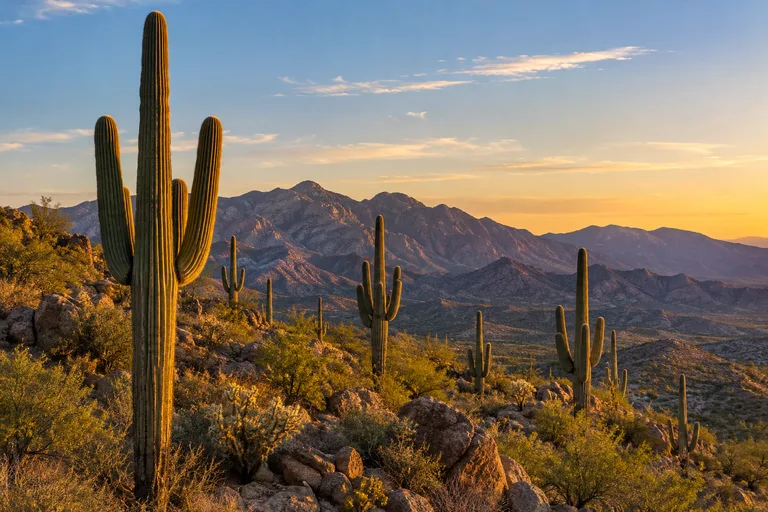
The best things to do in Tucson start with Saguaro National Park, which sits on both the east and west sides of the city. After the park, most visitors add the Arizona-Sonora Desert Museum, Sabino Canyon, Mission San Xavier del Bac and the cool drive up Mount Lemmon. Three days cover all of it at an easy pace.
This guide compares Saguaro National Park East vs West, then lists the top sights in town, the best Tucson day trips, the best time to visit Tucson and a 3-day plan. It is part of the Arizona travel guide, which shows how Tucson fits into a wider trip across the state.
Tucson at a Glance
Tucson is a desert city ringed by mountains, about 110 miles south of Phoenix. These are the facts most travelers want first.
| Question | Short answer |
|---|---|
| Where is it? | Southern Arizona, in the Sonoran Desert, about 110 miles south of Phoenix |
| How long is the drive from Phoenix? | About 1 hour and 40 minutes on Interstate 10, according to Visit Tucson |
| What surrounds it? | Five mountain ranges: the Rincon, Tucson, Santa Catalina, Santa Rita and Tortolita mountains |
| How sunny is it? | More than 340 days of sunshine a year, according to Visit Tucson |
| What is the top sight? | Saguaro National Park, in two districts on either side of the city |
| How many days? | Two for the highlights, three for both park districts and Mount Lemmon |
| Best seasons? | Fall, winter and spring |
Is Tucson Worth Visiting?
Yes. Tucson is one of the few cities in the country with a national park on two sides of it. A visitor can walk among giant cacti in the morning, tour a mission from the 1700s after lunch and watch the sunset from a mountain road. It works well for families, couples and solo travelers.
The city also has deep roots. Visit Tucson notes that Tucson is home to the O'odham and Yaqui peoples. Mission Garden, at the foot of Sentinel Peak, marks a site where archaeologists have documented 4,100 years of continuous farming. That long food history helped Tucson become the first UNESCO City of Gastronomy in the United States, in December 2015.
The trade-off is heat. Summer highs regularly pass 100 degrees, so summer trips need early starts and indoor afternoons. From fall through spring, the weather is the reason many people come.
Saguaro National Park East vs West: Which District to Visit
Saguaro National Park has two separate districts, and one entrance pass covers both for 7 days. The Tucson Mountain District is on the west side of the city. The Rincon Mountain District is on the east side. The National Park Service says the drive between them takes about 30 to 60 minutes, depending on the route and traffic.
The park's own comparison gives these numbers:
| West (Tucson Mountain District) | East (Rincon Mountain District) | |
|---|---|---|
| Size | 25,391 acres | 67,476 acres |
| Saguaro forest | Denser and younger, at a lower height | Older forest, with higher country and varied woodland |
| Scenic drive | Bajada Loop Drive, a gravel loop | Cactus Forest Loop Drive, 8 miles, paved |
| Hiking trails | 43 miles | 128 miles |
| Highest point | Wasson Peak, 4,687 feet | Mica Mountain, 8,666 feet |
| Picnic areas | 5 | 2 |
| Camping | None | 6 backcountry sites, by permit |
| Visitor center | Red Hills Visitor Center | Rincon Mountain Visitor Center |
| Opened | 1961 | 1933 |
For a first visit with only half a day, the West district is the easy pick. The cacti stand close together, and the Arizona-Sonora Desert Museum is nearby. With a full day, or a bike, or a wish for longer trails, the East district gives more room. With two days, see both.
Saguaro West: The Tucson Mountain District
The West district is the classic postcard view: hillsides thick with saguaros. Start at the Red Hills Visitor Center for a map and current trail advice. Then pick from these:
- Bajada Loop Drive: a gravel loop through the cactus forest. The park's pages list it as 5 or 6 miles. Bikes may use the road but not the trails around it.
- Desert Discovery Trail: the accessible trail in this district, good for strollers and wheelchairs.
- Signal Hill: a picnic area off Golden Gate Road, known for the rock art on the hill above it.
- Wild Dog Trail: 1.8 miles, reached from the Valley View trail, ending near the Signal Hill turnoff.
- King Canyon and Gould Mine Loop: 2.4 miles with about 380 feet of climbing, partly on an old mining road.
- Wasson Peak: the high point of the west side at 4,687 feet. The Sendero Esperanza route runs from 3.4 to 8 miles, depending on how far hikers go.
Saguaro East: The Rincon Mountain District
The East district is bigger, older and quieter in feel. Its paved Cactus Forest Loop Drive runs 8 miles and is a favorite with cyclists. Trails climb from the desert floor toward the higher woodland of Mica Mountain. Good choices include:
- Mica View Trail and Desert Ecology Trail: the two accessible trails in this district.
- Freeman Homestead Trail: 1 mile to an old homestead site and a grove of large saguaros. Signs along the way include activities for children.
- Loma Verde Loop: 3.8 miles and nearly flat. The park suggests this loop for seeing especially tall saguaros.
- Hope Camp and Ridgeview Trail: 2 miles with about 400 feet of climbing and an overlook into Box Canyon.
- Garwood Dam and Wildhorse Tank: 6.4 miles from the Douglas Spring trailhead, with views toward the Santa Catalina Mountains.
- Tanque Verde Ridge Trail: a strenuous route from the Javelina Picnic Area. A crested saguaro stands at mile 2.5.
Fees, Hours and Rules
The park is open every day of the year except Thanksgiving and Christmas Day, according to the National Park Service. A few rules shape every visit:
- Passes: sold per vehicle, per motorcycle or per person, and each is good for 7 days in both districts. Check the official site for current prices.
- No cash: the park accepts credit and debit cards only.
- No water on the drives: drinking water is not available on either loop drive or at any picnic area. Fill bottles at a visitor center.
- Pets: dogs are not allowed on some trails. Ask at a visitor center before setting out.
- Phones: cell coverage is spotty. Both visitor centers have public Wi-Fi.
Contact: Saguaro National Park, 3693 S Old Spanish Trail, Tucson, AZ 85730. Phone: 520-733-5153. Web: nps.gov/sagu.
Saguaro Facts Worth Knowing
A few facts from the park make the walk more fun, especially with kids:
- The name is said "sa-WAH-ro".
- Saguaros bloom from late April through June.
- A young saguaro grows only 1 to 1.5 inches in its first eight years, park studies show.
- The tallest saguaro on record stood 78 feet. It fell in 1986.
- The spines are not poisonous, but a puncture can become infected. Keep small hands back.
Best Things to Do in Tucson Beyond the Park
Saguaro National Park is the headline, but the city fills several more days. These are the sights that the leading Tucson guides agree on, with verified contact details where the official site gives them.
Arizona-Sonora Desert Museum
The Arizona-Sonora Desert Museum is mostly outdoors. It is part zoo, part botanical garden and part art gallery, set beside Saguaro West. Its own site describes about two miles of paths and says a visit takes at least two hours. Go early, wear a hat and carry water. Hours change by season, so check the official site before driving out.
Sabino Canyon
Sabino Canyon Recreation Area sits in the Santa Catalina foothills on the northeast side of town. Private cars stop at the entrance. From there, visitors walk, or ride the Sabino Canyon Crawler, an emission-free electric shuttle that seats up to 48 people. A second shuttle route serves Bear Canyon. Tickets are booked online for a set date and time, and the recreation area charges its own separate fee. In some seasons the Crawler also runs a night tour of about 90 minutes.
Contact: Sabino Canyon Crawler, 5700 N. Sabino Canyon Road, Tucson, AZ 85750. Phone: (520) 792-2953. Web: sabinocanyoncrawler.com.
Mount Lemmon and the Catalina Highway
Mount Lemmon is the summer escape. The summit stands 9,157 feet above sea level, the tallest peak in the Santa Catalina Mountains. Visit Tucson says summer temperatures up top average 20 to 30 degrees cooler than the valley. The Catalina Highway climbs there from the city in about an hour from downtown.
Along the way and at the top, visitors find:
- Scenic overlooks and sunset views
- Hiking, mountain biking and rock climbing
- Wildflowers in late spring and fall color in early fall
- Skiing and snow play in winter, at what Visit Tucson calls the southernmost ski resort in the United States
- Stargazing at the Mount Lemmon SkyCenter, which has some of the largest public telescopes in the country
Plan with the Visit Tucson page for Mount Lemmon. Bring a jacket, even in June.
Mission San Xavier del Bac
The white mission south of the city appears in nearly every Tucson guide, and it earns the stop. Father Eusebio Francisco Kino, a Jesuit missionary, founded the mission in 1692. The present church was built from 1783 to 1797. The mission describes it as Arizona's oldest European structure, in Spanish Colonial style with Baroque details.
It still serves the village of Wa:k on the Tohono O'odham reservation as an active parish, and the mission says it remains free to the public. Dress and act as guests in a working church. Check the official site for visiting hours, which shift around services.
Contact: Mission San Xavier del Bac, 1950 W San Xavier Rd, Tucson, AZ 85746. Phone: (520) 294-2624. Web: sanxaviermission.org.
Pima Air & Space Museum
Aircraft fans can spend most of a day here. The museum shows a very large collection of aircraft, indoors in hangars and outdoors on the grounds. It is run by the Arizona Aerospace Foundation, which also operates the Titan Missile Museum in Sahuarita. The hangars make it a smart choice for a hot afternoon. Last admittance is well before closing, so check the official site for current hours.
Contact: Pima Air & Space Museum, 6000 E Valencia Rd, Tucson, AZ 85756. Phone: 520-574-0462. Web: pimaair.org.
Downtown Tucson and the Historic Courthouse
Downtown is the place for a walk, a meal and a first look at local history. Start at the Southern Arizona Heritage and Visitor Center, inside the Historic Pima County Courthouse. Staff can suggest walking routes through the old neighborhoods, such as the adobe streets of Barrio Viejo and the shops of Fourth Avenue. The Sun Link streetcar links the urban core, so the car can stay parked.
Contact: Southern Arizona Heritage and Visitor Center, 115 N. Church Ave., Tucson, AZ 85701. Phone: (800) 638-8350. Web: visittucson.org.
Mission Garden and Sentinel Peak
Mission Garden calls itself a living agricultural museum. It grows heritage fruit trees, heirloom crops and edible native plants suited to the Sonoran Desert. The garden stands at the foot of Sentinel Peak, on the site of the Tohono O'odham village of Cuk Ṣon. Its site states plainly: this is Tucson's birthplace. Sentinel Peak above it is a favorite local spot for a sunset view over the city. The garden keeps short morning hours on certain days, so check before going.
Contact: Mission Garden, 946 W Mission Lane, Tucson, AZ 85745. Phone: (520) 955-5200. Web: missiongarden.org.
Tucson Botanical Gardens
This midtown garden packs 20 themed gardens into one site. It is a gentle stop for couples, and for families with small children who need a break from the car. A butterfly exhibit and a Japanese garden next door keep their own hours.
Contact: Tucson Botanical Gardens, 2150 North Alvernon Way, Tucson, AZ 85712. Phone: (520) 326-9686. Web: tucsonbotanical.org.
Catalina State Park
On the north side of the metro area, Catalina State Park covers 5,500 acres of foothills, canyons and streams. The park counts nearly 5,000 saguaros. Trails for hikers, riders and birders lead into the Coronado National Forest, and the campground has 120 sites with electric and water hookups.
Contact: Catalina State Park, 11570 N. Oracle Rd, Tucson, AZ 85737. Phone: (520) 628-5798. Web: azstateparks.com/catalina.
More Sights the Top Guides Name
Travel writers often add these stops. Details change from season to season, so confirm each one before going:
- Tucson Mountain Park and Gates Pass: county parkland next to Saguaro West, with a scenic road and sunset pullouts.
- Old Tucson: a Western film set in the Tucson Mountains. It does not always open for daytime visits.
- Trail Dust Town: an Old West themed stop with a Ferris wheel, named by the leading guides as a family pick.
- The Loop: a paved, car-free path of more than 130 miles that circles the city, for walking and cycling.
Eating in a UNESCO City of Gastronomy
Food is a real reason to visit Tucson. In December 2015 it became the first city in the United States to earn the UNESCO City of Gastronomy title. Farming here goes back a very long way: Mission Garden reports 4,100 years of continuous cultivation at its site.
What to look for:
- Sonoran Mexican cooking: the local style, named by nearly every Tucson guide. The Sonoran hot dog is the famous street food.
- Heritage ingredients: Mission Garden grows the fruit trees and heirloom crops behind many local dishes.
- Food events: Visit Tucson lists Sonoran Restaurant Week each September, the Agave Heritage Festival and the Pueblos de Maíz Festival.
No single restaurant is named here, because menus and owners change. The visitor center downtown keeps a current list.
Tucson Day Trips
The best Tucson day trips stay within southern Arizona. Each of these fills a morning or a full day.
| Day trip | What it is | Good for |
|---|---|---|
| Mount Lemmon | A 9,157-foot summit, about an hour from downtown | Cool air in summer, snow in winter |
| Kartchner Caverns State Park | A limestone cave with guided tours, 9 miles south of Benson | Families, hot or rainy days |
| Tumacácori National Historical Park | A mission church and grounds in the Santa Cruz River valley | History lovers, a pair with San Xavier |
| Kitt Peak National Observatory | A mountaintop observatory southwest of the city | Stargazing fans who book ahead |
| Phoenix | The state capital, about 110 miles north | A flight home or a city day |
Kartchner Caverns State Park
Two cavers, Gary Tenen and Randy Tufts, found this cave in November 1974 and kept it secret until 1978. Today it is a state park with guided cave tours, a campground and cabins. It is also an International Dark Sky Park. Cave tour tickets cost extra and can sell out, so reserve ahead on the official site.
Contact: Kartchner Caverns State Park, 2980 S Hwy 90, Benson, AZ 85602. Phone: (520) 586-4100. Web: azstateparks.com/kartchner.
Tumacácori National Historical Park
South of Tucson, Tumacácori National Historical Park protects a mission church and its grounds. The National Park Service describes the site as a cultural crossroads in the Santa Cruz River valley. O'odham, Yaqui and Apache people met Jesuit and Franciscan missionaries, settlers and soldiers here. Pair it with San Xavier for a full mission day. Check the park's site for hours and fees.
Farther Afield in Arizona
Travelers on a longer loop often continue north. The red rocks of Sedona make a strong contrast with the Sonoran Desert. To the east, Interstate 10 leads on toward New Mexico. The day trips page has more ideas for short outings across the country.
Festivals and Events in Tucson
Tucson's calendar is busiest in the cooler months. Visit Tucson lists these annual events. Dates change each year, so check the official events calendar before booking.
- Tucson Gem, Mineral & Fossil Showcase: a huge show that draws collectors from around the world. Hotels fill fast.
- Tucson Rodeo and Parade (La Fiesta de los Vaqueros): a yearly celebration of Old West traditions.
- Tucson Festival of Books: author panels and readings for all ages.
- Tucson Meet Yourself: a free festival of local food, music, dance and folk arts.
- All Souls Procession: a procession inspired by Dia de los Muertos, with costumes and lights.
- 4th Ave Street Fair: a street fair with more than 350 vendors.
- El Tour de Tucson: a fall cycling event with several routes.
- Tucson International Mariachi Conference: workshops, concerts and folkloric dance.
Best Time to Visit Tucson
The best time to visit Tucson is from fall through spring, when days are warm and dry. Summer is hot, and it brings the monsoon storms. The National Park Service and Visit Tucson give this picture:
| Season | What to expect | Best for |
|---|---|---|
| Winter | Days average about 65 degrees in the park and nights about 40. Light rain now and then. Snow is common in the high country. | Long hikes, the gem show, skiing on Mount Lemmon |
| Spring | Warm days. Cholla cacti flower, and saguaros bloom from late April through June. | Wildflowers, cycling, festivals |
| Summer | Highs regularly pass 100 degrees. June is usually the driest month. Monsoon storms follow. | Mount Lemmon, museums, dawn walks |
| Fall | Heat eases. Days and nights can differ widely, so layers help. | Both park districts, El Tour de Tucson, patio dining |
A note on the monsoon: the park dates the season from June 15 to September 30. Visit Tucson says the storms mostly come from mid-July through mid-September. Rain falls mainly in the afternoon and can flood washes and canyons fast.
The Park's Heat Rules for Hikers
Saguaro National Park publishes simple rules for hot days. They apply just as well on any trail around Tucson.
| Forecast high | Park advice |
|---|---|
| 95 to 110 degrees | Finish the hike by 10 a.m. |
| Above 110 degrees | Do not hike |
| Any hot day | Turn around before half the water is gone |
| Storm in the area | Stay out of washes. In a flash flood, climb as high as possible. |
Getting to Tucson and Getting Around
Most visitors fly in or drive down from Phoenix. Tucson International Airport is served by Alaska, American, Delta, Frontier, Southwest, Sun Country and United, with nonstop flights to key U.S. cities. From Phoenix, the drive is about 110 miles on Interstate 10.
Once in town, plan around these points:
- Rent a car. The park districts, Sabino Canyon, the mission and Mount Lemmon sit on different edges of the city.
- Use the streetcar downtown. The Sun Link serves the urban core.
- Allow cross-town time. The two park districts are 30 to 60 minutes apart.
- Try The Loop. The paved path of more than 130 miles is car-free and good for families on bikes.
Packing is simple: sun protection, a refillable bottle for each person and a warm layer for desert nights. The weekend getaway packing list covers the rest.
Where to Stay in Tucson
The right base depends on the plan. Tucson covers nearly 500 square miles, so location saves driving.
- Downtown: best for food, the streetcar and walking to historic streets.
- The Catalina foothills: resort country on the north side, close to Sabino Canyon and the Mount Lemmon road.
- The west side: closest to Saguaro West and the Desert Museum.
- The east side: handy for Saguaro East and an early start on the loop drive.
- Camping: Catalina State Park has 120 sites with hookups. Saguaro East has six backcountry sites, reserved on Recreation.gov.
Book early for the gem show weeks. For general booking advice, see how to plan a weekend getaway.
A 3-Day Tucson Itinerary
This plan groups sights by side of town, so each day has little driving. Swap the days to suit the weather.
Day 1: Saguaro West and the Desert Museum
- Early morning: the Arizona-Sonora Desert Museum, while animals are active and the air is cool. Allow at least two hours.
- Late morning: the Red Hills Visitor Center, then the Desert Discovery Trail.
- Afternoon: the Bajada Loop Drive, with a picnic and a short walk at Signal Hill.
- Evening: sunset from a pullout in the Tucson Mountains, then dinner downtown.
Day 2: Canyon, Downtown and the Mission
- Morning: Sabino Canyon, on foot or on the Crawler shuttle.
- Midday: lunch downtown and a stop at the visitor center in the historic courthouse.
- Afternoon: Mission San Xavier del Bac. On the days it is open, add Mission Garden first.
- Evening: a Sonoran dinner, the heart of the City of Gastronomy.
Day 3: Saguaro East and Mount Lemmon
- Morning: the Cactus Forest Loop Drive, with the Freeman Homestead Trail or the Mica View Trail.
- Afternoon: drive the Catalina Highway up Mount Lemmon for cool air and long views.
- Hot day swap: trade the mountain for the hangars at the Pima Air & Space Museum.
With only two days, drop Day 3 and choose one park district. More weekend ideas are on the getaways page.
Tucson for Families and Couples
Tucson suits both groups, with a few different picks.
With Kids
- The Desert Museum and the Freeman Homestead Trail, which has activities for children on its signs.
- The Sabino Canyon Crawler, so short legs can save their energy for the creek.
- Kartchner Caverns, where the cave stays out of the sun.
- The accessible trails in each park district, which work with strollers.
For Couples
- Sunset on Mount Lemmon, followed by stargazing.
- A slow morning at Tucson Botanical Gardens or Mission Garden.
- Mission San Xavier del Bac in the soft light of late afternoon.
- Dinner downtown, reached by streetcar.
Hidden Gems in Tucson and Saguaro National Park
Once the main sights are done, these quieter stops reward a little extra time:
- The crested saguaro on Tanque Verde Ridge: a fan-topped cactus at mile 2.5 of the trail in Saguaro East.
- Loma Verde Loop: the park's own tip for very tall saguaros, on a nearly flat 3.8-mile loop.
- Wildhorse Tank: one of the few places in the park with water all year, on the Garwood Dam route.
- Mission Garden: a small garden with a 4,100-year story that many visitors drive right past.
- The Historic Pima County Courthouse: the visitor center inside doubles as a free first lesson in the region.
- Catalina State Park at dawn: nearly 5,000 saguaros with far fewer people than the national park.
Insider Tips for Visiting Tucson
- Buy one park pass and keep the receipt. It is good for 7 days in both districts.
- Bring a card. Saguaro National Park does not take cash.
- Fill water before the loop drives. Neither drive has drinking water.
- Do outdoor sights first. In summer, Visit Tucson suggests keeping outdoor activity to before 7 a.m. or after about 8 p.m.
- Save museums for the afternoon. The air museum's hangars and the cave at Kartchner are the cool choices.
- Book the Crawler and cave tours ahead. Both sell tickets for set times.
- Pack layers from fall to spring. Desert days and nights can differ widely.
- Watch where hands and feet go. If a rattle sounds, the park says to stop, find the sound and move away from it.
Plan Your Visit: Official Resources
- Saguaro National Park: nps.gov/sagu for alerts, fees and ranger programs.
- City tourism office: visittucson.org for the events calendar and neighborhood guides.
- Arizona State Parks: azstateparks.com for Catalina and Kartchner Caverns reservations.
Frequently Asked Questions
What is Tucson best known for?
Tucson is best known for Saguaro National Park, which sits on both sides of the city, and for its Sonoran Desert scenery. It is also known for Mission San Xavier del Bac, Mount Lemmon, and its food. Tucson became the first UNESCO City of Gastronomy in the United States in December 2015.
Which side of Saguaro National Park is better, East or West?
The West district has a denser, younger saguaro forest at a lower height and suits a short first visit. The East district is larger, with an older saguaro forest, an 8-mile paved loop drive, 128 miles of trails and backcountry camping. One entrance pass covers both for 7 days.
How far apart are the two districts of Saguaro National Park?
The city of Tucson sits between them. The National Park Service says the drive between the two districts takes about 30 to 60 minutes, depending on the route and traffic.
How many days do you need in Tucson?
Three days cover both districts of Saguaro National Park, Sabino Canyon, Mission San Xavier del Bac, downtown and Mount Lemmon without rushing. A weekend is enough for one park district and the main city sights.
What is the best time to visit Tucson?
Fall, winter and spring are the most comfortable. Winter days in Saguaro National Park average about 65 degrees Fahrenheit. Summer highs regularly pass 100 degrees, so summer visitors should plan outdoor time for early morning.
When do saguaro cacti bloom?
The National Park Service says saguaros bloom from late April through June.
Is there an entrance fee for Saguaro National Park?
Yes. The park sells passes per vehicle, per motorcycle and per person, each good for 7 days in both districts. The park does not accept cash. Check the official park site for current prices.
Do you need a car in Tucson?
For most trips, yes. The Sun Link streetcar serves the urban core, but both park districts, Sabino Canyon, Mount Lemmon and the mission are spread around the edges of the city.
How far is Tucson from Phoenix?
Visit Tucson puts Phoenix about 110 miles to the north, roughly 1 hour and 40 minutes by car on Interstate 10.
Can you visit Saguaro National Park in summer?
Yes, with care. The park advises finishing hikes by 10 a.m. when the high is between 95 and 110 degrees, and not hiking at all when the high is above 110. The paved Cactus Forest Loop Drive lets visitors see the East district from the car.
Planning your next U.S. getaway? Explore more destination guides, road trips, and travel tips at Vacation Getaways US. Have a question or a spot we should cover? Email us at [email protected].